Ordering valve pouches on the strength of a press release risks a costly mismatch if the film structure was never specified. SunDance announced on 28 September 2026 that it now makes custom, digitally printed coffee valve pouches in low minimum order quantities, but the release does not describe the film, the barrier or the valve.
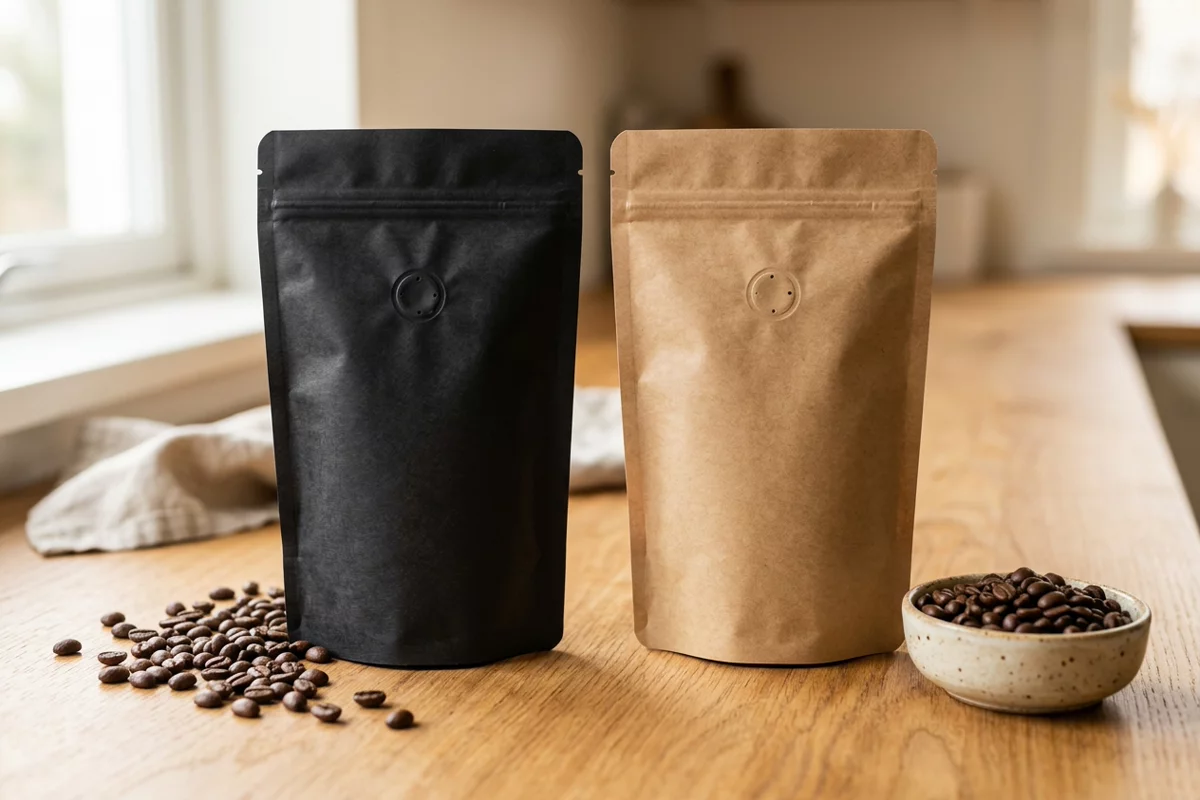
If you buy or specify coffee packaging and saw the SunDance news, here is what it confirms and what it does not. SunDance, an Orlando, Florida printer and packaging maker, says it combines one-way degassing valves with digital flexible-packaging production so brands can order quantities matched to demand. The release names no minimum order quantity, price, lead time, pouch size, valve specification, film structure, oxygen or moisture barrier figure, or recyclability claim. Use the announcement as a lead, then ask any digital pouch supplier for a layer-by-layer structure and barrier data with test methods stated.
Key points:
- What happened: SunDance added custom coffee valve pouches to its flexible packaging range (PR Newswire, 28 September 2026).
- What is described: a one-way degassing valve, digital printing and low minimum order quantities.
- What is missing: the numbers a technical buyer needs.
- One source only: the Packaging Europe story of 2 October 2026 rewrites the same release.
What SunDance announced on 28 September 2026
SunDance published one release through PR Newswire on 28 September 2026 announcing custom coffee valve pouches as an addition to its flexible packaging portfolio. Everything this article says about the product comes from that release; a trade-press rewrite followed four days later.
| Event | Date | Source | Source type |
|---|---|---|---|
| Release: custom coffee valve pouches with digital printing and low minimum order quantities | 28 Sep 2026 | PR Newswire (SunDanceUSA) | Company announcement |
| Trade-press rewrite of the release | 2 Oct 2026 | Packaging Europe | Media rewrite of the same release |
| Release and rewrite read for this article | 7 Oct 2026 | Both pages | Checked |
The release describes SunDance as an “award-winning commercial printer and packaging manufacturer” founded in 2007. Its stated customers are specialty roasters, emerging brands, seasonal and limited-edition blends, subscriptions and launches. President JohnHenry Ruggieri is quoted saying coffee brands need packaging that protects quality while giving them flexibility as they grow.
Common mistake: Treating the Flexible Packaging Association award in the company’s boilerplate as an award for this pouch. The release lists a 2026 award for Shelf Impact without naming the product.
Takeaway: This is one company describing a new capability in one release; read every benefit as SunDance’s claim.
What the release says, and what it leaves out
The release explains the valve’s job and the commercial model; it says nothing about materials or test data. Read side by side, the announced items fit in four lines, and the undisclosed items fill the rest of a technical specification.
| Topic | What the release says | What it leaves out |
|---|---|---|
| Valve | One-way degassing valve lets CO2 from fresh roasts escape and keeps oxygen out | Valve type, supplier, opening and closing pressures, placement |
| Digital printing; brand graphics, messaging and product information can be customised | Print engine, ink system, colour limits, surface preparation | |
| Order model | Low minimum order quantities; order to actual demand | The minimum quantity, price breaks, lead time |
| Applications | Whole bean and ground coffee; the format “may also be suitable” for other specialty foods and dry products | Any tested product other than coffee |
| Film structure | Not mentioned | Layers, materials, thicknesses, metallised or foil layer |
| Barrier | Not mentioned | Oxygen and water vapour transmission rates, with methods and conditions |
| Seal and closure | Not mentioned | Seal strength, zipper or tin-tie options |
| End of life | Not mentioned | Recyclability or recycled content |
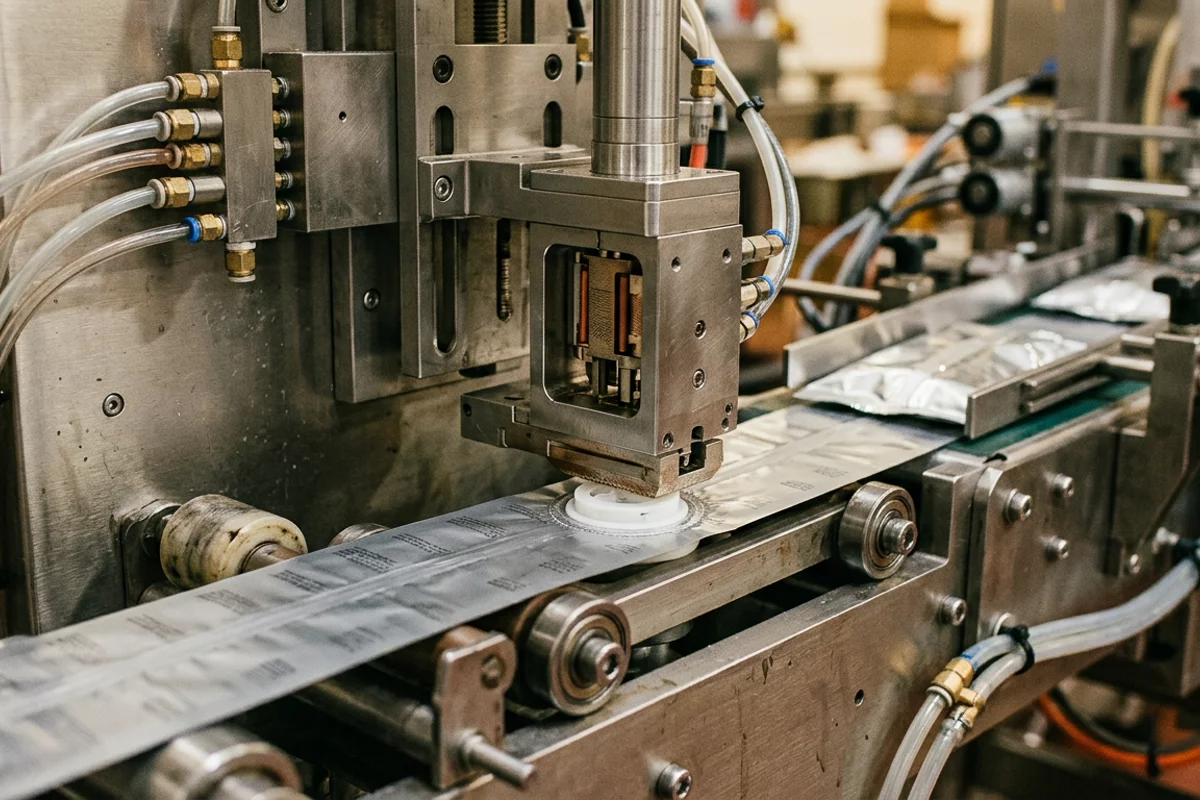
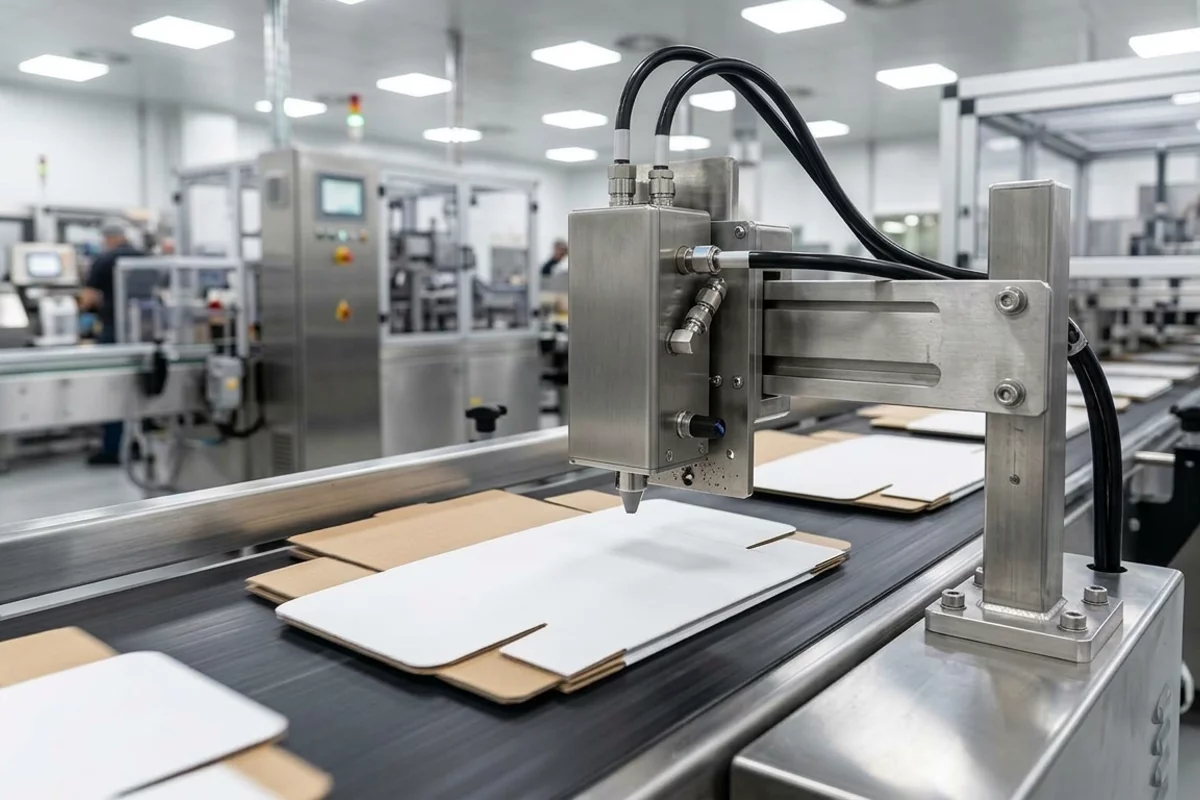
Illustrative photo — generated editorial image, not an engineered packaging line drawing.
Packaging Europe’s rewrite adds that SunDance had earlier shown a cereal pouch said to use about 30% to 40% less material than conventional stand-up pouches, made with recyclable and post-consumer recycled film structures. That claim belongs to a different product. Nothing in the coffee pouch release connects it to the same structure.
Common mistake: Carrying the cereal pouch’s material-reduction and recycled-content claims over to the coffee valve pouch. They describe another product.
Takeaway: Read the release as a commercial model plus a valve; the material specification is still blank.
Who this affects
The release is aimed at small and growing coffee brands in the US, and the practical impact lands on whoever writes their packaging specifications. Converters and film suppliers are affected only indirectly, as one more short-run digital pouch offer to compare against.
| Reader | Practical impact | Basis |
|---|---|---|
| Specialty roasters and emerging coffee brands | A new US source to evaluate for short runs, seasonal and subscription packs | Release: named target customers |
| Packaging buyers and designers at those brands | Need a full structure and barrier specification before comparing offers | Release discloses no material data |
| Specialty food and dry-goods brands | Possible use, by SunDance’s own “may also be suitable” wording only | Release: no tested product besides coffee |
| Film and pouch converters | A competitor offer in short-run digital pouches; no technical detail to benchmark | Release only |
Digitally printed flexible packs raise the same surface questions as any printing on plastic film: ink and film surface have to be matched, and the supplier should say how that is checked. Converters that receive film for such jobs can record its surface with a dyne test as part of incoming inspection.
Takeaway: The brand’s packaging buyer carries the burden of turning this announcement into a specification.
When to act
No date in the release obliges anyone to act. SunDance says the capability exists now, but it gives no ordering opening date, minimum quantity, lead time or capacity figure. If a short-run valve pouch fits your launch or seasonal calendar, the useful timing is your own: allow time for structure approval, samples and a shelf trial before the launch date.
| Date | Item | Status |
|---|---|---|
| 28 Sep 2026 | Capability announced | Confirmed (release) |
| 2 Oct 2026 | Packaging Europe rewrite | Same source |
| 7 Oct 2026 | Release read for this article | Checked |
| Not given | Ordering availability, minimum quantity, lead time | Confirm with SunDance |
| Your calendar | Structure approval, samples, shelf trial | Plan backwards from your launch |
Project timeline considerations balance announced digital pouch packaging milestones against undisclosed parameters including specific barrier film thickness, degassing valve type, and production capacity.
Takeaway: Plan sampling and shelf testing from your launch date, not from the press release.
What is still open
Ten items stay open after reading the release: commercial terms, formats, valve, structure, barrier, seals, print, recyclability and the award reference. The list names who can close each one and the document to see in writing.
| Open item | Who can confirm | Document that closes it |
|---|---|---|
| Minimum order quantity and price breaks | SunDance sales | Written price schedule for your size |
| Lead time and capacity | SunDance | Written lead time for your volume |
| Pouch sizes and formats | SunDance | Size and format list with drawings |
| Valve specification | SunDance and its valve supplier | Valve data sheet |
| Film structure | SunDance | Layer-by-layer specification with thicknesses |
| Oxygen and moisture barrier | SunDance or a test lab | Test reports with method, temperature and humidity |
| Seal strength | SunDance or a test lab | Seal test results with method |
| Print system and surface preparation | SunDance | Print method, ink system, surface treatment and adhesion test results |
| Recyclability | SunDance | Structure-based recyclability assessment, if any |
| Link to the 2026 FPA award | SunDance | The award entry, if relevant |
The print row covers surface preparation even though the release does not mention it; our explainer on what a dyne test measures shows how a supplier can document it.
Takeaway: Ask for documents, not adjectives.
Film structure and print questions to put to any digital pouch supplier
The release cannot be compared with another offer until both suppliers answer the same technical questions. The checklist below applies to SunDance or any other short-run pouch maker and names the public test methods that make answers comparable. Listing these methods is our suggestion; SunDance does not mention any test method.
| Question | Why it matters | Evidence to request |
|---|---|---|
| What is each layer, its material and thickness? | Sets barrier, stiffness and seal behaviour | Layer-by-layer structure sheet |
| What is the oxygen transmission rate? | Quantifies the oxygen barrier of the chosen structure | Result with method named, for example ASTM D3985, plus temperature and humidity |
| What is the water vapour transmission rate? | Quantifies the moisture barrier of the chosen structure | Result with method named, for example ASTM F1249, plus conditions |
| Which valve is used and where? | The release gives no valve specification | Valve data sheet and placement drawing |
| How strong are the seals? | Seal performance is part of the pack, not the film alone | Seal strength results, for example to ASTM F88/F88M, with failure mode |
| How is print adhesion checked? | Digital inks must stay on the film surface | Tape adhesion results, for example to ASTM F2252, and agreed pass criteria |
| How is the print surface prepared? | ASTM D2578 links ink retention on PE and PP film to its surface | Surface treatment and the wetting level checked at print |
| Is the structure recyclable where you sell? | Claims need a basis | A structure-based assessment and the programme it refers to |
ASTM D3985 covers oxygen transmission through plastic film, sheeting, laminates, coextrusions and plastic-coated papers; ASTM F1249 covers water vapour transmission through flexible barrier materials up to 3 mm thick; ASTM F88/F88M measures the force to separate a seal and records how it fails; ASTM F2252 describes a tape test for ink or coating adhesion on flexible packaging and leaves pass criteria to buyer and producer. Our guide to inks and pretreatment for film explains the print-side questions; wetting is checked with a dyne test or a water contact angle measurement.
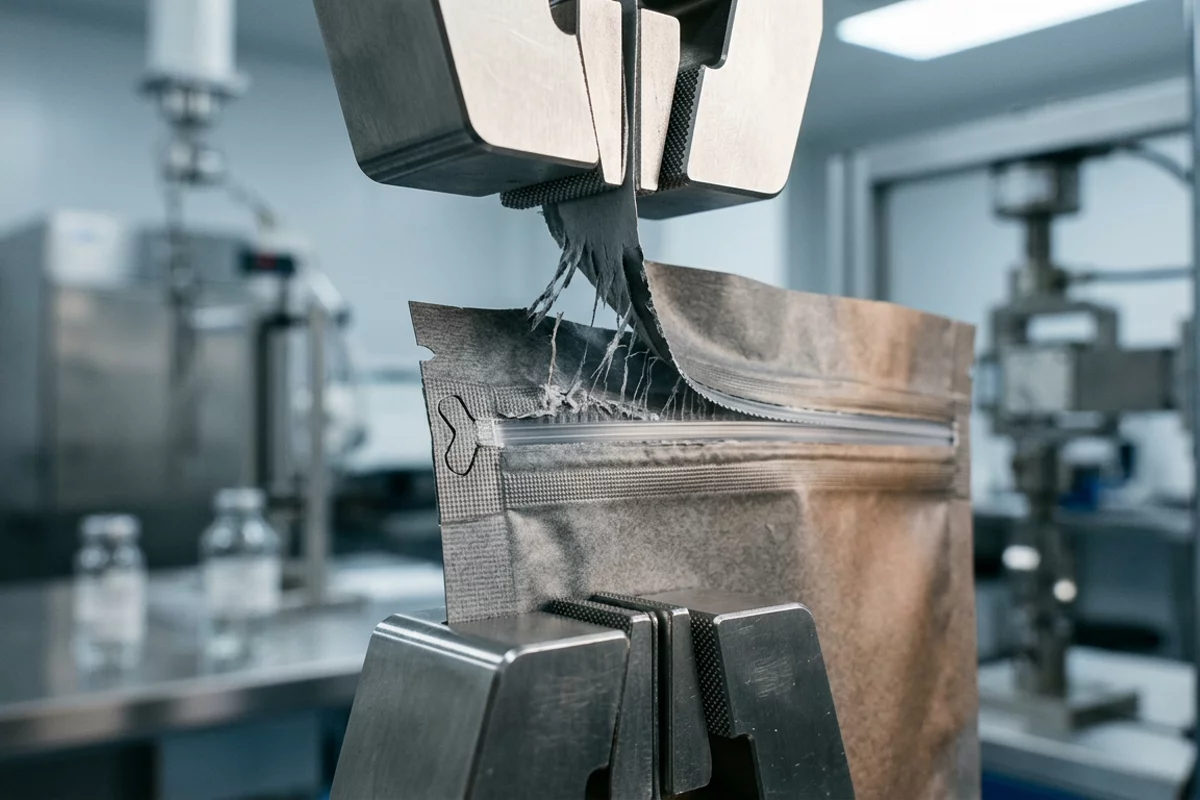
Illustrative photo — generated editorial image, not a laboratory certification or seal test record.
Takeaway: Put the same eight questions to every supplier and insist on the test method and conditions behind each number.
Our reading
Our reading is that SunDance is announcing a commercial service, short-run digital pouches with a valve, rather than a new material. For a small roaster, that can be useful, and its value rests on two things the release does not show: the barrier of the chosen structure and the price at low volume. The same gap between announcement and evidence runs through other recent packaging news we covered, from Stahl’s Senoprint metallic coatings to the Kelpi coated paper sachet and BASF’s lower-carbon coating binders.
Takeaway: Judge the offer on the structure sheet and the price list, not on the valve.
When this does not apply
This explainer reads one release as of 7 October 2026. It does not apply in these cases:
- You need shelf-life guidance. Nothing here states how long coffee keeps in any pouch.
- You are comparing prices. The release gives none, and neither do we.
- SunDance has since published specifications, minimum quantities or structure details. Those documents replace this summary.
- Your product is not coffee. The release names other specialty foods only as a possibility.
More film and print topics are in Films and Printing, and surface preparation is covered under Surface Treatment.
Takeaway: Re-read SunDance’s own materials before using this summary in a supplier comparison.
How we checked this
We read SunDance’s PR Newswire release and the Packaging Europe rewrite on 7 October 2026. The rewrite repeats the release, so it counts as one source. Test method scopes come from ASTM’s public abstract pages. We have no relationship with SunDance and did not test its pouches. Sources and access dates are listed below.
Takeaway: Use this summary for a first screen, then decide on the supplier’s current specifications and test reports.
Last updated 7 October 2026 (first published).