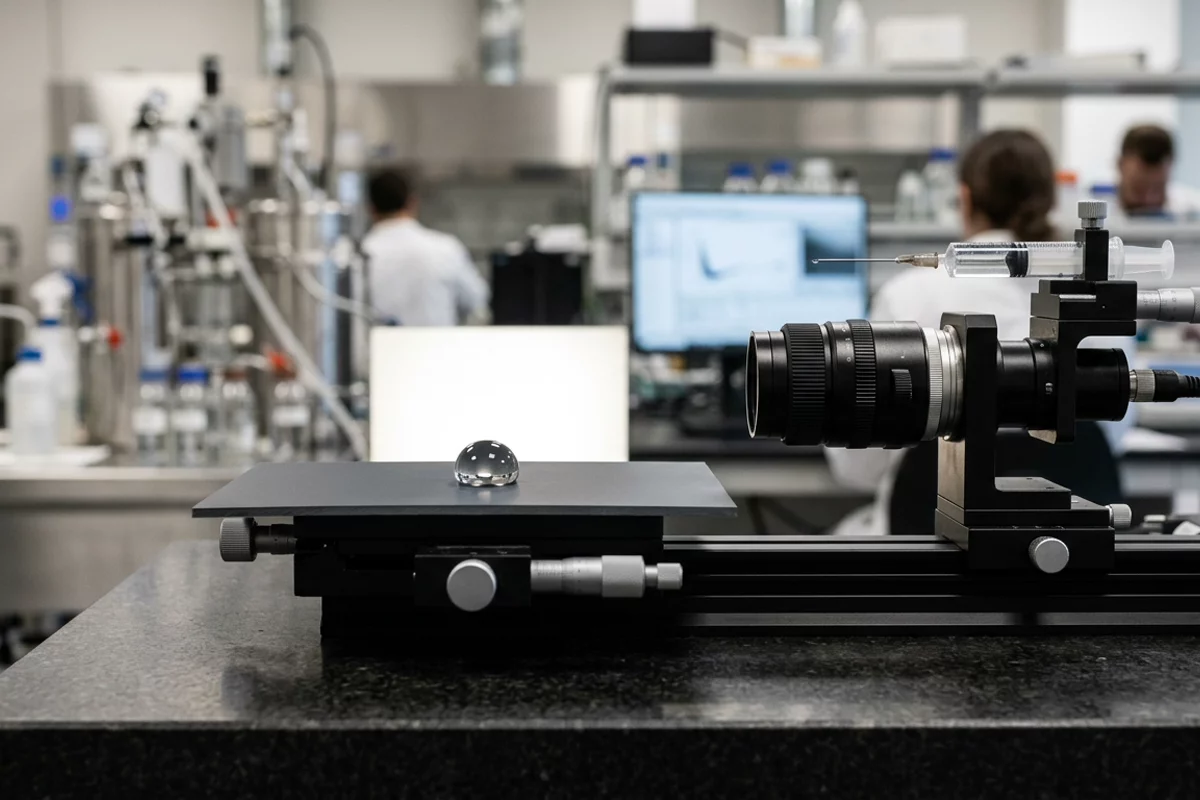
A single water drop cannot characterise a whole film, and it cannot split surface energy into its polar and dispersive parts, so treating it as a surface energy figure leads to wrong adhesion decisions. A contact angle goniometer is an optical instrument that images a liquid drop on the surface and measures the angle where liquid, solid and air meet; with two or more liquids of known surface tension components, those angles convert to the solid’s surface free energy using a model such as Owens, Wendt, Rabel and Kaelble (OWRK).
Contact angle is the objective way to check how well a film, coating or print substrate wets. Below 90° a liquid wets the surface; above 90° it does not. For corona-treated polyolefin film, ASTM D5946-24 reads water angles above 90° as marginal or no treatment and below 71° as very high treatment. To get a surface energy in mJ/m² (the same number as mN/m or dynes/cm), measure at least two liquids, one of them polar, and apply a model such as OWRK. Results depend on the liquid data set, the drop method and the number of points measured, so record all three.
| Item | Value or source | Why it matters |
|---|---|---|
| Wetting boundary | 0° full wetting; below 90° wettable; above 90° not wettable (KRÜSS) | First reading of any angle |
| Treated-film guide | Water angle bands from above 90° to below 71° (ASTM D5946-24) | Converts a water angle into a treatment level |
| Advancing angle method | Sessile drop enlarged through a needle (ASTM D7334; KRÜSS) | Less sensitive to time effects and local defects |
| Liquids for surface energy | At least two, one with a polar component (KRÜSS, OWRK) | One liquid cannot split polar and dispersive parts |
| Reference liquid data | Water 72.8 mN/m, diiodomethane 50.8 mN/m at 20 °C (van Oss data via Diversified Enterprises) | Inputs to the calculation |
| Units | mJ/m², numerically equal to mN/m and dynes/cm | Same unit, but surface free energy and dyne wetting tension are different measurements; keep method and conditions with every number |
For an electronics coating workflow, use the PCB cleaning and coating handoff checklist to keep wetting observations separate from preparation and assembly acceptance.
What a contact angle tells you
A contact angle is the angle between the surface of a liquid drop and the solid it rests on, measured at the contact line, and it is a direct measure of how well that liquid wets that solid. Low angles mean spreading; high angles mean beading. Young’s equation ties the angle to the liquid’s surface tension, the solid–liquid interfacial tension and the solid’s surface free energy.
| Angle | What it indicates | Source |
|---|---|---|
| 0° | Complete wetting, the liquid spreads | KRÜSS |
| Between 0° and 90° | The solid is wettable by this liquid | KRÜSS |
| 90° | Boundary between wetting and non-wetting | KRÜSS |
| Above 90° | Not wettable by this liquid | KRÜSS |
| Approaching 180° | Ultrahydrophobic surfaces, the theoretical limit | KRÜSS |
KRÜSS, a goniometer maker whose glossary is a clear public reference, notes that Young’s equation holds for ideal surfaces, smooth and chemically homogeneous, with pure liquids at equilibrium. Real films, coatings and printed surfaces are none of those, which is why measurements are repeated and why the method matters. ASTM D2578, the dyne test standard, starts from the same force balance; our dyne testing guide explains how that test reads wetting with a ladder of fluids instead.
Takeaway: Read an angle first against 90°, then against the band your standard or specification uses.
How a goniometer measures the angle
A goniometer deposits a small drop on a flat sample, lights it from behind and records its profile with a camera; the angle is measured from the profile at the contact line. The sessile drop is the standard arrangement. What changes between methods is whether the drop is left alone (static angle) or grown and shrunk (advancing and receding angles).
| Method | What is measured | Use it when | Watch for |
|---|---|---|---|
| Static sessile drop | Angle of a resting drop | Quick checks and comparisons on one material | Evaporation and time drift; one drop is one spot |
| Advancing angle (drop enlarged through a needle) | Angle as the drop spreads over fresh surface | Coatings and substrates per ASTM D7334; reducing time effects | KRÜSS notes the needle affects the first readings; it describes forming about 3–5 µL and enlarging slowly |
| Receding angle (drop reduced) | Angle as the drop retracts | Assessing hysteresis and dewetting | Needs dosing control |
| Tilting table | Advancing and receding angles on an inclined sample | Hydrophobic or anti-stick surfaces | Sample must be flat and fixed |
| Wilhelmy plate (force method) | Advancing and receding angles from force on an immersed plate | Uniform plates or fibres | Not an imaging method; sample must be regular |
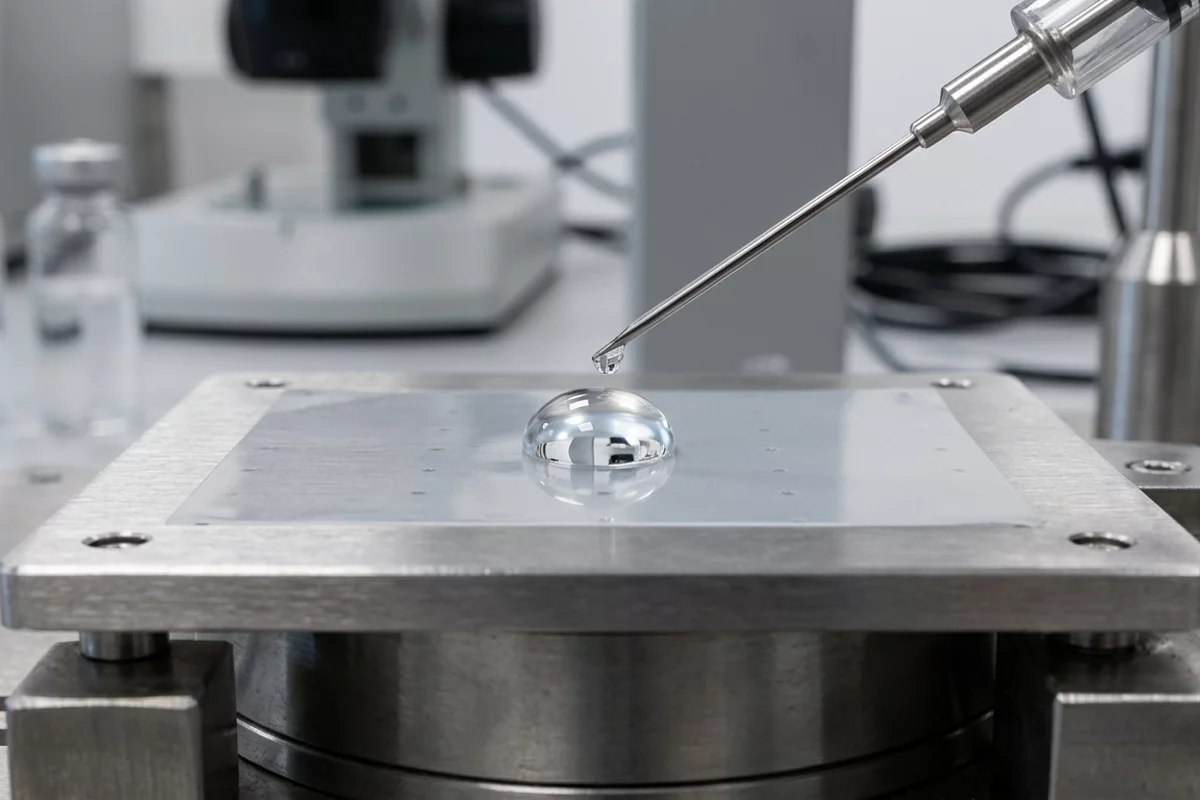
Illustrative photo — generated editorial image, not a test record or laboratory certification.
The difference between advancing and receding angles is the contact angle hysteresis. KRÜSS links it to roughness, chemical inhomogeneity and adhesion between liquid and solid, and notes that a high initial angle does not by itself prove a surface is water-repellent.
Takeaway: Pick static drops for quick comparisons and advancing angles when you need a reproducible number for coatings.
Standards for film, coating and print work
Three ASTM standards cover most film, coating and print uses: D5946 for water angle on corona-treated film, D7334 for advancing angles on coatings and substrates, and D2578 for the related dyne test. Each states what the number can and cannot tell you, and those statements belong in any specification that quotes a contact angle.
| Standard | Covers | Key statements |
|---|---|---|
| ASTM D5946-24 (identical to ISO 15989) | Water contact angle on corona-treated polymer film | Treatment bands for polyolefins and similar films; multiple measurements needed; capability studies per film and treatment; not a complete measure of adhesion |
| ASTM D7334-08(2022) | Advancing contact angle on coatings, substrates and pigment discs | Advancing angles only; supplements, not replaces, the instrument maker’s instructions; water is common, other liquids allowed; cannot measure surface tension directly |
| ASTM D2578-23 (equivalent to ISO 8296) | Wetting tension of PE and PP film with test fluids | Defines wetting tension from Young’s relation; relates to adhesion only through experience |
ASTM D5946 also states that the wetting tension of a polymer has no standard of accuracy, that different methods give different results on identical samples, and that dynes/cm treatment levels come from a subjective reading of fluid behaviour. That is the main argument for adding contact angle to a dyne routine, covered in our comparison of dyne tests and water contact angle.
Takeaway: Quote the standard and its edition with every angle you specify, and include its stated limits.
Step by step: measuring water contact angle on treated film
A usable water contact angle on film comes from a clean, flat sample, a consistent drop and several points across the web. The sequence below is our record-keeping checklist, not an ASTM procedure: multiple measurements (ASTM D5946), time effects (KRÜSS) and the primacy of the instrument maker’s instructions (ASTM D7334) come from the sources, while the other record fields are our suggestions.
| Step | What to do | Why |
|---|---|---|
| 1. Sample | Cut flat pieces without touching the test face; mark machine direction and position across the web | Contamination and curl distort the drop |
| 2. Mount | Fix the sample flat on the stage | The baseline must be level for a correct angle |
| 3. Liquid | Use the liquid your method specifies, usually water for treatment checks | Different liquids give different angles |
| 4. Drop | Dose the volume your method or instrument specifies, the same every time | Keeps drops comparable between points and days |
| 5. Timing | Measure at a fixed time after deposition, or use advancing angles | Time effects such as evaporation change static angles (KRÜSS) |
| 6. Read both sides | Record left and right angles of the drop profile | A large left–right difference is worth checking before you report |
| 7. Repeat | Measure several points; ASTM D5946 calls for multiple measurements | Treatment and roughness vary point to point |
| 8. Record | Liquid, volume, timing, temperature, sample position, mean and spread | Makes results comparable over time |
The record-keeping sequence follows eight key milestones: sample preparation, stage mounting, test liquid selection, controlled drop dosing, timed observation, dual-side contact angle measurement, multiple web location repetitions, and documentation of ambient conditions.
Common mistake: Reporting one drop. ASTM D5946 notes that contact angle varies from point to point and that non-uniform corona treatment adds variation, so a single drop is a single point, not a result.
Takeaway: Fix the liquid, volume and timing, then measure enough points to report a mean and a spread.
From contact angle to surface energy
To convert angles into surface free energy with OWRK, measure the same surface with at least two liquids whose dispersive and polar surface tension components are known, at least one with a polar part above zero. With water alone you get a wettability reading but cannot separate the polar and dispersive parts this way.
The OWRK relation for each liquid is:
γL (1 + cos θ) = 2 (√(γS^D · γL^D) + √(γS^P · γL^P))
where γL is the liquid’s surface tension, θ the measured angle, and the superscripts D and P the dispersive and polar parts of the liquid (L) and solid (S). A purely dispersive liquid such as diiodomethane gives the solid’s dispersive part directly; a polar liquid such as water then gives the polar part.
| Liquid (20 °C) | Total, mN/m | Dispersive | Polar | Source |
|---|---|---|---|---|
| Water | 72.8 | 21.8 | 51.0 | van Oss (2006), via Diversified Enterprises |
| Diiodomethane | 50.8 | 50.8 | 0.0 | van Oss (2006), via Diversified Enterprises |
Worked example, assumed angles, not a measured film. Suppose a treated film gives 45° with diiodomethane and 80° with water. Diiodomethane: 50.8 × (1 + cos 45°) = 86.72 = 2√(γS^D × 50.8), so γS^D = 37.0 mJ/m². Water: 72.8 × (1 + cos 80°) = 85.44 = 2(√(37.0 × 21.8) + √(γS^P × 51.0)), so γS^P = 4.0 mJ/m². Total surface free energy ≈ 41.0 mJ/m².
The calculation flow links two contact angles to surface free energy: diiodomethane contact angle yields dispersive energy, water contact angle yields polar energy, and their sum gives total surface free energy under the OWRK model.
The liquid data set matters. The same table lists other published splits for water, such as 22.6/50.2 and 22.1/50.7 mN/m, which its footnotes attribute to a different (harmonic-mean) model. Check that the liquid data your software uses belongs to the model it applies, record which data set that is, and keep it fixed.
Common mistake: Calling a water contact angle a “surface energy”. One liquid gives one angle; the split into polar and dispersive parts needs at least two liquids.
Takeaway: Use two liquids, one dispersive and one polar, fix the liquid data set, and report the parts as well as the total.
How to read the results
Read results as changes against your own baseline first and against published bands second. A water angle that falls after treatment means the surface became more wettable; whether that is enough for a given ink or adhesive is set by experience, as ASTM D2578 and D5946 both note. The next steps in the table are our suggestions.
| What you see | What it means | Next step |
|---|---|---|
| Water angle above 90° on polyolefin film | Marginal or no treatment by ASTM D5946’s guide | Check treatment before printing or laminating |
| Water angle in the 71–84° range | Medium to high treatment by D5946’s guide | Compare with the level that works for your ink or adhesive |
| Wide scatter across the web | Non-uniform treatment or surface variation | Map the pattern across the width |
| Angles rise over days, same method and conditions | Possible treatment loss or additive bloom, to be checked | Test closer to use; log time since treatment |
| High hysteresis | Roughness, chemical unevenness or liquid–solid adhesion (KRÜSS) | Add receding angles; inspect the surface |
| Surface energy high, adhesion still poor | Wetting is not the whole story | Run an adhesion test with the real ink or adhesive |
For print work, the adhesion check that follows, and how pretreatment and ink choice interact, are covered in our guide to printing on plastic film.
Takeaway: Track your own baseline over time and treat published bands as orientation, not acceptance limits.
Choosing a contact angle goniometer
Choose a goniometer by the measurement you need, not the other way round. The checklist below is our suggestion, built from the public methods and standards above: questions to settle before comparing instruments. We do not name models or prices.
| Question | If yes | Why |
|---|---|---|
| Do you only need water angles on treated film? | A sessile-drop set-up for water covers ASTM D5946-type checks; confirm against the standard’s requirements | Simplest route |
| Do you need advancing or receding angles? | Look for motorised dosing or a tilting stage | ASTM D7334 uses advancing angles |
| Do you need surface energy? | Look for several dosing channels and software that applies OWRK or similar models with editable liquid data | Two or more liquids are required |
| Are samples large, curved or on rolls? | Check stage size and sample-holder options | The baseline must be flat and level |
| Will several operators use it? | Ask suppliers how baseline and angle fitting are set, how settings are logged, and what repeatability data they can show | Operator differences need to be checked, not assumed away |
| Is it for incoming checks at the line? | Weigh portability against the stability of a lab stand | Where you measure decides how you measure |
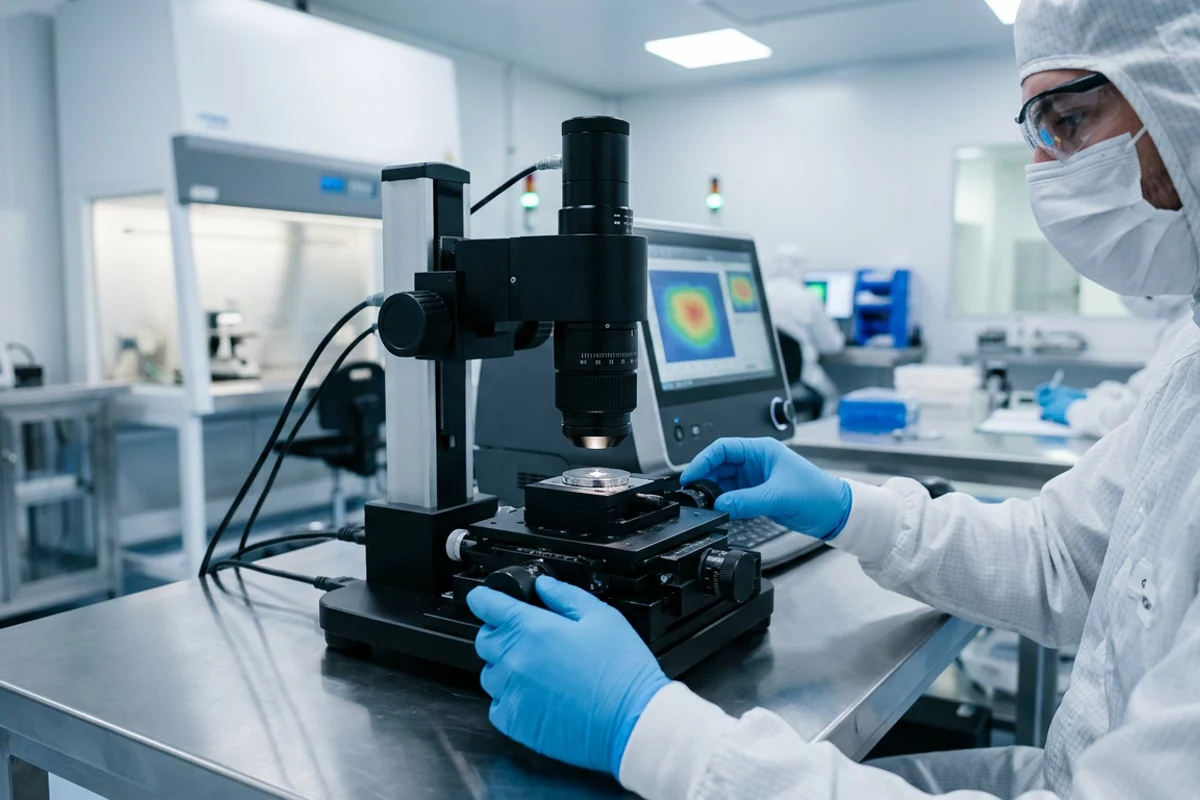
Illustrative photo — generated editorial image, not a specific instrument quotation or vendor recommendation.
If your main need is a fast pass or fail on polyolefin film, a dyne routine following our dyne testing guide is the simpler starting point, and a goniometer can serve as the audit tool.
Takeaway: Define static, dynamic or surface-energy measurement first; the instrument features follow from it.
When this does not apply
The methods and numbers above have limits. Do not rely on them in these cases:
- Porous or absorbent surfaces. Diversified Enterprises notes that test fluids soaking into fibre substrates such as paper give falsely easy wetting; confirm a suitable contact angle method with the instrument or material supplier. Coated-paper launches such as BASF’s reduced-carbon coating binders and Kelpi’s coated paper sachet raise exactly this question.
- Adhesion acceptance. Neither contact angle nor surface energy is a complete measure of adhesion.
- Films outside D5946’s scope. Its treatment bands are a guide for polyolefins and similar low-energy films.
- Process settings. This guide does not set treatment levels or targets for your product.
- Instrument operation. Follow the instrument maker’s instructions; ASTM D7334 says the same.
For a trial where a substrate record helps, see the checklist in our Senoprint metallic coatings explainer. More topics are under Surface Treatment.
Takeaway: Use contact angle as a wetting record and pair it with an adhesion test when a decision depends on it.
How we checked this
We compiled this guide on 7 October 2026 from ASTM’s public abstract pages for D5946-24, D7334-08(2022) and D2578-23, the KRÜSS glossary pages listed below, a liquid surface tension components table published by Diversified Enterprises, which cites van Oss (2006) at 20 °C, and Diversified’s test procedure note on absorbent substrates. KRÜSS and Diversified Enterprises sell measuring equipment and supplies. The worked example uses assumed angles; we did not measure any sample, and we name no instrument models or prices. See About for how this site works.
Takeaway: Check the current editions of the standards before using these numbers in a specification.
Last updated 7 October 2026 (first published).