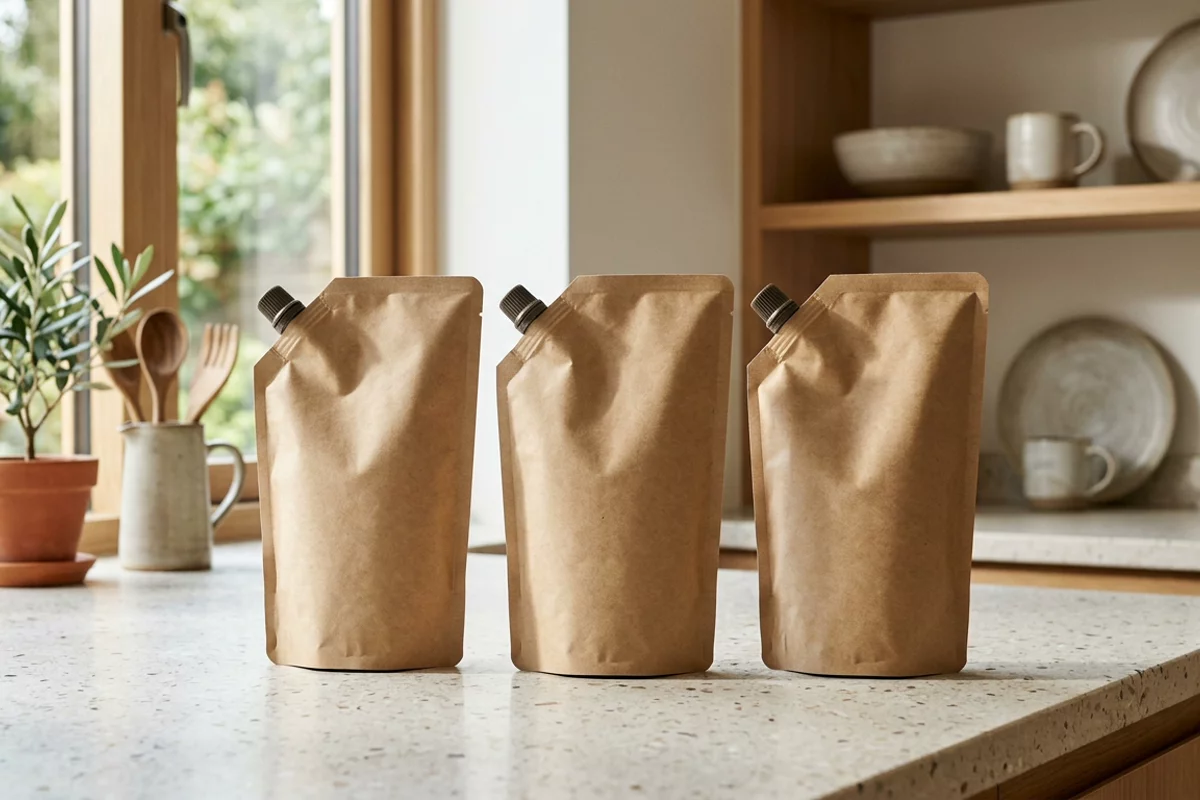
A sachet material that leaks on a different filling line wastes a whole sampling run. Kelpi announced on 17 September 2026 that a seaweed-derived coating let Bower Collective sample hand wash in 5 ml paper sachets filled on Guardpack’s existing lines, but the published claims cover one product, one filler and one limited trial.
If you engineer coatings, films or sachets, here is what the Kelpi and Bower Collective launch establishes. Kelpi says its proprietary bio-based coating gives paper the water barrier to hold a liquid without a fossil-fuel plastic lining, that the sachets ran on Guardpack’s existing filling lines with no equipment changes, and that the pack can go into household paper recycling. Bower Collective adds that the coating bonds seaweed sugars with plant oils and that its biobased carbon was “independently tested”, without naming the lab or method. The announcement and blog checked on 7 October 2026 give no barrier, seal, leak or shelf data. Treat the launch as a sample worth requesting, with a data list attached.
Key points:
- What happened: Kelpi and Bower Collective launched a limited-edition sample box of three 5 ml paper sachets of hand wash (Kelpi announcement, 17 September 2026).
- Who made it: Guardpack, a UK sachet and wet-wipe producer, made and filled the sachets.
- What is claimed: liquid hold-out without a fossil-fuel plastic lining, drop-in running on existing lines, household paper recycling, safe biodegradation by design.
- What is missing: barrier, seal, leak and shelf data; other machines and liquids; US availability.
What Kelpi and Bower Collective announced in September 2026
Kelpi, a Bristol biomaterials company, announced on 17 September 2026 a paper sachet for a liquid product made with its seaweed-derived coating, launched with the refill brand Bower Collective. Bower published its own blog post the next day; Packaging Europe rewrote the announcement on 21 September.
| Event | Date | Source | Source type |
|---|---|---|---|
| Paper liquid sachet announced; Kelpi calls it a world-first | 17 Sep 2026 | Kelpi announcement | Company announcement |
| Bower blog describes the coating chemistry and the customer trial | 18 Sep 2026 | Bower Collective blog | Partner’s own post |
| Trade-press rewrite with the same quotes | 21 Sep 2026 | Packaging Europe | Media rewrite |
| All three read for this article | 7 Oct 2026 | — | Checked |
The sample box holds three 5 ml sachets of Bower’s hand wash (Orange Blossom & Mimosa, Pistachio & Vanilla, Wild Peach) for customers to try before buying full size. Guardpack, founded in 1995 in Chelmsford, Essex, made and filled them after earlier trials of the coated paper on its lines.
Common mistake: Reporting “world-first” as an established fact. It is the companies’ own description; no independent source confirms it.
Takeaway: Two partners and one trade rewrite describe a single limited launch; all performance language is theirs.
What is known about the coating
Public information on the coating comes down to a composition sketch and a set of claims. Bower describes it as natural seaweed sugars bonded with sustainably sourced plant oils into an ultra-thin barrier layer; Kelpi calls it a proprietary biomaterial that gives paper the water barrier to hold a liquid. Neither the announcement nor the blog gives a coat weight, a barrier value or test conditions.
| Item | What is said | Who says it | Status |
|---|---|---|---|
| Composition | Seaweed sugars bonded with plant oils into an ultra-thin layer | Bower Collective blog | Partner’s description |
| Function | Water barrier to hold a liquid formulation without a fossil-fuel plastic lining | Kelpi | Company claim; no data |
| Performance level | “Matches fossil fuel plastic’s performance” | Kelpi | Company claim; no comparison data |
| Biobased carbon | All carbon from seaweed and plant oils, “independently tested” | Bower Collective blog | Lab and method not named |
| Machinability | Ran on Guardpack’s existing sachet-filling lines, no equipment changes | Kelpi | One filler’s lines |
| End of life | Household paper recycling; designed to biodegrade safely in nature | Kelpi | No programme, region or test named |
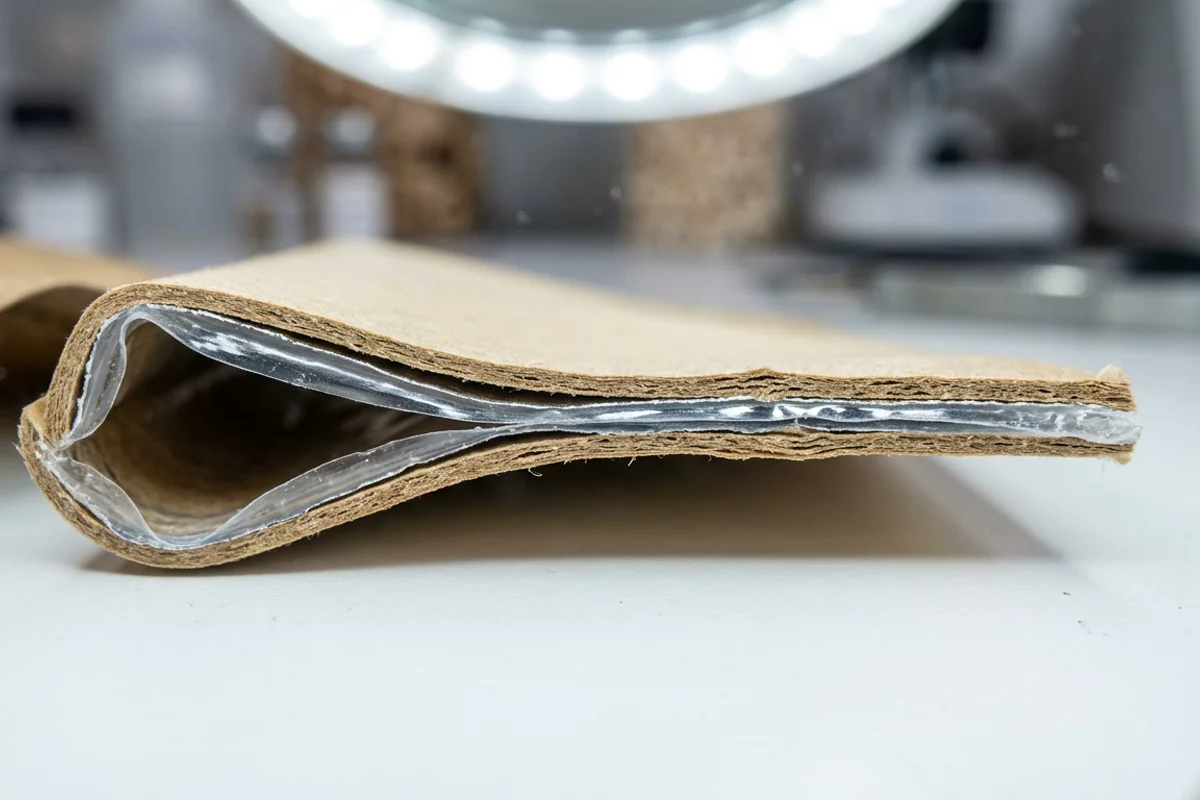
Illustrative photo — generated editorial image, not a commercial package or certified barrier test.
For engineers used to film structures, one open part is the seal. The announcement does not say whether this coating heat-seals, how the seal is formed, or at what settings; together with machine type and line speed, that is what decides whether “no equipment changes” transfers to another line. If the coated face also carries print, confirm with the supplier which face is printed and whether test fluids are compatible with it before using the methods in our dyne testing guide, since fluids that soak into paper give misleading results.
Takeaway: The composition is described, the performance is asserted, and the seal is not explained.
Who this affects
The launch matters most to people who make, fill or specify liquid sachets, and to brands looking for an alternative to multi-laminate packs. US readers face an extra layer of uncertainty: the partners and the filler are in the UK, and the recycling statement names no country or programme, so acceptance in US programmes has to be checked separately.
| Reader | Practical impact | Basis |
|---|---|---|
| Personal-care and household brands sampling liquids | A candidate material to request for evaluation | Kelpi announcement: hand-wash samples |
| Sachet contract fillers | A claim of drop-in running to test on their own machines | Kelpi: one filler, existing lines |
| Coating and barrier engineers | A reference point for bio-based water barriers on paper, with no published data | Bower: composition only |
| US packaging buyers | Recycling and availability unknown for the US | No US programme or date mentioned |
Brands comparing paper with film sachets can use our explainer on printing on plastic film as the film baseline.
Takeaway: Fillers should test the drop-in claim on their own machines before anyone else relies on it.
When to act
No date in the announcement gives other brands access to the material. Bower calls it a limited-edition launch and says customer feedback is the starting point, so the practical move is a watch-list entry plus a request for samples and data.
| Date | Item | Status |
|---|---|---|
| 17 Sep 2026 | Launch announced | Confirmed (Kelpi) |
| 18 Sep 2026 | Bower blog on coating and trial | Confirmed (Bower) |
| 21 Sep 2026 | Packaging Europe rewrite | Same source |
| Not given | Supply to other brands, volumes, prices | Ask Kelpi |
| Not given | US availability and recycling acceptance | Ask Kelpi; check the local programme |
The development timeline traces bio-based barrier coating trial milestones from initial material proof-of-concept to pilot retail sachet field trials.
Paper-based coating news from larger suppliers follows the same pattern of announcement first and data later; BASF’s reduced-carbon paper coating binders are a recent example.
Takeaway: Put the material on a watch list and ask Kelpi about samples and supply terms; the sources checked do not say whether other brands can order it.
What is still open
The gaps are machine fit, barrier, liquid hold-out and leakage, end-of-life evidence, the biobased carbon test and supply terms. Each is listed with who can close it and the document to ask for.
| Open item | Who can confirm | Document that closes it |
|---|---|---|
| Fit with other sachet machines and seal methods | Kelpi, Guardpack | Line trial records naming machine type, seal method and settings |
| Barrier against plastic-lined sachets | Kelpi or a test lab | Water vapour transmission and liquid hold-out results for both materials under the same conditions |
| Leakage and shelf behaviour | Kelpi, Bower | Leak and storage test results for the filled sachet |
| Recycling acceptance in the US | Kelpi; local programmes | A recyclability assessment for the target programme |
| Biodegradation | Kelpi | Test reports or certificates naming the standard |
| Biobased carbon test | Kelpi, Bower | The lab report naming the method, for example ASTM D6866 |
| Capacity, cost and other liquids | Kelpi | Supply terms and compatibility data for your formulation |
Common mistake: Writing “plastic-free” in a specification or on a pack. The announcement’s wording is “fossil fuel plastic free”, and the coating itself is not described in detail.
Takeaway: Request samples plus machine, seal and barrier data first; leave end-of-life and supply documents for the adoption decision.
Coating parameter questions for engineers
A coated-paper sachet has to do three jobs a laminate usually does: hold the liquid, seal reliably and survive storage. The questions below turn the open items into parameters a coating or packaging engineer can compare across suppliers. Listing these methods is our suggestion; the companies have not said which tests they ran.
| Parameter | Why it matters | Evidence to request | Example method |
|---|---|---|---|
| Coat weight and coverage | Sets barrier and cost | Coat weight per area and how it is measured | Supplier method |
| Water vapour transmission | Moisture loss through the wall | WVTR with temperature and humidity | ASTM F1249 covers coated flexible barrier materials up to 3 mm |
| Liquid hold-out and paper wetting over time | The core claim; WVTR does not measure it | Storage and contact test with the actual formulation, time and temperature | Agreed with the filler |
| Seal formation and strength | Decides machine fit | Seal method, settings, and seal strength with failure mode | ASTM F88/F88M |
| Leak testing of filled sachets | Catches pinholes and weak seals | Leak test method and results | Agreed with the filler |
| Compatibility with other liquids | Surfactants and solvents differ | Results for each formulation | Storage and leak tests per liquid |
| Biobased carbon | Supports the bio-based claim | Lab report naming the method | ASTM D6866 (radiocarbon) |
| Recycling and biodegradation | Supports end-of-life claims | Programme-specific assessment; named test standards | Programme and certifier specific |
ASTM D6866 measures biobased carbon by radiocarbon analysis and, as its scope states, does not address environmental impact or product performance, so a biobased carbon result says nothing about barrier or biodegradation. ASTM F88/F88M measures the force to separate a seal and records how it fails. If the coated face also carries print, our guide to inks and pretreatment on film and the dyne testing guide give method background, and a water contact angle measurement is another way to record the surface; confirm with the supplier which method suits this coated paper before relying on any of them.
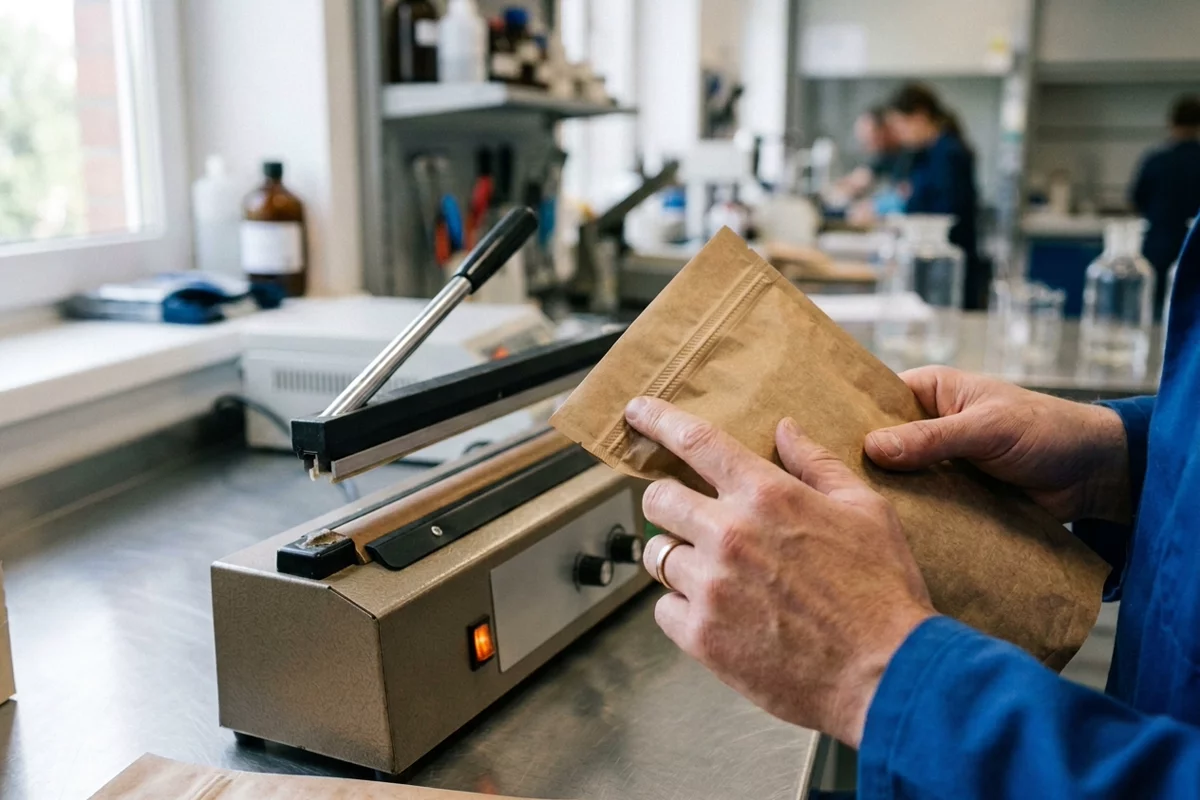
Illustrative photo — generated editorial image, not an engineered packaging specification.
Takeaway: Compare coated-paper sachets on seal, barrier and storage data, measured the same way for every supplier.
Our reading
Our reading is that the Kelpi and Bower launch is a limited customer trial, single-product and single-filler, wrapped in stronger language than its published evidence supports. For a filler, the drop-in claim is a sensible first question, because it can be checked in a controlled trial on your own line once samples and seal settings are in hand. Similar patterns appear in Stahl’s Senoprint metallic coatings launch, BASF’s rPCF coating binders and SunDance’s coffee valve pouches: real launches, supplier-only evidence.
Takeaway: Get samples and seal settings, run a controlled trial on your own line, and collect the remaining documents before any adoption decision.
When this does not apply
This explainer reads the companies’ published statements as of 7 October 2026. It does not apply in these cases:
- You need a compliance or labelling decision on recyclability or biodegradability. Nothing here assesses either.
- Your liquid is not a hand wash. The only published use is Bower’s hand-wash samples.
- Kelpi has since published technical data, certificates or supply terms. Those replace this summary.
- You need food-contact information. The sachet launch does not address food use.
More coating and print topics are in Films and Printing, and wetting and adhesion are covered under Surface Treatment.
Takeaway: Re-check Kelpi’s own materials before using this summary in a specification.
How we checked this
We worked from Kelpi’s 17 September 2026 announcement, Bower Collective’s 18 September blog post and Packaging Europe’s 21 September rewrite, all checked on 7 October 2026. Kelpi’s page renders in the browser, and Bower’s server limited automated requests that day, so for those two we relied on the full page text captured during our source search the same day. The three items describe one launch and count as one source. Test method scopes come from ASTM’s public abstract pages. We did not test the sachets. See About for how this site works.
Takeaway: These sources support a reading of the announcement; an engineering decision needs the original test data.
Last updated 7 October 2026 (first published).