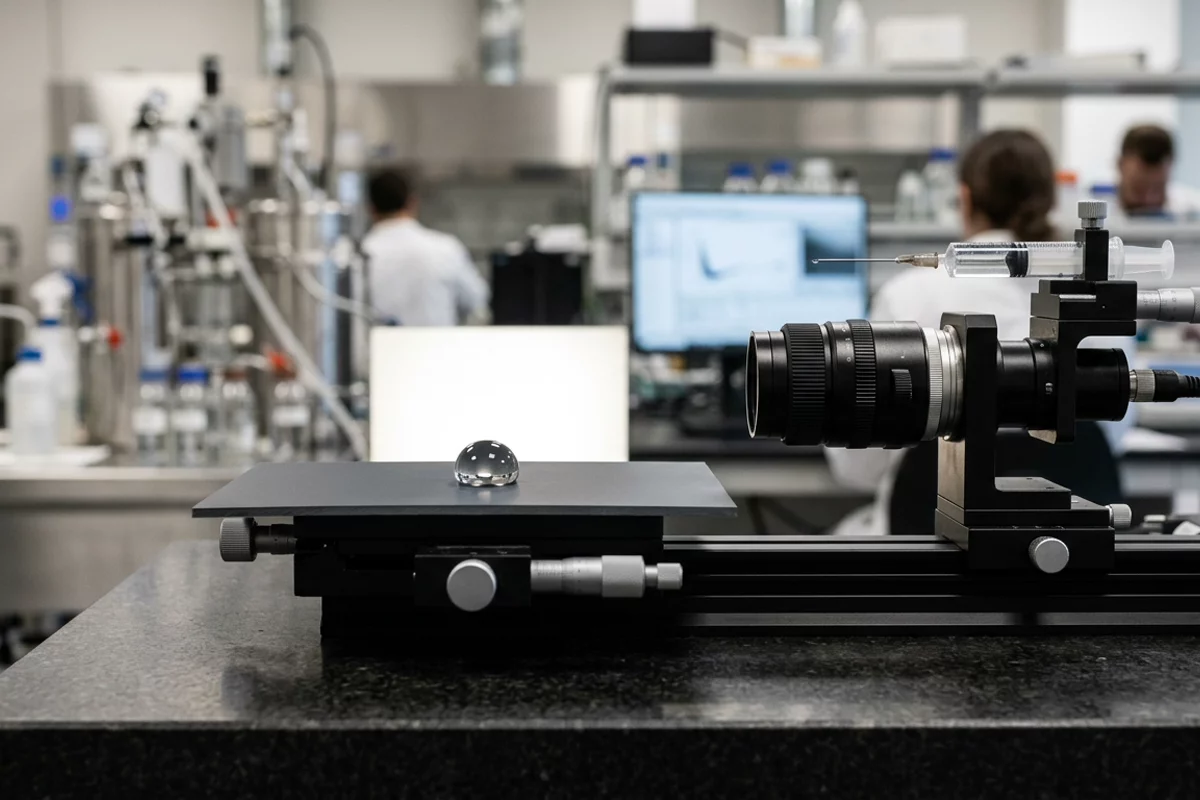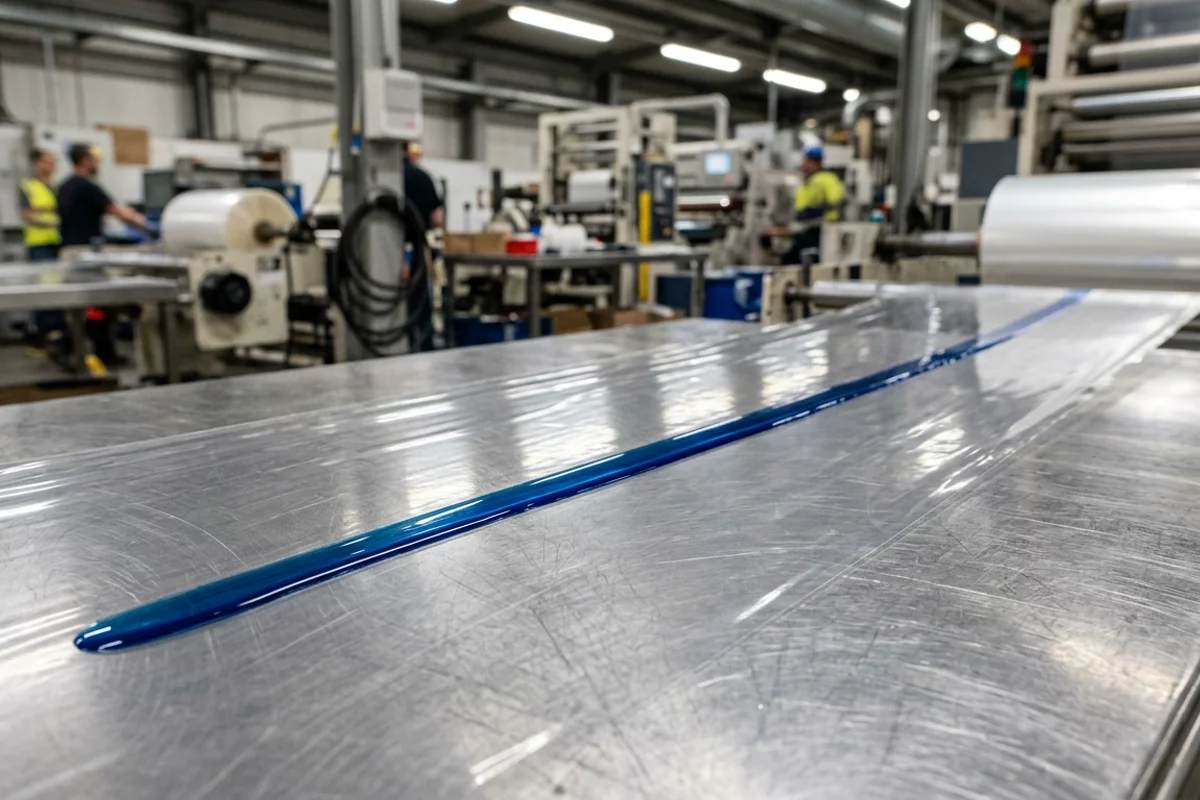
A dyne reading taken the wrong way passes film that later fails at the print station. A dyne test finds the test liquid, rated in dynes/cm, that stays spread as a continuous film on the surface for about two seconds; that value is the surface’s wetting tension, and comparing it with a specification validated for your film and ink shows whether wetting is on target. It does not prove adhesion on its own.
Dyne testing is the standard shop-floor check of treatment on plastic film. ASTM D2578, equivalent to ISO 8296, covers polyethylene and polypropylene films and uses mixtures of formamide and ethyl Cellosolve. You spread fluids of rising surface tension and report the level that holds closest to two seconds before breaking into droplets. The standard also limits what the number means: wetting tension relates to ink, coating or adhesive retention only through experience, and it is not a complete measure of adhesion. ASTM D2578-23 Note 3 gives 35 dynes/cm as generally acceptable for one case, Type 1 polyethylene tubular film in commercial flexo, and states that no generally acceptable level exists for polypropylene film in commercial flexographic printing.
| Item | Value or source | Why it matters |
|---|---|---|
| Standard | ASTM D2578-23; ISO 8296 is equivalent | Defines the test for PE and PP film |
| Unit | dynes/cm, same number as mN/m | Lets you compare readings and specifications |
| End point | Level that wets closest to 2 seconds (Diversified Enterprises procedure, read 7 Oct 2026) | Defines the reported value |
| Test fluids | Formamide and ethyl Cellosolve mixtures (ASTM D2578) | Calibrated surface tension steps |
| Sampling | At least three points across the web, plus edges (supplier procedure) | Treatment varies across the web |
| Reference level | 35 dynes/cm for Type 1 PE tubular film in commercial flexo (ASTM D2578-23 Note 3) | One documented case, not a universal target |
What a dyne test measures
A dyne test measures wetting tension: how strongly a solid surface pulls a liquid into a continuous film. ASTM D2578 defines it from the balance of forces at the edge of a drop, as the difference between the solid–gas and solid–liquid surface energies, and notes it is not a fundamental property of the surface but depends on the test environment. When a liquid just wets the surface, its contact angle is 0° and the wetting tension equals that liquid’s surface tension.
| Term | What it means | Source |
|---|---|---|
| Wetting tension | Difference between solid–gas and solid–liquid surface energies, measured with specific test liquids | ASTM D2578, section 5.1 |
| Dyne level | Everyday name for the wetting tension found by the test, in dynes/cm | Brighton Science |
| Test fluid | Mixture of formamide and ethyl Cellosolve with a known surface tension | ASTM D2578, section 5.2 |
| dynes/cm and mN/m | Two names for the same unit | ASTM D5946, section 5.3 |
| Treatment | Corona, flame, plasma or chemical processes that raise wetting tension | ASTM D2578, section 5.2 |
The practical reason to measure it: ASTM D2578 states that the ability of polyethylene and polypropylene films to retain inks, coatings and adhesives depends mainly on their surface, that treatment raises wetting tension, and that the two can be related, but only through experience. Treatment itself is covered in our surface treatment articles.
Takeaway: A dyne reading is a wetting measurement with a clear definition; adhesion is a separate question.
Which standard applies
Use ASTM D2578, or its equivalent ISO 8296, for polyethylene and polypropylene film. ASTM D2578 allows the method on other polymers only if the user establishes that it applies, because other materials change the interface energies the test relies on. For corona-treated films where you want an instrument reading, ASTM D5946 measures water contact angle instead.
| Standard | What it covers | Use it when |
|---|---|---|
| ASTM D2578-23 | Wetting tension of PE and PP film with formamide and ethyl Cellosolve mixtures | Routine treatment checks on polyolefin film |
| ISO 8296 | Equivalent to ASTM D2578 (stated in D2578 Note 2) | Specifications written to ISO |
| ASTM D5946-24 | Water contact angle on corona-treated polymer film; identical to ISO 15989 | You need an instrument reading instead of a visual judgement |
| ASTM F2252/F2252M-25 | Tape test of ink or coating adhesion on flexible packaging | You need to check adhesion, not wetting |
Other films such as polyester or polyamide can be dyne tested, but ASTM D2578 puts the burden of proving that the result means something on the user. Paper and board are a weaker fit: Diversified Enterprises notes that a test fluid that soaks into a fibre substrate and swells it gives a falsely easy wetting result, a point that matters for coated paper binders and coated paper sachets.
Takeaway: Quote ASTM D2578 for PE and PP; for anything else, write down why the method fits before relying on it.
Step by step: running the swab test
Take an untouched sample across the web, test several points, bracket the level with fresh swabs, and report the level that wets closest to two seconds. This follows the public procedure from Diversified Enterprises, a test-fluid supplier that states its cotton-swab method complies fully with ASTM D2578 and ISO 8296. Brighton Science describes the end point slightly differently, as the highest fluid that stays spread for at least two seconds; use one rule consistently and name it in your records.
| Step | What to do | Why |
|---|---|---|
| 1. Condition | Record room temperature and humidity; let the sample and fluids reach room conditions. Diversified suggests 20–25 °C and 40–60% RH as ideal | Temperature and humidity shift readings |
| 2. Sample | Cut a full web cross-section without touching the test face; mark machine direction; lay it on a clean, level surface and hold down curling edges | Fingerprints, handling and curl distort the test |
| 3. Choose points | Test at least at 1/4, 1/2 and 3/4 of the web width; edges too | Treatment varies across the web |
| 4. Start low | Pick a fluid a few dynes/cm below the level you expect | Gives a wetting result to work up from |
| 5. Apply | Wet a fresh swab tip with just enough fluid for about one square inch (6.5 cm²); spread it quickly with light pressure | Thick or scrubbed films read differently |
| 6. Watch the centre | Time how long the film stays continuous, judging the centre, not the edges | Edges retract first and mislead |
| 7. Step up or down | Still continuous after 2 seconds: move up a level. Beads before 2 seconds: drop 2–4 dynes/cm | Brackets the result |
| 8. Read | The level that holds closest to exactly 2 seconds is the wetting tension | This is the reported value |
| 9. Repeat | New swab for every application; fresh spot for every test; all points across the web | Contaminated swabs and retested spots give false results |
| 10. Record | Each point’s result, material and side tested, time since treatment, temperature and humidity (our suggested record) | Makes results comparable and traceable |
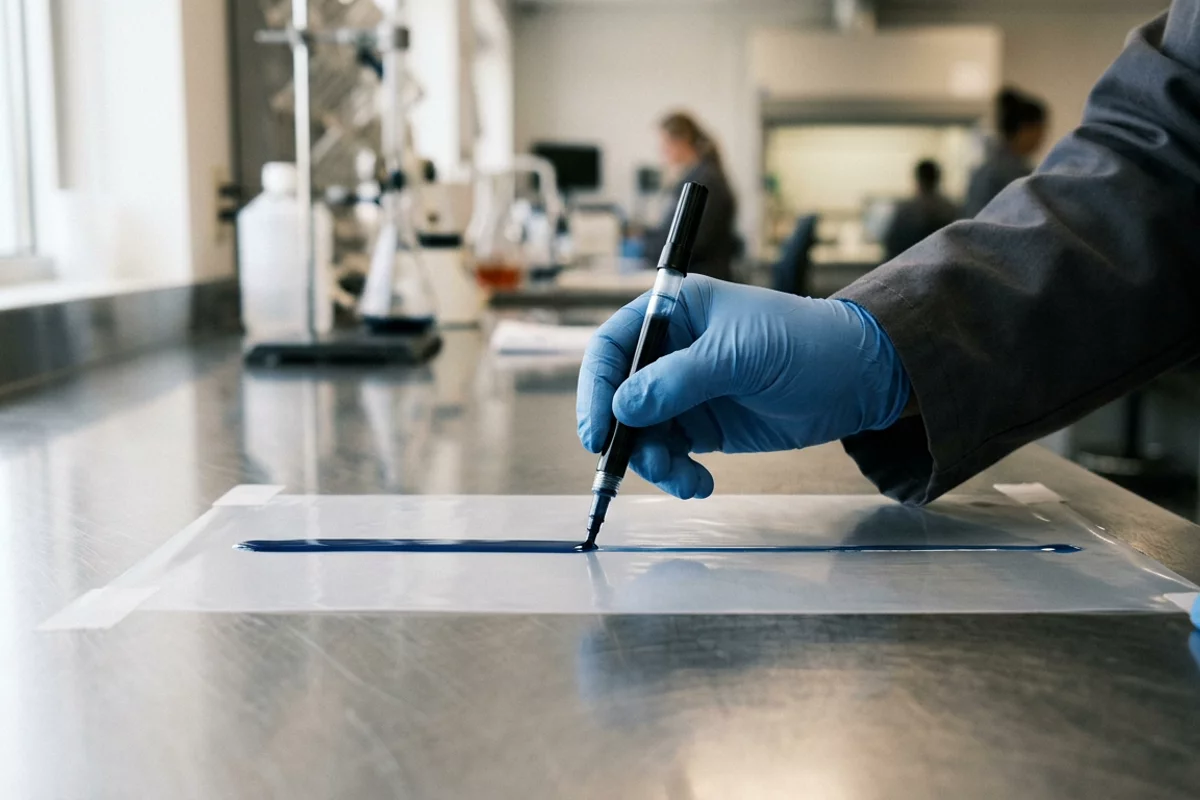
Illustrative photo — generated editorial image, not a test record or laboratory certification.
Test fluids contain hazardous solvents. Diversified Enterprises advises avoiding skin contact, working with good ventilation and wearing eye protection; follow the fluid’s safety data sheet and your site rules. The tested sample is contaminated and should not go back into production.
Common mistake: Retesting the same spot or reusing a swab. Both carry fluid or contamination from the last test into the next one.
Takeaway: Bracket the reading from below, judge the centre of the stroke at two seconds, and never reuse a swab or a spot.
How to read the result and what to do next
Read the result as the surface’s wetting level under the procedure you used, then compare it with your specification, which should come from experience with your ink, coating or adhesive, as ASTM D2578 says. The first three rows follow the supplier procedure; the remaining causes and next steps are our suggestions for troubleshooting, built from the public sources.
| What you see | What it means | Next step |
|---|---|---|
| Stroke stays continuous past 2 seconds | Wetting tension is at least this fluid’s level | Step up a level until a fluid beads |
| Stroke breaks into droplets within 2 seconds | Wetting tension is below this level | Step down 2–4 dynes/cm |
| Edges pull back, centre holds | Edge effect; centre decides | Judge the centre only |
| Readings differ across the web | Possibly uneven treatment, possibly a measurement difference | Retest fresh samples; if the pattern repeats, check the treater set-up across the width |
| Reading at the unwind is below the reading after treatment | Possibly treatment loss in handling, possibly a measurement difference | Retest under the same conditions; if it repeats, test closer to the print station |
| Reading meets specification, but ink or coating fails | Wetting is not the whole adhesion story | Run a tape adhesion check on the ink or coating and look at cure and additives |
| Reading meets specification, but an adhesive bond or laminate fails | Wetting is not the whole bond story | Agree a bond test and acceptance criteria with your customer or lab |
| Result below specification | Surface not at target, or a measurement problem | Hold the material, retest fresh samples under the same conditions, then follow your acceptance procedure |
The decision sequence follows standard evaluation logic: if the fluid film holds continuous past 2 seconds, step up to a higher dyne level; if droplets form within 2 seconds, step down 2–4 dynes/cm; once the boundary is confirmed, compare against supplier ink specification before releasing material.
Published reference levels exist, but each comes with conditions. ASTM D2578 Note 3 says 35 dynes/cm or higher has generally indicated acceptable treatment for tubular film from Type 1 polyethylene intended for commercial flexographic printing, that other films or uses can need other levels, and that no generally acceptable level has been established for polypropylene film. Diversified Enterprises’ published guidance (read 7 October 2026) says most solvent-based printing needs plastics treated to 36–40 dynes/cm, water-based inks usually 40–44, and some laminating and coating uses 50 or more. Treat both as starting points for a conversation with your ink supplier, not as a specification.
When adhesion fails on film that passed, ASTM F2252 describes a tape method for ink and coating adhesion on flexible packaging, with pass criteria agreed between user and producer. Our guide to printing on plastic film explains where that check fits in a print trial and why some inks need higher levels than others.
Takeaway: Compare the reading with your own specification, and when wetting passes but adhesion fails, test adhesion directly.
Why dyne readings drift
Dyne readings can change because the treatment really changed, or because of the sample, the fluids, the room or the person reading them, so check the measurement conditions first. Brighton Science cites published round-robin work showing variation between technicians testing the same material. The causes below come from the two supplier sources; the controls are our suggestions.
| Cause | Effect on the reading | Control |
|---|---|---|
| Touched or dirty surface | Lower wetting | Do not touch the test face; cut fresh samples |
| Contaminated pen tip or reused swab | Shifts later readings | New swab every time; replace pens per the supplier’s advice |
| Slip agents and other additives blooming to the surface | Fluids dissolve them, so the reading misses them (Brighton Science) | Consider a water-based check such as water contact angle |
| Treatment decay after corona | Readings drop with time and handling; Diversified reports that a virtually immediate loss of 10 dynes/cm is possible | Test near the print station; log time since treatment |
| Temperature and humidity outside the normal range | Reading shifts | Test at stable room conditions and record them |
| Static charge on treated film | Distorts fluid behaviour (Diversified) | Neutralise static in the test area |
| Different pen brands or old fluids | Same nominal level reads differently | Use one supplier and in-date, capped fluids |
| Different operators | Subjective judgement of the 2-second point | One trainer, one written method |
Potential causes of dyne reading drift group into four primary categories: sample contamination or handling, applicator fluid age or tip wear, ambient room temperature and relative humidity shifts, and operator interpretation differences at the two-second mark.
Static control belongs to the measurement as well as the process: Diversified notes that static charge on corona-treated film affects dyne results. When readings drift between shifts, check the operator method before adjusting the treater.
Common mistake: Judging the result at the edge of the stroke. Edges retract first; Diversified’s procedure bases the decision on the centre of the liquid film.
Takeaway: Before changing treatment settings, rule out the sample, the fluids, the room and the reader.
Dyne test or water contact angle?
Use a dyne test for fast, low-cost checks on polyolefin film; add water contact angle when you want an instrument record of the drop’s geometry instead of a visual judgement of fluid behaviour. ASTM D5946 notes that dynes/cm treatment levels come from a subjective interpretation of fluid behaviour; contact angle still needs a defined method, sampling and repeat measurements. Brighton Science, which sells contact angle instruments, adds that test fluids dissolve slip agents and similar additives that water does not.
| Factor | Dyne test (ASTM D2578) | Water contact angle (ASTM D5946) |
|---|---|---|
| What is read | Strongest fluid that wets for about 2 seconds | Angle of a water drop on the film |
| Who decides | Operator’s visual judgement | Instrument or measured image |
| Materials | PE and PP film; others only if the user proves fit | Corona-treated polymer film |
| Effect on sample | Contaminates the tested area | Small water drop |
| Treatment guide in the standard | 35 dynes/cm note for one PE case | >90° marginal or none; 85–90° low; 78–84° medium; 71–77° high; <71° very high |
| Caveat | Not a complete measure of adhesion | Not a complete measure of adhesion; capability study needed per film |
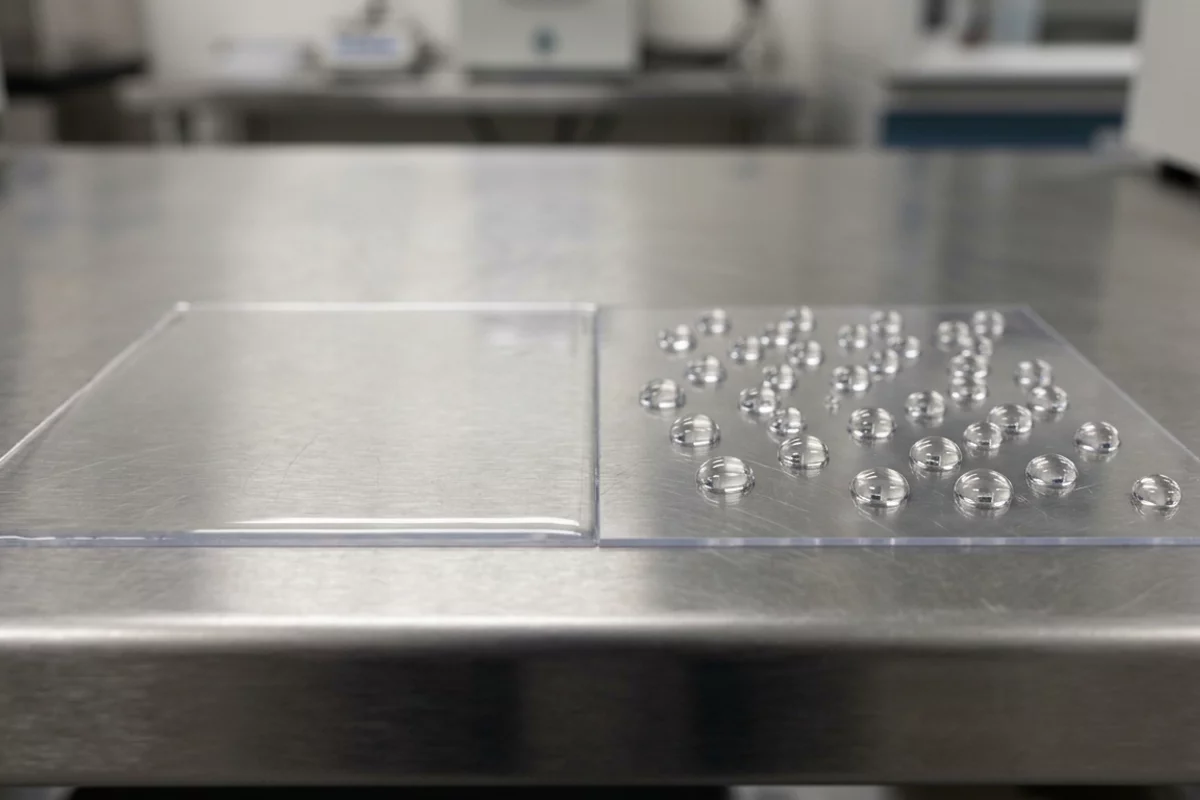
Illustrative photo — generated editorial image, not an instrument calibration standard.
ASTM D5946 also notes that contact angle varies from point to point and that non-uniform corona treatment adds variation, so it calls for multiple measurements. For the instrument side of the comparison, including how angles convert to surface energy, see our contact angle and surface energy guide.
Takeaway: Keep dyne tests for routine checks and add contact angle where you want an instrument record or suspect slip-agent bloom.
When this does not apply
Do not rely on the method or numbers above for absorbent materials, non-PE/PP film without a documented fit, or adhesion acceptance. In detail:
- Non-polyolefin film without a documented fit. ASTM D2578 leaves applicability to the user.
- Paper, board and other absorbent materials. Fluids that soak in give falsely easy wetting.
- Adhesion acceptance. Wetting tension is not a complete measure of adhesion; agree an adhesion test with your customer.
- Process settings. This guide does not set treatment power, line speed or dyne targets for your film; get those from your treater and ink suppliers.
- Safety procedures. Follow the test fluid’s safety data sheet and your site rules.
For process news where these checks come up, see our explainers on Stahl’s in-line metallic coatings and SunDance’s digitally printed valve pouches, or browse Films and Printing.
Takeaway: Use the dyne test where the standard supports it and back it with an adhesion test where the decision depends on it.
How we checked this
We compiled this guide from public sources read on 7 October 2026: ASTM’s abstract pages for D2578-23, D5946-24 and F2252/F2252M-25, and two supplier documents, Diversified Enterprises’ published test procedure and usage notes and Brighton Science’s explainer. Both suppliers sell testing products. We did not run tests for this article, and we name no instrument models or prices. The full ASTM texts are sold by ASTM; we quote only the publicly visible sections. See About for how this site works.
Takeaway: Check the current ASTM edition before writing any of these numbers into a specification.
Last updated 7 October 2026 (first published).