A foil-replacement trial planned from the press release alone can waste press time if it assumes a process or substrate Stahl has not confirmed for your grade. Stahl announced on 14 September 2026 that its Senoprint metallic coatings now include the range it sold in North America as LustreCoat, and its own press release and product page word the print processes and substrates differently.
If you run cartons or labels and are weighing an in-line metallic coating against hot or cold foil, here is the short answer. Stahl’s two official pages agree on the basics: UV and water-based formulations, silver and gold finishes, and a matched protective topcoat for every metallic layer. They word the scope differently. The 14 September 2026 release names paper and board on sheetfed, screen, flexo and narrow-web work; the product page lists flexo, gravure, offset, narrow web and screen and mentions flexible formats. Neither list says which grade runs on which press. Recyclability and regulatory statements on both pages are Stahl’s own and cite no independent test. Treat the launch as a reason to request documents and run a trial, not as a specification.
Key points:
- What happened: Stahl merged its North American LustreCoat range and its EMEA Senoprint range under one global Senoprint brand (Stahl release, 14 September 2026).
- What is consistent: UV and water-based options, silver and gold, a topcoat paired with every metallic coating.
- What differs: the wording of the print-process lists and the substrates.
- What is unproven: de-inking and recycling performance, PPWR conformity, food-contact use, cost and rub resistance figures.
For a wider process review, the PRINTING United convergence and coating handoff checklist helps assign evidence and responsibility across printing, coating and finishing.
What Stahl announced on 14 September 2026
Stahl, the Waalwijk-based specialty coatings supplier, issued a release on 14 September 2026 presenting Senoprint as a worldwide portfolio of high-brilliance metallic coatings applied during the print run. The only primary sources are Stahl’s own release and product page; trade-press stories repeat the release.
| Event | Date | Source | Source type |
|---|---|---|---|
| Senoprint presented as a global portfolio; LustreCoat range folded into the brand | 14 Sep 2026 | Stahl news release | Supplier announcement |
| Same release rewritten under the headline “Stahl introduces PPWR-compliant metallic coatings” | 14 Sep 2026 | Packaging Europe | Media rewrite of the same release |
| Showing planned at LOUPE Americas 2026, Chicago, booth 727 | 15–17 Sep 2026 | Stahl news release (announced in advance) | Supplier announcement |
| Product page lists benefits, processes and compliance targets | Read 7 Oct 2026 | Stahl product page (undated) | Supplier product page |
Both pages describe the merger of the North American LustreCoat range and the EMEA Senoprint range under one brand. Neither says whether LustreCoat product codes, safety data sheets or formulations change with the name.
The release’s own subheading speaks of “recycling packaging compliant with PPWR standards”, while its body text is more careful: the coatings help customers “respond to evolving packaging regulations, including” the PPWR. Packaging Europe’s headline, “PPWR-compliant metallic coatings”, follows the subheading.
Common mistake: Reading “compliant with PPWR standards” or “engineered for compliance” as a certification. Both are Stahl’s marketing wording; neither page cites a conformity assessment.
Takeaway: One company, two pages, one announcement date: treat every performance and compliance line as Stahl’s statement.
Formulations, topcoats and print processes: the two Stahl pages side by side
Both Stahl pages list UV and water-based formulations and pair each metallic layer with a Stahl-developed topcoat; they word the process and substrate lists differently. Only the product page names gravure, offset and “flexible formats”, and neither page maps grades to presses. The table lines the wording up so you can see which source supports which part of a trial plan.
| Item | Press release (14 Sep 2026) | Product page (read 7 Oct 2026) | What to ask Stahl |
|---|---|---|---|
| Formulations | UV-based and water-based | UV-cured and water-based; “energy-cured” in the summary | Which grade matches your press, dryer or UV lamp set-up |
| Topcoat | Every metallic coating paired with a protective topcoat, developed in-house as a single system | Same; topcoat said to resist abrasion, handling and environmental factors | Topcoat grade, cure conditions and the rub test behind the claim |
| Finishes | Silver and gold; more colours by overprinting | Silver and gold as standard; full palette by overprinting the silver base | Overprint ink systems Stahl has run on the silver |
| Substrates | Paper and board | “From cartons and direct mail to labels and flexible formats”; “a vast range of substrates” | A written list of tested substrates, including any films |
| Print processes | Sheetfed, screen, flexo, narrow web | Flexo, gravure, offset, narrow web, screen | Whether gravure and offset grades exist in your region |
| Recycling | Designed to be de-inked and recovered through standard paper recycling streams | “Full de-inking and recyclability through standard paper recycling”; “fully recyclable” | The de-inking test report, method and lab |
| Regulation | Subheading: “compliant with PPWR standards”; body: engineered to meet worldwide requirements, helps customers respond to the PPWR | Engineered for compliance across REACH, GIO, PPWR and U.S. TSCA | Declarations of compliance for your exact grades |
| Food contact | Not mentioned | Indirect food-contact suitability assessed per application and product | A written assessment for your pack, if it is a food pack |

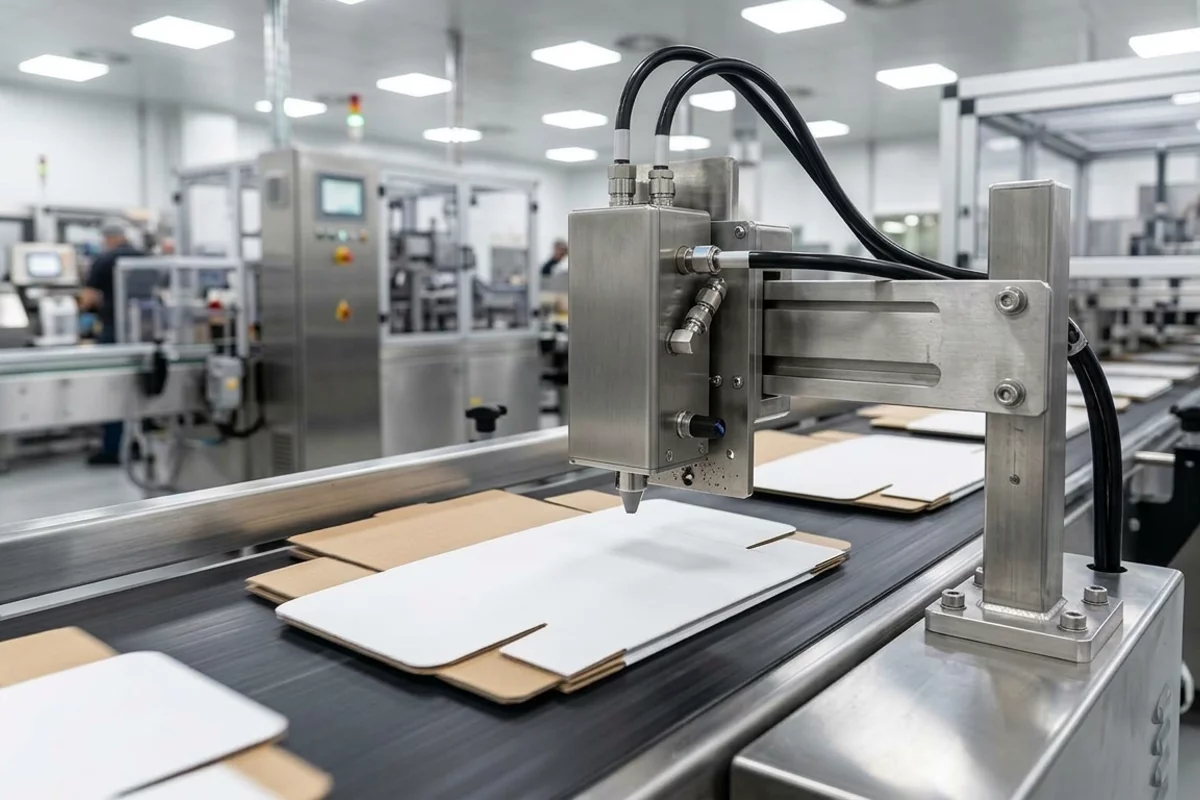
Illustrative photo — generated editorial image, not a proprietary chemical formulation or facility audit.
The “flexible formats” line matters for this site’s readers. The release limits itself to paper and board, and neither page names a plastic film, a film surface treatment or a surface energy requirement. If your interest is metallic effects on film, read the product page line as an opening to ask, not as an approval; our guide to printing on plastic film covers why film surfaces need their own checks.
Common mistake: Treating either list as a grade-by-press approval. The lists name process families; they do not say which grade, cure set-up or substrate Stahl has run.
Takeaway: Ask Stahl for a written grade-by-process compatibility list before planning any trial.
Who this affects
Three groups have a practical reason to act: North American converters already running LustreCoat, carton and label printers evaluating foil replacement, and brand owners whose packs are sold in the EU. Converters printing on plastic film are a fourth group, but only as askers: no Stahl source confirms film as a tested substrate.
| Reader | Practical impact | Basis |
|---|---|---|
| Existing LustreCoat users in North America | Product name changes to Senoprint; continuity of codes and documents unknown | Release and product page (merger statement only) |
| Carton and label converters using hot or cold foil | A supplier-backed in-line option to evaluate against foil on their own presses | Release: sheetfed, screen, flexo, narrow web on paper and board |
| Brand owners selling packs in the EU | A supplier claim to set against recyclability requirements | Release and product page mention PPWR; no third-party conformity statement |
| Film and flexible-packaging converters | An open question, not a confirmed option | Product page mentions “flexible formats” only |
If you already buy LustreCoat, start with the paperwork: ask whether item codes, safety data sheets and compliance declarations are being reissued under the Senoprint name. Film converters should start one step earlier, with a written list of tested substrates, and check how their own film is prepared for printing before any trial.
Takeaway: LustreCoat users should update their supplier documents first; everyone else starts from a scoped trial request.
When to act
No date in either Stahl page forces a decision. The release gives the launch date and a trade-show slot that has now passed; it gives no ordering date, price, minimum quantity or regional availability date. The release cites the EU Packaging and Packaging Waste Regulation (PPWR), and neither Stahl page states which PPWR dates apply to a decorated carton.
| Date | Item | Status |
|---|---|---|
| 14 Sep 2026 | Global Senoprint launch announced | Confirmed (Stahl release) |
| 15–17 Sep 2026 | Planned showing at LOUPE Americas 2026, Chicago, booth 727 | Date passed; announced in advance |
| 7 Oct 2026 | Both Stahl pages read for this article | Checked |
| Not given | Ordering dates, prices, regional availability | Ask Stahl |
| Not given | PPWR dates relevant to your packs | Check the regulation text with your compliance adviser |
The commercial evaluation timeline links product announcement milestones to prototype trials, leaving pricing, delivery lead times, and regulatory filings to bilateral agreements.
Takeaway: Act on your own trial calendar; check any PPWR deadline against the regulation itself, not the release.
What is still open
The open items are recycling evidence, regulatory status, food contact, cost, rub resistance, film use and LustreCoat document continuity. Each one has a named party and a document that would close it; the list below is what we would put in a supplier questionnaire.
| Open item | Who can confirm | What document closes it |
|---|---|---|
| De-inking and paper-stream recycling performance | Stahl; an independent test lab | A de-inking or recyclability test report naming the method and lab |
| PPWR, REACH, GIO and TSCA status for your grade | Stahl regulatory team | Signed declarations per grade and per market |
| Food-contact suitability | Stahl, case by case | A written assessment for your specific pack and use |
| Cost against foil | Your estimating team, with Stahl input | A costed comparison on your own job |
| Rub and handling resistance | Stahl; your quality lab | Test results with the method, cure and substrate stated |
| Film or flexible-packaging use | Stahl application lab | A list of tested film substrates and treatment requirements |
| LustreCoat code and document continuity | Stahl customer service | A cross-reference of old and new item codes and SDS versions |
One record you can add yourself is the starting surface of the stock. Stahl’s pages do not mention substrate surface energy. Once Stahl or your lab confirms a method suits the substrate, a dyne test before the trial or a water contact angle reading documents the surface you started from. A reading alone does not prove adhesion or identify a failure cause, and the link to this coating is our suggestion, not something Stahl states; our surface treatment articles explain the background.
Takeaway: Send the seven questions in writing before the press trial, and record the substrate surface yourself.
A trial checklist for print and coating teams
A useful Senoprint trial answers four things: does it run on your press, does it match your foil job, does it stay on, and can you document the recycling and compliance claims. The checklist turns the open items into steps a pressroom and a quality lab can run.
| Check | Why it matters | Evidence to request or record |
|---|---|---|
| Confirm process and grade | The two Stahl lists are worded differently and name no grades | Stahl’s written grade recommendation for your press and dryer or UV set-up |
| Record the substrate surface | Gives a documented starting point for comparing runs | Dyne level or water contact angle on the stock, with method, date and location |
| Run metallic layer plus topcoat as one system | Stahl presents them as a single system | Cure settings used, line speed, any deviations |
| Compare against your current foil job | The benefit claimed is against foil | Side-by-side samples under the same light, signed off by the brand owner |
| Test rub and adhesion | The topcoat claim has no published figures | Rub test agreed with your customer; tape adhesion check |
| File recycling and compliance documents | Claims will be repeated on your customer’s pack | Test report and declarations from the “What is still open” list |
For flexible packaging materials, ASTM F2252 describes a tape method for evaluating ink or coating adhesion and leaves the pass criteria to buyer and producer to agree. It is written for flexible packaging, so confirm with your customer or lab which rub and adhesion methods fit carton board before the trial. Our film printing guide covers tape adhesion checks in more detail, and the dyne test guide explains how to read a wetting result if you are new to it.

Illustrative photo — generated editorial image, not an official certified test record.
Takeaway: Decide the pass criteria with your customer before the press trial, not after.
Our reading
Our reading is that Senoprint is mainly a branding consolidation of an established North American range, presented with sustainability language that runs ahead of the published evidence. For a carton or label printer, it is an in-line alternative to evaluate against foil. Similar caution applies to other recent coating announcements we covered, such as BASF’s lower-carbon paper coating binders, the seaweed-based coating on Kelpi’s paper sachet and SunDance’s digitally printed coffee valve pouches: the launch is real, the performance evidence sits with the supplier.
Takeaway: Value the launch as a trial lead; hold the sustainability language until you see test reports.
When this does not apply
This article reads two Stahl pages as of 7 October 2026. It does not apply in these cases:
- You need a regulatory determination. Nothing here assesses PPWR, REACH, GIO, TSCA or food-contact status.
- You print on plastic film or foil laminates and expect a confirmed option. No Stahl source lists a tested film.
- Stahl has published new technical data sheets, test reports or regional availability after 7 October 2026. Those documents replace the comparison above.
- You need cost guidance. Neither page gives prices or savings figures.
For more coating and print topics, see the Films and Printing section.
Takeaway: Re-check Stahl’s pages before relying on this comparison for a purchase decision.
How we checked this
We read Stahl’s news release and its metallic coatings product page on 7 October 2026 and compared them line by line. The Packaging Europe story is a rewrite of the same release, so it counts as one source, not two. We did not test any Senoprint grade and have no relationship with Stahl. The ASTM F2252 description comes from ASTM’s public abstract page. Sources are listed below with access dates. This site is an independent publication; see About.
Takeaway: Check the access dates below before reusing this comparison; supplier pages change without notice.
Last updated 7 October 2026 (first published).