Releasing a printed reel on a dyne reading alone risks ink flaking, unreadable barcodes, and rejected packaging rolls downstream. When an ink adhesion test for plastic film is needed after wetting passes, select the evaluation method that fits a flexible web and record the sample history, cure state, tape application, peel conditions, and joint acceptance rule on one sheet.
Wetting tension and cured ink adhesion answer two different questions. In ASTM D2578-23 (updated 3 March 2023), Section 5.2 states that wetting tension relates to ink, coating, or adhesive retention only through experience and is not a completely acceptable measure of adhesion. For flexible packaging webs, ASTM F2252/F2252M-25 (updated 30 April 2025) describes evaluating ink or coating adhesion with pressure-sensitive tape on flexible packaging materials whose surfaces are not damaged by applying and removing the tape (Section 1.1). Its public Significance and Use notes that inter-laboratory disagreements can be reduced by defining and controlling tape application pressure and method—such as using a weighted roller—along with removal speed and angle (Section 3.2), while acceptability criteria must be jointly determined by the user and producer (Section 3.3). This guide provides a public-scope method selector and a blank test record without reproducing paid standard procedures or inventing universal pass percentages.
| Input or item | Documented scope or public source | Why it belongs on the record |
|---|---|---|
| Wetting tension screen | ASTM D2578-23 (ISO 8296) on PE/PP film; ASTM D5946-24 water contact angle on corona-treated film | Shows whether the unprinted surface wet before printing, not whether cured ink anchored |
| Flexible-packaging tape practice | ASTM F2252/F2252M-25 (public Scope 1.1–1.2; Significance 3.1–3.3) | Covers flexible packaging materials whose surfaces are not damaged by tape application and removal |
| Cross-cut coating tape test | ASTM D3359-23 (Method A >125 µm / 5 mils; Method B <125 µm / 5 mils) | Developed for metallic substrates (Note 1 states precision and bias data on plastic is lacking) |
| Portable pull-off test | ASTM D4541-22 (Protocols 1 and 2; Instrument Test Methods B–F) | Perpendicular tension via glued dolly on metal or addressed rigid substrates, not thin webs |
| Pre-print treatment decay | Up to 10 dynes/cm immediate loss possible after corona treatment (Diversified Enterprises, checked 17 Oct 2026) | Separates reel-unwind readings from the surface reaching the print station |
| Tape application and peel control | Application pressure/method (e.g., weighted roller), removal angle and pull rate (ASTM F2252-25 3.2; ASTM D3359-23 5.6) | Uncontrolled smoothing pressure or peel rate changes peel force and transfer results |
| Acceptance criterion | Jointly determined by user and producer (ASTM F2252/F2252M-25 Section 3.3) | Blank until both parties write the pass/fail rule onto the specification |
Which test fits wetting, flexible-film ink adhesion, or rigid coating strength?
Match the test family to the physical substrate and the question under dispute before logging any pass or fail result. A wetting fluid checks whether an unprinted polymer surface spreads a reference liquid, a tape pull on an uncut flexible web evaluates whether printed ink lifts from a film that will not tear under tape, and cross-cut or pull-off methods address thicker or rigid coated parts.
Download the ink adhesion method selector (CSV) to document which evaluation applies to a job and why other methods were ruled out.
| Evaluation question | Public standard reference | Documented substrate and thickness scope | What the result reports | Public boundary to record |
|---|---|---|---|---|
| Does the unprinted polyolefin film wet at a target surface tension? | ASTM D2578-23 (equivalent to ISO 8296 per Note 2) | Polyethylene and polypropylene films; other polymers require user validation (Note 1) | Wetting tension in dynes/cm (mN/m) using formamide and ethyl Cellosolve mixtures | Section 5.2 states wetting tension is not a completely acceptable measure of ink, coating, or adhesive adhesion |
| Does a corona-treated polymer film meet a water contact angle band? | ASTM D5946-24 (identical to ISO 15989) | Corona-treated polymer films | Water droplet contact angle in degrees | Measures surface wettability; does not verify cured ink anchorage |
| Does printed ink or coating stay on a flexible packaging web under tape pull? | ASTM F2252/F2252M-25 | Flexible packaging materials whose surfaces are not damaged by tape application and removal (Section 1.1) | Visual transfer of ink or coating to pressure-sensitive tape under agreed conditions | Section 3.2 recommends defining tape application pressure/method and removal speed/angle; Section 3.3 leaves pass criteria to user and producer |
| Does a coating resist detachment over cuts made through the film to the substrate? | ASTM D3359-23 (similar in content, not technically equivalent, to ISO 2409) | Relatively ductile coatings on metallic substrates: Method A >125 µm (5 mils); Method B <125 µm (5 mils) (Sections 1.1–1.2) | Whole-number rating from 0 to 5 (no intermediate values per Section 5.2) | Note 1 states D3359 was developed for metal and precision/bias data on plastics is lacking; cutting thin flexible film risks slicing the web |
| What perpendicular tensile stress detaches a coating plug? | ASTM D4541-22 | Coating systems on flat metal substrates; rigid plastic requires addressing flexibility and loading rate (Section 1.1, Note 1) | Fracture pull-off stress (Protocol 1) or pass/fail at a defined load (Protocol 2) using instrument types B–F | Glued loading fixture (dolly) and concentric counter-load require a rigid substrate; unsuitable for unsupported flexible film |
ASTM D3359-23 Section 5.2 also notes that tape rating methods are limited to evaluating lower levels of adhesion and are insensitive to all but large differences. Where a buyer’s specification calls out ASTM D3359 on a flexible packaging pouch or label stock, record the mismatch between the metallic-substrate cut method and an uncut flexible web, and confirm with both parties whether ASTM F2252/F2252M-25 is the intended practice. For the broader press trial workflow, see our guide to printing on plastic film.
Takeaway: Separate pre-print wetting checks (ASTM D2578 / D5946) from post-print flexible-film tape testing (ASTM F2252), and do not apply rigid metal cross-cut or dolly pull-off rules to thin film webs without written agreement.
Why can ink lift off plastic film when the dyne reading passed?
Ink can transfer to tape on a film that passed a dyne check because wetting tension only indicates that the surface energy exceeded the test fluid’s tension at the moment and spot tested—it does not verify chemical compatibility, full drying or crosslinking, additive stability, or where the bond actually parted.
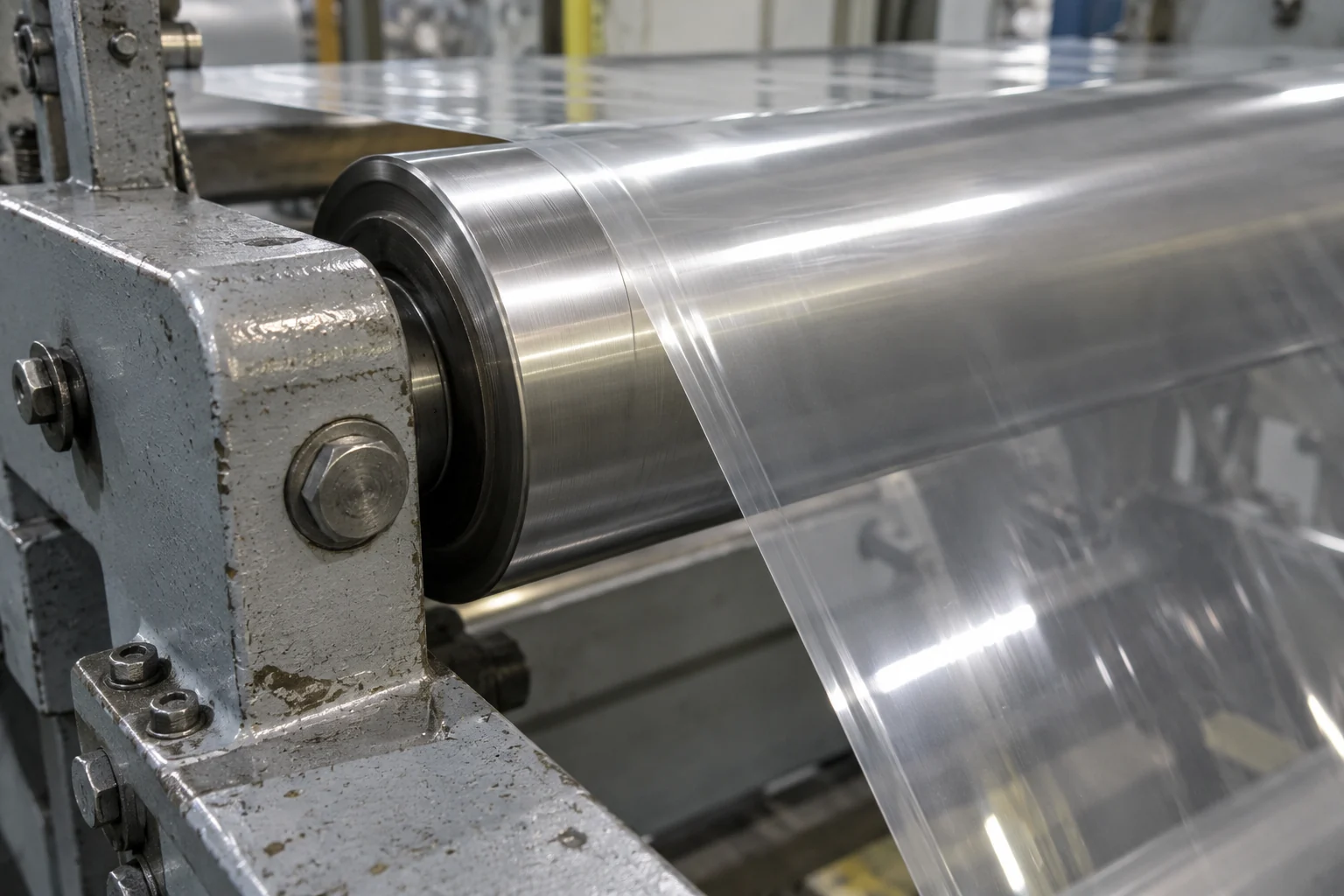
A clear flexible plastic film web passing over a single brushed steel idler roller mounted in a grey cast-iron converting frame.
Public technical literature from ASTM International, Diversified Enterprises, and Enercon Industries identifies six distinct reasons a press run can show passing dyne numbers yet fail an adhesion check:
- Wetting tension dropped between the unwind and the print station. Diversified Enterprises’ usage notes (checked 17 October 2026) state that a virtually immediate loss of 10 dynes/cm is possible after corona treatment due to contact with process rolls (especially heated metal rolls), surface blooming of slip or antistatic additives, and interfacial transfer between treated and untreated faces inside the wound roll. It advises printers and coaters to test the roll before mounting it and again as soon before the print station as possible.
- The ink system required higher surface energy or slower leveling than an older solvent benchmark. In Diversified Enterprises’ surface treatment discussion, Russell E. Smith notes that marginal treatment levels of 34 to 38 dynes/cm that worked for earlier solvent inks led to pinholes, fisheyes, and ink liftoff with waterborne and energy-cured (UV) systems, which required 40 dynes/cm and higher at the press. The same source notes that waterborne and UV formulations have higher surface tension and lower tolerance for contaminants, additives, and short-chain polymer fractions, while UV inks also carry higher viscosity and tend to shrink during curing. Meanwhile, ASTM D2578-23 Note 3 states that while 35 dynes/cm or higher has generally been acceptable for Type 1 polyethylene tubular film in commercial flexographic printing, no generally acceptable wetting tension level has been established for polypropylene film.
- Overtreatment degraded the outer polymer layer. Diversified Enterprises warns that attempting to raise surface energy by more than 10 to 12 dynes/cm at once via corona treatment is often inadvisable because overtreatment can cause pinholing, surface degradation, and accelerated treatment decay—leaving a weak boundary layer that wets easily but pulls away with the ink.
- Chemical primers changed the dyne reading. Diversified Enterprises notes that polyester (PET) film reading consistently below 42 dynes/cm is almost certainly chemically “print primed.” That primer lowers the measured dyne level slightly while making the surface accept a wider range of ink and coating compounds; judging a primed film by an unprimed corona dyne target misreads the substrate.
- Backside corona discharge reduced front-side treatment in one lane. When air trapped between the film and the treater ground roll ionizes, the reverse face picks up treatment while the print face in that lane stays light. Log both faces across five web lanes using our backside corona treatment map, and verify that the treater calculation inputs were not mixed by checking the corona watt-density unit audit. As Enercon Industries explains in Can you use Watt Density to Predict Dyne Levels? (published 11 October 2023), applied watt density relates nonlinearly to dyne level and cannot by itself guarantee adhesion.
- Failure occurred between ink layers or after moisture and temperature exposure. ASTM D3359-23 Section 1.5 points out that in multicoat systems (for example, a surface print with a white backup layer, process colors, and an overprint varnish), failure can occur between coats so that adhesion of the base layer to the substrate is not what failed. In addition, Diversified Enterprises notes that on-the-shelf delamination or ink liftoff can appear after a job has shipped, and pressroom troubleshooting threads (such as FlexoExchange
viewtopic.php?t=1912on UV-printed polypropylene bottle labels) report prints that pass an immediate dry tape pull off press but scratch off after immersion in icy water. Treat such community reports as a prompt to record post-print cure time and end-use conditioning (dry ambient vs water or cold soak), not as a standard specification.
For the wetting procedures themselves, use our dyne testing guide and contact angle goniometer guide.
Common mistake: Adjusting corona generator power before checking whether the ink split between coats or lifted only after water or cold exposure. Inspect the back of the peeled tape and the film spot first to see which layer parted.
Takeaway: Record incoming and pre-print wetting tension, primer status, ink layer sequence, cure settings, and post-print exposure before blaming the treater.
What variables change a tape test result on flexible packaging film?
Even on the same printed film sample, a tape pull will give conflicting results across shifts or between a converter’s lab and a supplier’s lab unless the tape, backing support, smoothing pressure, peel angle, removal speed, and room conditions are fixed in writing.
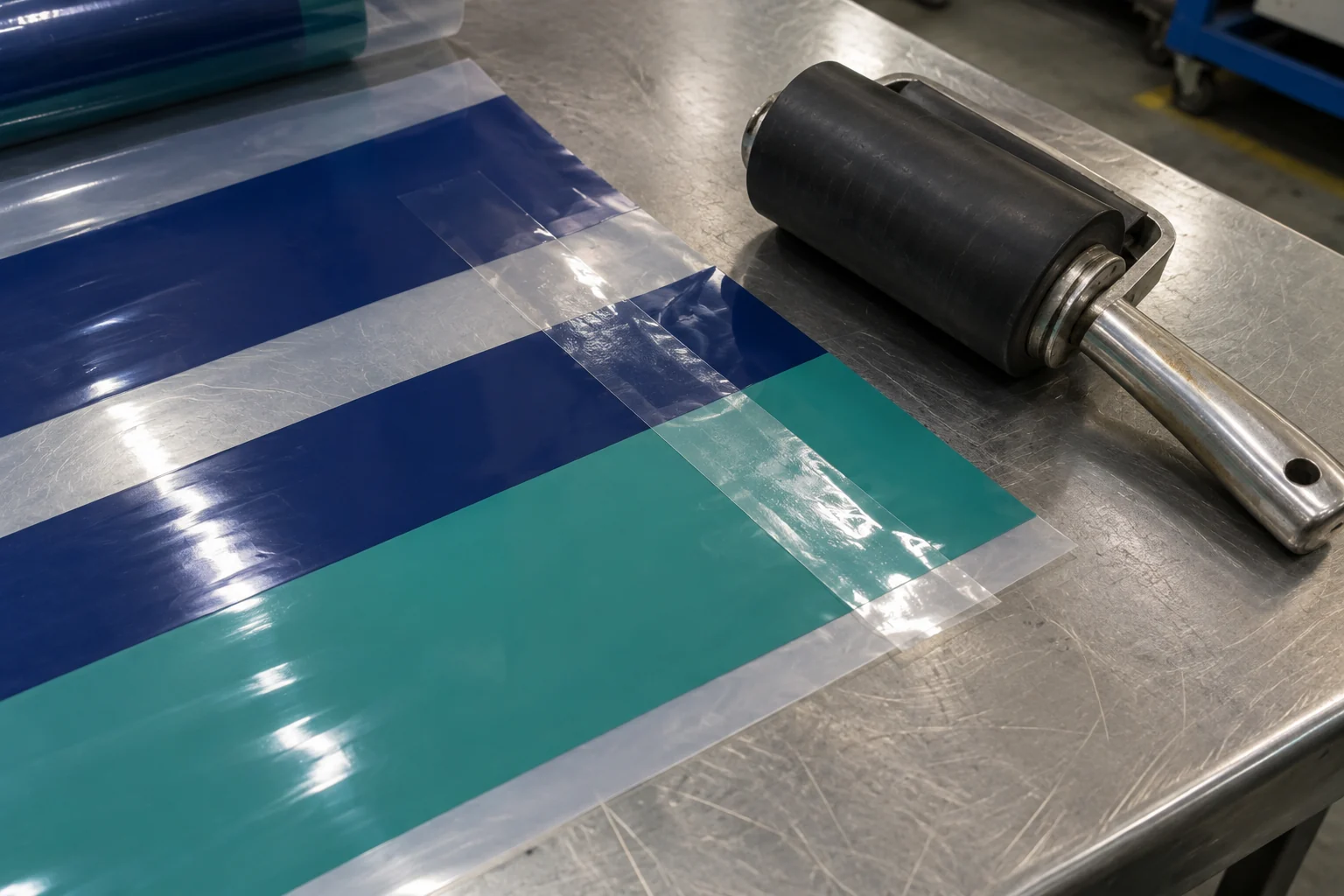
A clear adhesive tape strip pressed across solid blue and teal ink bands on a flexible plastic film sheet beside a weighted rubber hand roller on a steel bench.
The public Scope and Significance clauses of ASTM F2252/F2252M-25 and ASTM D3359-23 identify the mechanical and environmental variables that shift tape test outcomes:
| Variable group | Public standard statement | What changes if left uncontrolled | What to lock down on the record |
|---|---|---|---|
| Base-film integrity | ASTM F2252/F2252M-25 Section 1.1 limits the practice to flexible packaging materials whose surfaces are not damaged by applying and removing tape | Thin or extensible films stretch, delaminate internally, or tear, invalidating the visual ink-transfer check | Polymer, thickness, flat backing support, and a Yes/No check that the base film remained undamaged |
| Unit system consistency | ASTM F2252/F2252M-25 Section 1.2 states SI and inch-pound values are standard separately and shall not be combined | Mixing metric roller widths or speeds with imperial weights or dimensions creates non-equivalent test setups | Declare SI only or inch-pound only for the entire test record |
| Tape selection and coating affinity | ASTM D3359-23 Section 5.4 states a given tape may not adhere equally well to different coatings due to composition and topology, and no single tape fits all coatings | Switching tape brands, adhesive chemistries, or aged rolls changes bond grip on the ink or overprint varnish | Tape manufacturer, product designation, width, lot number, and storage condition agreed by both parties |
| Application pressure and smoothing method | ASTM F2252/F2252M-25 Section 3.2 states inter-laboratory disagreements can be reduced by defining and controlling the pressure and method of tape application (for example, using a weighted roller) | Light finger smoothing traps micro-air pockets over ink texture; heavy rubbing increases adhesive wet-out | Application tool (e.g., weighted roller mass and pass count, or defined manual applicator) and dwell time before pull |
| Peel angle and pull rate | ASTM F2252/F2252M-25 Section 3.2 and ASTM D3359-23 Section 5.6 state peel angle and pull rate must be controlled; D3359 5.6 notes peel force changes dramatically with angle and rate due to backing and adhesive rheology | A slow 90° peel and a rapid 180° snap apply different tensile and shear stresses to the ink-film interface | Agreed peel angle (for example, pulled back close to 180° or another specified angle) and removal rate rule |
| Ambient temperature and humidity | ASTM D3359-23 Section 5.3 notes temperature or relative humidity extremes affect tape or coating adhesion; Diversified Enterprises recommends 20 to 25 °C (and 40–60% RH in its test procedure) | Warm or humid pressrooms soften pressure-sensitive adhesives and retard waterborne ink drying | Ambient temperature (°C) and relative humidity (% RH) at the test bench |
| Operator consistency | ASTM D3359-23 Section 5.5 notes accuracy and precision depend largely on operator training and consistency in tape removal and visual assessment | Different technicians judge minor pinholes or edge pick differently | Operator identifier and agreed visual reference description |
Because static charge on a moving or freshly unwound web can attract dust onto the print face before ink deposition and cause localized pinhole lift-off, record whether static was present or neutralized; see measuring static on a moving film web and removing static from plastic film for those checks.
Takeaway: Do not write “passed tape test” on a QC log without naming the tape, smoothing method, dwell window, peel angle, pull rate, and room conditions.
What belongs on a supplier-review tape test record?
A reviewable ink adhesion record pairs the substrate and cure history with the controlled tape variables and the mutually agreed acceptance criterion so that the converter, film producer, and ink supplier are reading the same event.
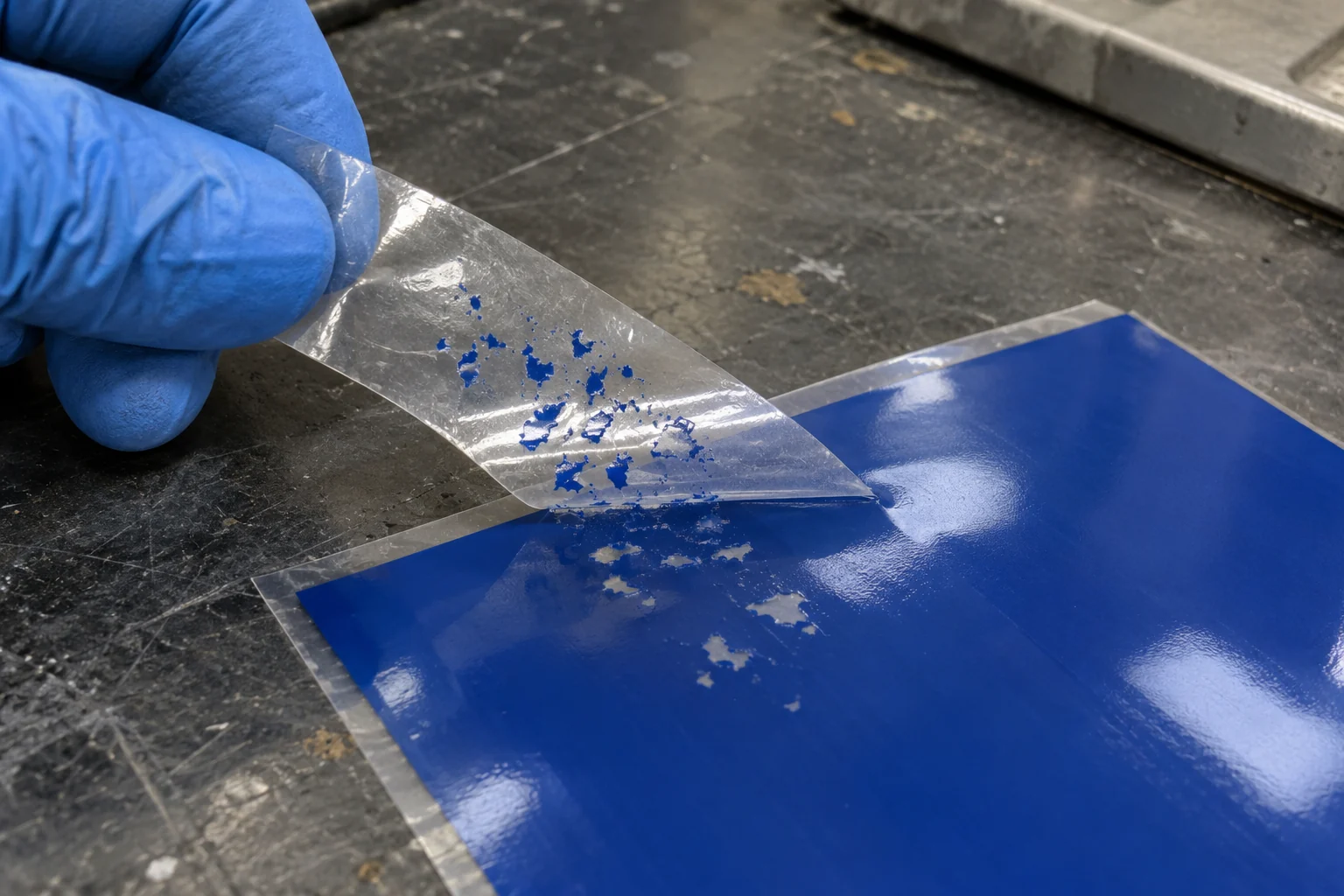
A blue-nitrile-gloved hand peeling a clear adhesive tape strip at a low angle from a dark blue printed plastic film sample, showing small blue ink flecks transferred onto the tape adhesive and matching bare patches on the film.
Download the blank tape test record sheet (CSV). In the table below, leave any unmeasured or unconfirmed cell blank or enter Unknown / verify on the unit. Do not fill in a guessed dyne value, a generic tape model, or an unagreed pass percentage.
| Record block | Field to record | Your entry | Source or agreement boundary |
|---|---|---|---|
| 1. Sample & web identity | Job, reel, and lot identifier | Converter production ticket and supplier roll tag | |
| 1. Sample & web identity | Substrate polymer, structure, and thickness | Film data sheet; keep SI or inch-pound units consistent (ASTM F2252-25 1.2) | |
| 1. Sample & web identity | Supplier pretreatment or chemical primer | Corona, flame, plasma, or print-primed (note PET <42 dynes/cm primer rule, Diversified Enterprises) | |
| 1. Sample & web identity | Cross-web lane positions tested | Operator edge, 1/4, center, 3/4, drive edge | |
| 2. Wetting history | Wetting tension before unwind | ASTM D2578-23 (dynes/cm) or ASTM D5946-24 (°); leave blank if not measured | |
| 2. Wetting history | Wetting tension immediately before print station | Isolates web-handling decay (up to 10 dynes/cm possible, Diversified Enterprises) | |
| 2. Wetting history | Reverse-face wetting check | Checks for backside corona treatment at the same lanes | |
| 3. Ink, cure & conditioning | Ink system and printed layer sequence | Solvent, waterborne, or UV; list primer, white backup, color, and overprint varnish order | |
| 3. Ink, cure & conditioning | Dryer temperature/airflow or UV lamp output log | Press run log at the time the sample was pulled | |
| 3. Ink, cure & conditioning | Elapsed time from printing to tape pull | Distinguishes immediate off-press screening from post-cure or aged-roll checks | |
| 3. Ink, cure & conditioning | Pre-test conditioning exposure | Dry ambient, heat aging, water soak, or ice-water immersion duration | |
| 3. Ink, cure & conditioning | Bench temperature and relative humidity | ASTM D3359-23 Section 5.3; Diversified recommends 20–25 °C | |
| 4. Tape application & pull | Tape brand, product code, width, and lot number | Jointly specified by user and producer; no single tape suits all coatings (ASTM D3359-23 5.4) | |
| 4. Tape application & pull | Flat backing plate under sample | Smooth surface preventing film crease during tape application | |
| 4. Tape application & pull | Application pressure and smoothing method | Weighted roller mass/passes or defined smoothing method (ASTM F2252-25 Section 3.2) | |
| 4. Tape application & pull | Dwell time on ink before removal | Seconds between smoothing completion and peel start | |
| 4. Tape application & pull | Peel angle and removal speed | Defined angle and pull rate (ASTM F2252-25 Section 3.2; ASTM D3359-23 Section 5.6) | |
| 5. Inspection & sign-off | Was the base film undamaged by the tape pull? | Must be Yes for ASTM F2252/F2252M-25 Section 1.1 to apply | |
| 5. Inspection & sign-off | Failure mode and plane observed | No transfer, ink-to-film lift, inter-coat split (ASTM D3359-23 1.5), or pinhole picking | |
| 5. Inspection & sign-off | Jointly agreed acceptability criterion | Written pass/fail rule determined by user and producer (ASTM F2252-25 Section 3.3) | |
| 5. Inspection & sign-off | Disposition and reviewer sign-off | Pass, Hold, or Retest with converter and supplier dates |
Takeaway: A complete record separates where the bond failed (ink-to-film vs inter-coat) and preserves blank cells wherever a variable was not measured or agreed.
When this method selector and record sheet do not apply
This guide is limited to choosing between public ASTM evaluation scopes and recording variables for printed or coated flexible plastic film. Stop and use a dedicated procedure in these situations:
- You need the full step-by-step operating text of a paid ASTM or ISO standard. Only the public Scope and Significance & Use clauses of ASTM F2252/F2252M-25, ASTM D3359-23, ASTM D2578-23, and ASTM D4541-22 were reviewed for this article. Obtain the active licensed standard directly from ASTM International or ISO before claiming standard compliance in a contract or audit.
- The tape stretches, delaminates, or tears the base film. ASTM F2252/F2252M-25 Section 1.1 explicitly restricts the practice to flexible packaging materials whose surfaces are not damaged by tape application and removal.
- The failure is a heat-seal seam opening or a laminated multi-ply bond peel. Tape tests on an exposed ink face do not measure heat-seal strength or inter-ply laminate peel force, which use tensile peel testing on sealed or laminated strips.
- You need a universal pass percentage, tape model number, or roller weight. ASTM F2252/F2252M-25 Section 3.3 leaves acceptability criteria to joint agreement between user and producer, and ASTM D3359-23 Section 5.4 notes that no single tape is suitable for all coatings.
- Food-contact migration, set-off, or odor compliance is at issue. Mechanical ink retention on tape does not evaluate chemical migration or regulatory compliance for food, medical, or cosmetic packaging.
Browse additional process and verification guides in our Films and Printing section or the full technical article index.
Frequently asked questions
Does a passed dyne test prove ink adhesion on plastic film?
No. ASTM D2578-23 Section 5.2 states that measured wetting tension relates to ink, coating, or adhesive retention only through experience and is not in itself a completely acceptable measure of adhesion. Verify cured print retention directly with an agreed adhesion test.
Can ASTM D3359 cross-cut tape testing be used on flexible plastic film?
ASTM D3359-23 was developed for assessing relatively ductile coating films on metallic substrates over cuts made in the coating, and Note 1 states that precision and bias data on non-metallic substrates such as plastic is lacking. For flexible packaging materials whose surfaces are not damaged by tape application and removal, ASTM F2252/F2252M-25 is the dedicated tape practice.
What pass percentage does ASTM F2252 specify for ink tape tests?
None. ASTM F2252/F2252M-25 Section 3.3 explicitly states that the practice does not address acceptability criteria and that those criteria must be jointly determined by the user and the producer of the product.
Method and sources
This guide was compiled on 17 October 2026 from live fetches of the public Scope and Significance & Use pages for ASTM F2252/F2252M-25 (updated 30 April 2025), ASTM D3359-23 (updated 7 March 2023), ASTM D2578-23 (updated 3 March 2023), and ASTM D4541-22 (updated 29 July 2022); live fetches of Diversified Enterprises’ published surface treatment discussion and dyne testing usage notes; and Enercon Industries’ technical article Can you use Watt Density to Predict Dyne Levels? (published 11 October 2023, archived 6 October 2026 and checked live 17 October 2026). Pressroom forum observations from FlexoExchange (viewtopic.php?t=1912) were reviewed only to identify real-world post-print water exposure questions, not as a technical standard.
We did not run laboratory tape pulls or purchase full paid ASTM standard texts for this article, and we do not prescribe tape part numbers, roller weights, peel speeds, or pass/fail percentages. The CSV templates are editorial recordkeeping aids. See About for our editorial independence policy. Updated October 2026.