A low number on a grounded roller sends the crew to the wrong span, and the film can still be charged. Read the electric field or the surface voltage where the web is in open air, use the meter as its manual says, and keep that setup when you check whether a neutralizer changed the web.
How to measure static electricity on a moving film web is to read the field, or the surface voltage tied to that field, on a free span, and to repeat the reading only when the setup matches. Fraser Anti-Static, in a note last updated 27 November 2020, says the coulomb charge in the material is not what industry measures. The accepted method is field strength or surface voltage. KEYENCE, in its surface-potential precautions read on 11 October 2026, says a longer gap or a smaller target lowers the number, and film against grounded metal can sit close to 0 V while it is still charged. This site has no reading of its own, and these sources do not name a voltage that is safe on every web.
| What you hold still | What to copy from the job | Why the next number moves |
|---|---|---|
| Distance | The gap named in the meter manual | KEYENCE: a longer gap lets fewer field lines reach the meter, so the number falls |
| Target size | Web width, or the patch the manual treats as large enough | KEYENCE: a target smaller than the detecting range reads low |
| Material face | The face the meter points at | The second reading has to see the same face |
| Speed | Line speed at the measurement | Fraser’s elimination guide: faster webs generate a higher charge |
| Position | The same free span, on the same side of the neutralizer | A roller is a different geometry from open air |
What does the meter report?
It reports field strength or surface voltage. It does not hand you the charge of the web in coulombs.
Fraser’s measurement note says static electricity is a surplus or deficit of electrons, and that quantity is the coulomb. The same note says it is not possible to measure that charge in the material, so industry measures the electric field or the surface voltage related to the charge. Field strength, in that note, is the voltage gradient at a point. Fraser’s note sets capacitance at a stated measuring distance on its surface-voltage meter, so on that instrument the voltage tracks charge at that distance. Use the distance in the manual for the meter you have.
KEYENCE calls the shop instruments surface potential sensors or electrostatic field meters. The display is a voltage. The same page says a surface potential meter senses field strength, which is why the number depends on distance. KEYENCE also describes a feedback type that reduces that dependence. Any range limit stays in the manual for that meter. Use the meter the manual in front of you describes. This page does not pick a brand.
A coulomb total is a different job. KEYENCE describes a coulomb meter that touches a conductor and moves the charge onto a capacitor, and a Faraday cage for an object that fits inside the cage. The touch method removes the charge, so it can be done once. Neither method is the moving-web check in these sources. Leave coulomb totals off this record.
Where on the free span do you take the reading?
Take it where the film has left the roller and is in open air. Take one reading upstream of the neutralizer and one downstream, in that same kind of span.
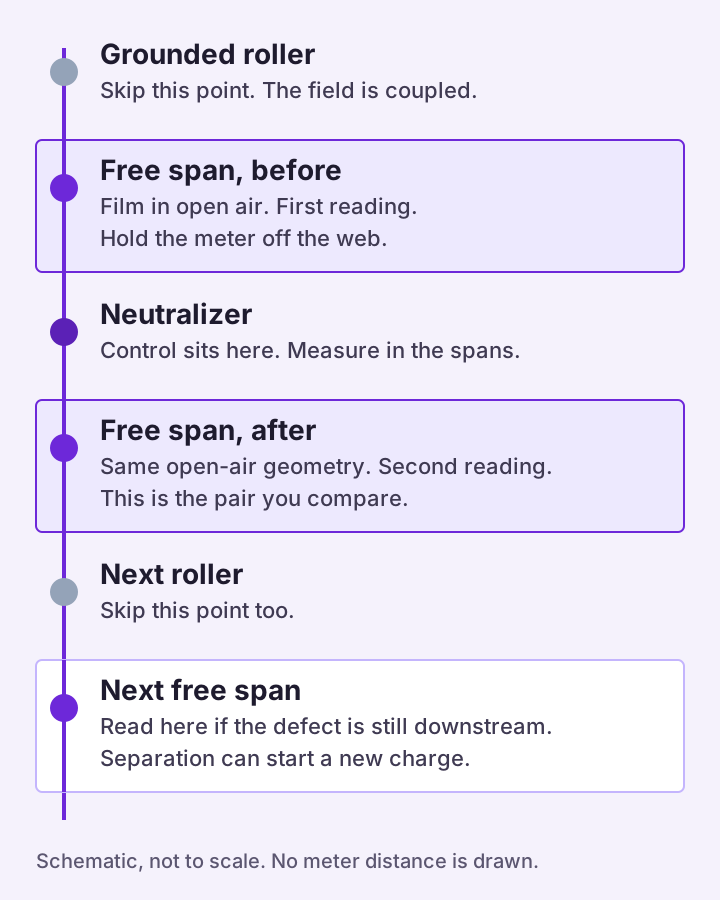
Schematic, not to scale. Purple spans are the comparison points. Grey points are roller contact. No bar spacing and no meter gap are specified.
Fraser’s measurement note says the field lines stand perpendicular to the charged material in open air, and that this is when a reading is usable. When the web passes over a roller, the charge couples with the roller and seems to disappear. The same paragraph says an accurate measurement near the roller is not available, and that the field returns once the material leaves the roller. The elimination guide says the same thing for neutralization: while the film touches another body, the field is coupled into that body and is not available to measure or to neutralize. Wait until the web has separated.
The pair that answers “did the neutralizer change it” is the free span before the bar and the free span after the bar, both in open air. The next free span, after the following roller, answers a different question: whether separation put charge back on the web. Where to place the bar is in removing static from plastic film.
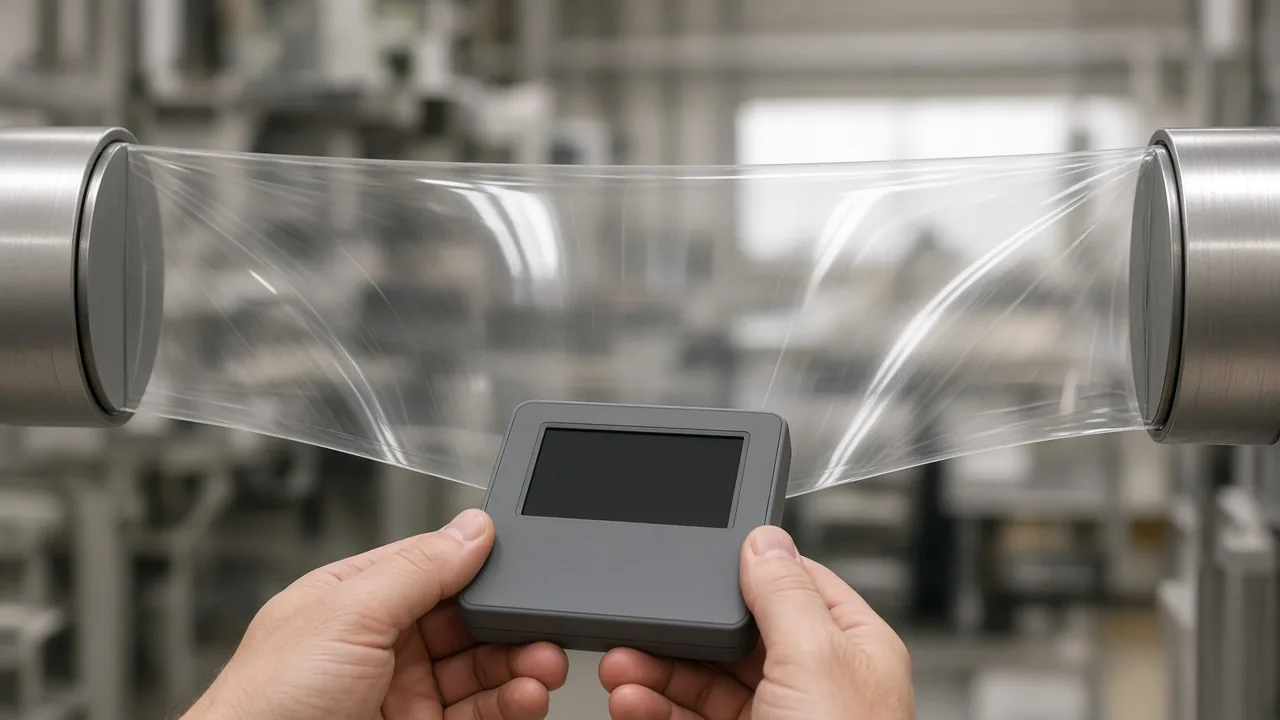
Illustration. The meter is off the film in the open span. Use the distance in that meter’s manual and keep the same gap for the next reading. The gap in the picture is not a distance to copy, and the screen shows no reading.
Takeaway: Compare two open-air readings. A number taken on the roller is a different measurement.
Common mistake: Treating the low number on the roller as proof the film is clear, then judging the neutralizer against that number.
Why can a grounded roller read low?
The field ends in the roller, so the meter is looking at a coupled web.
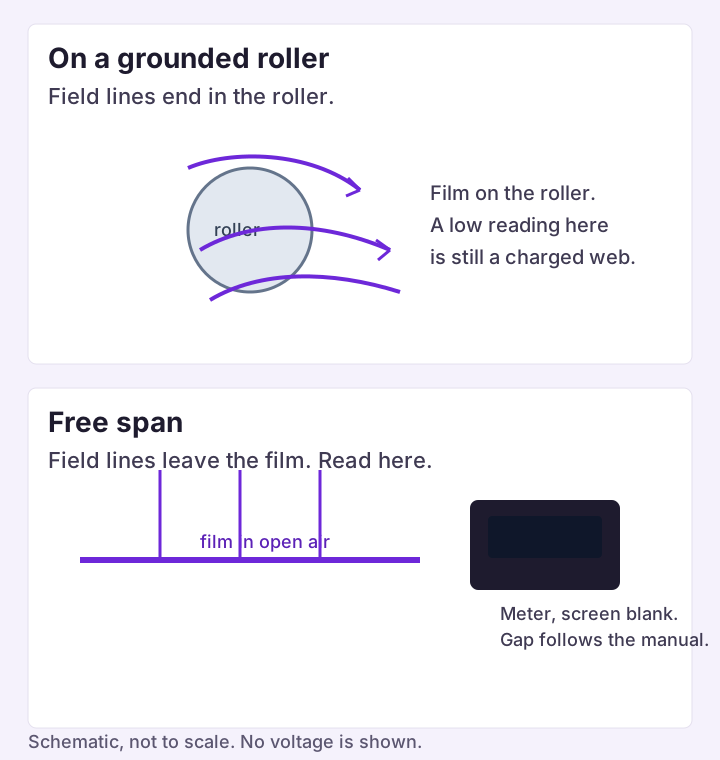
Schematic, not to scale. The roller drawing is why a low number there is still a charged web. The free-span drawing is where the comparison belongs. No voltage is shown.
KEYENCE’s precautions use a film against metal, and metal plates with a resin film between them. Even when those parts are charged, the potential can sit close to 0 V, because an inductive charge on the grounded metal side cancels the indication. The page says to be careful when the target is in contact with grounded metal. Fraser describes the web version of that cancellation: on the roller the field seems to disappear, and it is back in the next open span.
That 0 V figure is KEYENCE’s description of a cancelled indication. It is not a limit for a safe web, and it is not a reading from this site.
Takeaway: If the only low number you have was taken on the roller, you still do not know the charge on the free span.
Which conditions have to match?
Distance, target size, face, speed, and position. Change one of them and the two voltages are no longer the same measurement.
KEYENCE states the distance effect directly: the count of field lines that reach the instrument changes with distance, so a larger gap than the reference distance lowers the value, and a smaller gap raises it. The same section says many instruments assume a very large target. A target that fills the detecting range displays the value the instrument is built for. A target smaller than that range displays a smaller value. Write down the gap from the manual, and write whether the web is the large target that manual expects. Use both again for the second reading.
Write the face the meter points at. Fraser’s elimination guide says a thicker film can hold an independent charge on each face, and that both faces then need a check. The thickness where that guide draws the line stays in that guide. This page does not turn it into a cutoff. The record still names the face, so the second reading looks at the same side.
Write the line speed. The elimination guide says static generation is proportional to web speed, and that a faster web creates a higher charge. A before-and-after pair taken at two speeds mixes the neutralizer with a speed change. The guide’s figures for named bars and for a speed where extra bars were once used stay with those bars. Do not copy them onto this record.
Write the position in web order: free span before the neutralizer, free span after it, or the next free span after the following roller. Upstream and downstream of the bar are both valid open-air points. They answer different questions, so they are separate rows.
If the meter shows a sign, write the sign with the number. The cells below stay empty until you take the reading.
Blank record for the two readings
Copy the distance from the meter manual. Leave every voltage cell empty. This page has no number to put there.
| Position on the web | Distance | Target size | Material face | Speed | Reading before | Reading after |
|---|---|---|---|---|---|---|
| Free span before the neutralizer | ||||||
| Free span after the neutralizer | ||||||
| Next free span, after the following roller |
Use the meter as its manual says: the same distance, the same aim, and the same range the manual sets for that web. Fill “reading before” on the upstream free span and “reading after” on the downstream free span. The third row is for the span after the next roller, when you need to see whether charge came back. If you only have one pair, leave the unused row empty.
Takeaway: A filled distance cell and an empty voltage cell is the right state of this table before anyone measures.
When a lower reading still leaves the defect
A lower downstream reading says the field at that span changed. It does not say the rest of the machine is clear.
Fraser’s elimination guide says charge can be generated again at later rollers, so a neutralizer placed too early is undone by the next separation. If dust, cling, or a shock is still at a station downstream of your pair, read the next free span and treat that row as its own comparison. The placement of the bar, and the reason a grounded frame does not discharge an insulating film, is the subject of removing static from plastic film.
Other notes from this publication are in the article archive.
When this record does not apply
Use it for a moving film web and a non-contact field or surface-voltage reading. A coulomb meter on a small conductor, or a Faraday cage around an object that fits the cage, is the other measurement KEYENCE describes, and it is outside this table. A classified area follows the plant procedure and the meter manual. This page does not specify grounding construction, a universal safe voltage, or a meter to buy.
Method and sources
The field behavior on a roller and in open air is from Fraser Anti-Static, “Measurement of Static Electricity,” last updated 27 November 2020, read 11 October 2026. The distance and target-size precautions, the near-zero reading of film against grounded metal, and the coulomb-meter and Faraday-cage limits are from KEYENCE, “Measuring Static Electricity,” read 11 October 2026. The free-air rule, regeneration on later rollers, speed and generation, and charge on two faces are from Fraser’s elimination guide, last updated 27 November 2020, read the same day. No test was run for this page. Updated October 2026.