Backside treatment fails the one-side job: the print face in that lane is under-treated, and the seal face can pick up treatment it was not meant to have. Air trapped between the film and the ground roll becomes ionized, and corona treatment occurs on the back. Record both faces across the web before anyone changes tension, speed, or the roll. This page does not set watt density, gap, or a dyne target.
Backside corona treatment is discharge on the face that was meant to stay untreated. Enercon Industries, in Prevent Backside Treatment, published 10 October 2023, says it happens on bare-roll and covered-roll systems when air is trapped between the backside of the web and the ground roll. That air becomes ionized, and corona treatment occurs. The same note says the back can gain surface energy while the front is under-treated, and that bag making and sealing can see a change in the coefficient of friction. The only speed in that note is Enercon’s own condition: above 700 ft/minute, they say you should have a nip roll and a treater-roll drive. That figure is their guidance for that situation. Watt density and a dyne target are absent from the note, so those cells stay blank.
| What you record | Where it comes from | Why one front reading is not enough |
|---|---|---|
| Which face was supposed to be treated | The job ticket | The back can be treated while the front in that lane is under-treated |
| Front pattern at each lane | The wetting test you already run | A single spot hides a streak |
| Back pattern at the same lanes | The same test, other face | The trapped air treats the back |
| Wrinkle, scalloped edge, or bagging | Look at the web | Enercon lists these as material conditions that promote backside treatment |
| Nick, gouge, or debris on a covered roll | Look at the roll face | Enercon lists a damaged covering and a dirty ground roll |
| Line speed actually running | The line, that reel | Line speed is one of their five causes. The cell is a record, not a setpoint |
| Watt density | Blank. Not in the note this page uses | |
| Dyne target | Blank. Not set on this page |
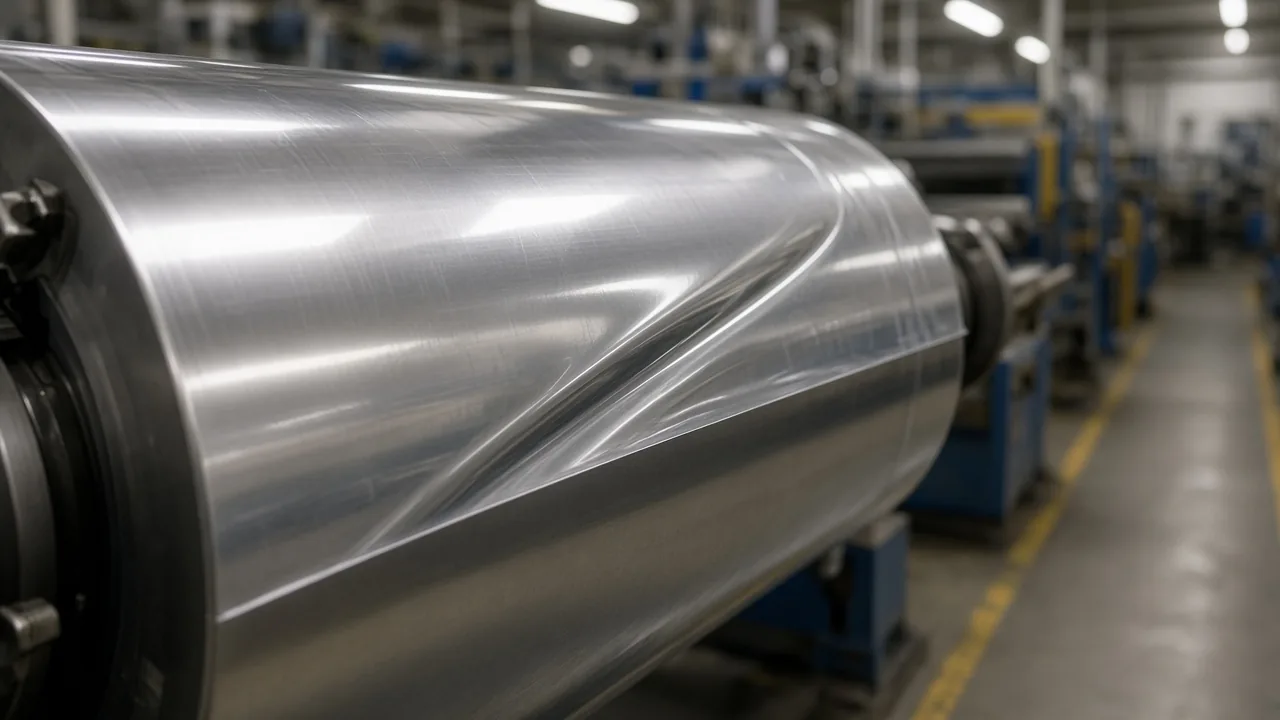
Clear film on a steel roller, with a wrinkle holding a gap along the roll.
What is backside corona treatment?
It is corona on the back of the web from air trapped against the ground roll, and it leaves the front under-treated in that area.
Enercon’s note of 10 October 2023 says backside treatment mitigates the effect of surface treating. In some cases it results in under-treatment of the substrate. It can also raise the energy of the backside and create processing problems. In bag making and seal applications, the note says backside treatment can alter the substrate’s coefficient of friction, and that this causes problems converting the material downstream. No friction number is in the note.
The same note says the problem is possible on both bare-roll and covered-roll treating systems.
Takeaway: Treat a light front and a wet back in the same lane as one event, not as two unrelated readings.
Why does trapped air treat the back?
The air under the web ionizes, so the discharge treats the back.
Enercon says this occurs when air is entrapped between the backside of the web and the ground roll. The air beneath the web becomes ionized, and corona treatment occurs. The note splits causes into material imperfections and operational problems. Wrinkles, scalloped edges, and bagging are the material conditions it names. Web tension and system cleanliness are the operational conditions it names. Its list of common causes is material imperfections, web tension, line speed, a dirty ground roll, and a damaged roll covering.
How to run the wetting test, and which face you mark, is in the dyne testing guide. Copy that method. Do not copy a dyne number from it onto this map.
Takeaway: The mechanism in this note is trapped air on the ground roll. A dyne target is a different page.
What does the two-sided map record?
It records the front pattern and the back pattern at the same lanes, plus what you saw on the web and on the roll. Number cells stay empty until you measure, and two of them stay empty anyway.
Enercon says that examining the results of simple surface energy measurements can often identify the probable cause. The table below is that record. It is not a diagnosis, and it is not a setpoint.
| Lane | Front-face pattern | Back-face pattern | Web or roll note |
|---|---|---|---|
| Operator edge | |||
| Quarter width | |||
| Center | |||
| Three-quarter width | |||
| Drive edge |
Fill a pattern cell from the wetting test on that face. If you did not test a lane, leave the cell blank. Do not average the five lanes into one number.
Common mistake: Reading only the front, then treating a light lane as low power. Enercon says backside treatment under-treats the front in the same area. The back cell for that lane comes first.
Which pattern matches a wrinkle, bagging, or the roll face?
Match the shape on both faces to the pattern Enercon describes, and write the lane. The match is a note for the supplier. It is not a completed repair.
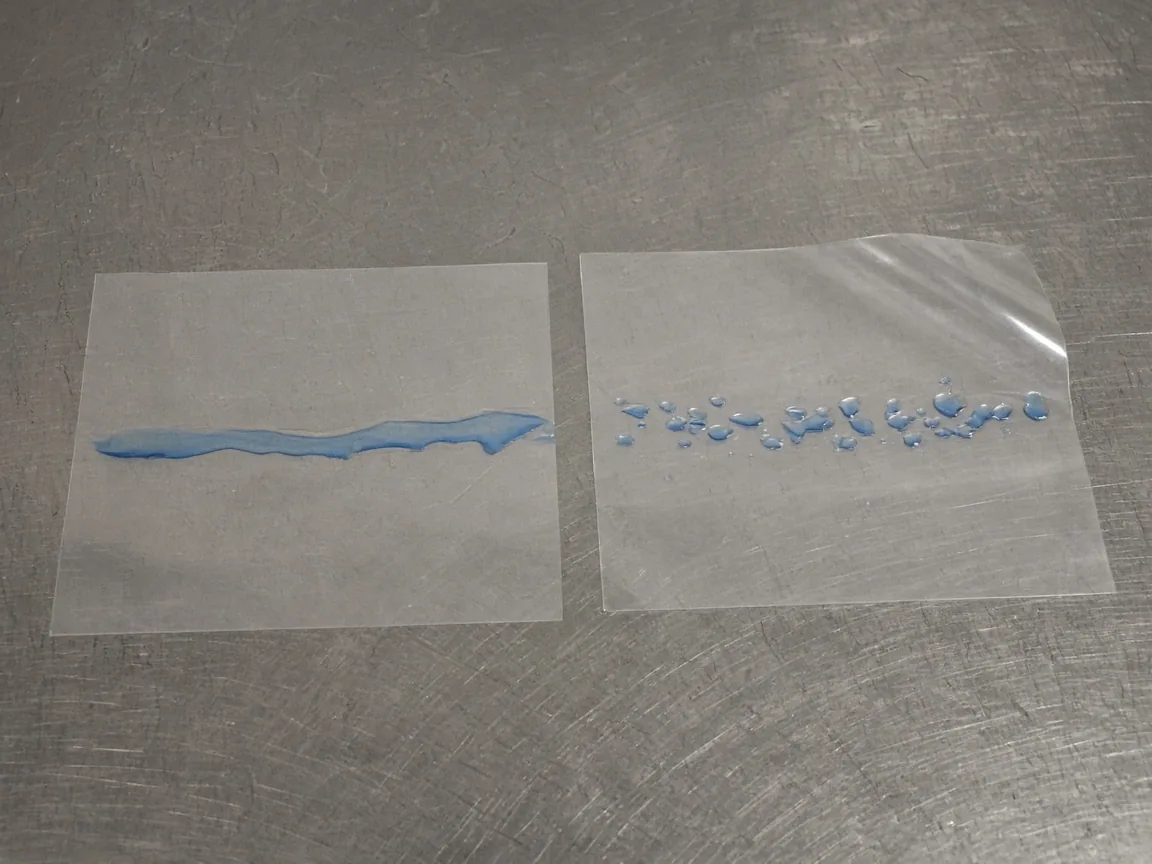
Two pieces of clear film on a scratched steel table. The left streak stays continuous. The right streak has broken into beads.
| What the two faces show | What Enercon’s 10 October 2023 note associates | Write this down | Set from this page |
|---|---|---|---|
| Back wets along a wrinkle; front is light in that lane | A wrinkled web. The note points to a distinct surface-energy pattern from wrinkles | Lane, which face, that a wrinkle was visible | |
| Back wets in a patch at the center or an edge; front is light there | Bagging. The note points to a blob pattern from bagging at the center or the edge | Center or edge, both faces | |
| Back wets at a scalloped edge | Scalloped edges, listed with wrinkles and bagging as material conditions | Which edge | |
| Back wets where a covered roll has a nick, a gouge, or debris | A damaged roll covering, or a dirty ground roll | What is on the roll, and the lane | |
| Front wets and the back does not, on the lanes you tested | Not described as the air-gap pattern in that note | Say the back was untreated at those lanes |
The last column stays blank. Tension, gap, power, a patch method, and a dyne number are not filled from this table.
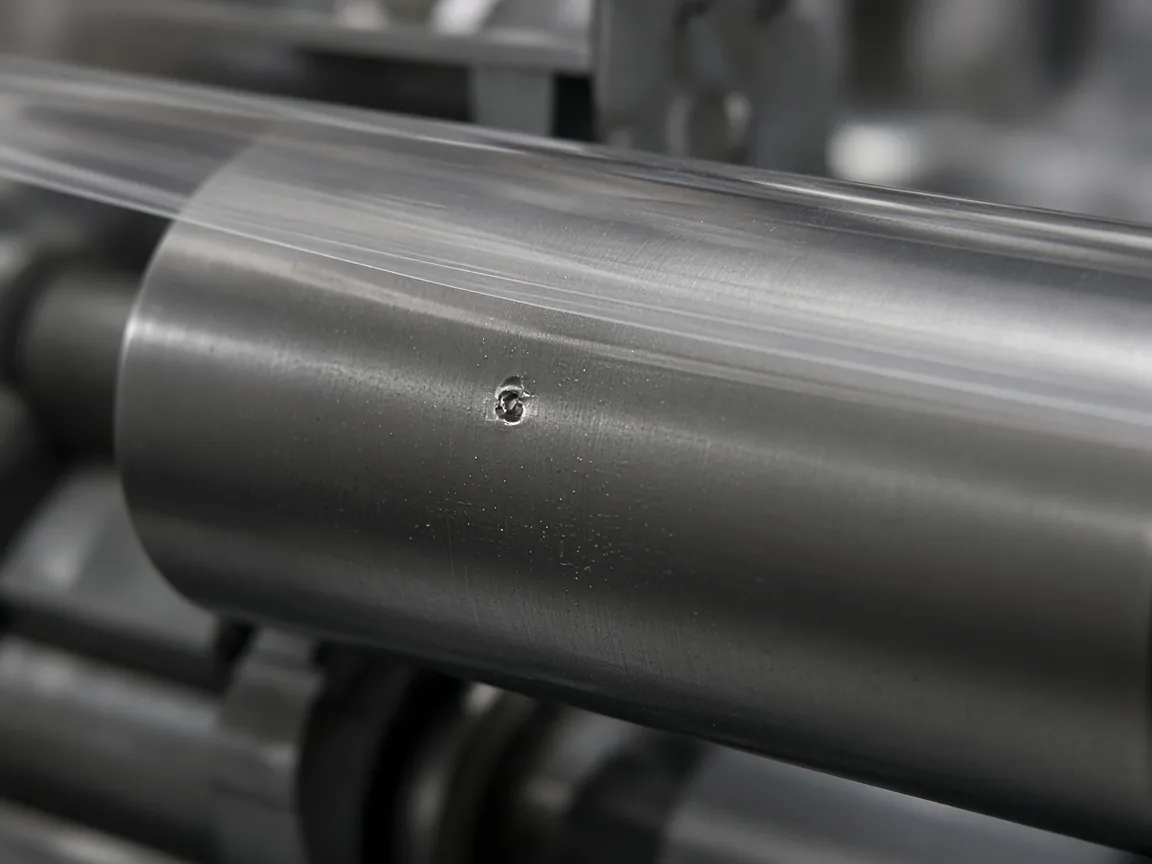
A small nick in a steel roller, with clear film running above the metal.
Enercon’s own sequence, from the same note, is a list to hand over, not a set of values for this page:
| Their check | What the 10 October 2023 note says | Copied onto this line |
|---|---|---|
| Threading | First check that the web is threaded properly | |
| Flat on the roll | Next check web tension, and that the substrate is flattened on the ground roll. It should travel across the roll smoothly, at proper tension, so air pockets do not form | |
| Tension that will not hold | Consider a nip roll and a treater-roll drive | |
| Above 700 ft/minute | They say you should have a nip roll and a drive. The figure is theirs, for that condition | |
| Those steps do not stop the back treatment | Reduce speed, to reduce the laminar airflow that travels across the web | |
| Covered roll | Look for nicks, gouges, or debris. Patch them, clean them, or replace the roll |
Takeaway: 700 ft/minute is Enercon’s condition for a nip and a drive. It is not a speed to write into the map.
What do you hand to the equipment and film suppliers?
Hand the filled map, the web notes, and the roll-face notes. They judge the cause. This page does not name a repair.
| Item | Why it is on the sheet | Your entry |
|---|---|---|
| Face that was supposed to be treated | Separates a back-face result from a front-face result | |
| Five lanes, both faces | The pattern is what Enercon says can point at the cause | |
| Wrinkle, scalloped edge, or bagging, and where | Those are the material conditions in the note | |
| Bare roll or covered roll | The note says both systems can trap air | |
| Nick, gouge, or debris, and the lane | Covered-roll causes in the note | |
| Speed the line was running | Line speed is one of the five causes. Leave 700 ft/minute out of this cell | |
| Watt density | Not in the note | |
| Dyne target | Not set here |
Takeaway: An empty watt-density cell and an empty dyne cell are the correct state of this sheet.
When this map does not settle the cause
Five lanes do not describe the rest of the reel, and a pattern match does not choose the repair.
Leave the cause open when any of these is true:
- A lane was not tested. That cell stays blank.
- The roll face was not looked at. A nick is then unknown.
- Only the front was tested. The back is then unknown.
- The treater is not a ground-roll corona station. The mechanism in this note is air trapped on that roll.
- The question is watt density, electrode gap, high voltage, or a dyne target. Those values are not in the note.
Enercon also tells its own readers to check threading and tension first, and it describes patching or replacing a damaged cover. Those lines stay in the table above as their words. They are not settings this page assigns.
Method and sources
The mechanism, the bare-roll and covered-roll scope, the wrinkle and bagging patterns, the five causes, the coefficient-of-friction line, and the 700 ft/minute nip-and-drive condition are from Enercon Industries, Prevent Backside Treatment, published 10 October 2023. The text was fetched 7 October 2026 and read 14 October 2026. No test was run for this page. No dyne level and no watt density were added. The speed cell on the map stays a record of the line you were running. Other notes on this site are in the article list. Updated October 2026.