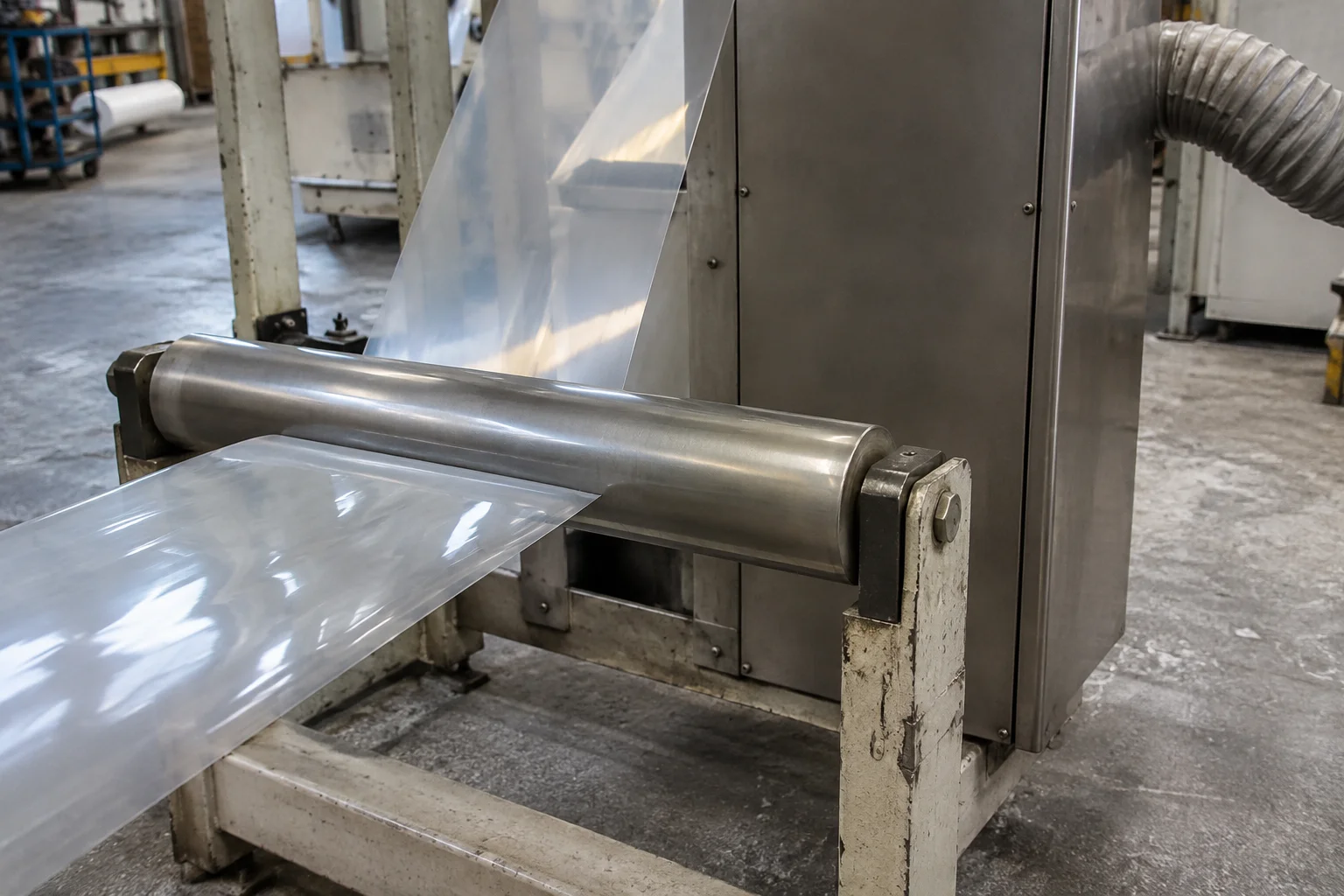
Wrong width definitions or mixed length units can produce a misleading comparison of corona-treatment inputs. Calculate corona watt density by dividing power supply output by width, running line speed and the number of treated sides, using the width and power definitions specified for that equipment.
The calculation describes treatment input per passing surface area. It does not establish a dyne target or prove adhesion. Use the audit below when comparing records after a change of reel width, speed or treated faces.
Start with the formula and its units
For the moving-web convention used in Enercon’s calculator, write:
WD = P ÷ (b × v × n)
| Variable | Input and unit | What to confirm |
|---|---|---|
| P | Power supply output, W | Which output the reading represents; convert kW to W |
| b | Width, ft or m | The width definition for this calculation |
| v | Running line speed, ft/min or m/min | Use the same length unit as b |
| n | Number of treated sides | Match the faces and power boundary being counted |
Enercon’s calculator labels b as electrode width. Its separate article on predicting dyne levels labels the denominator web width. QC Electronics describes treat width in its explanation but labels the calculator field electrode width. These labels need a documented interpretation before you transfer a calculation between machines.
The unit follows from the denominator: W ÷ [ft × (ft/min)] = W·min/ft². With metres and metres per minute, it is W·min/m². This is our dimensional reading of the formula. Some calculator displays use the wording “watts/ft²/min”; retain the full formula alongside that label so the minute is not accidentally inverted.
Indeeco’s heater explanation uses power divided by effective heated surface area, expressed in W/in². That is a heat-flux calculation with no moving-web speed term. A heater watt-density value cannot be compared directly with the corona calculation above. Indeeco’s heater definition, published 3 November 2014, provides the separate context.
Audit width and power before entering numbers
A correct division cannot resolve an undefined input. Record the manufacturer’s terminology beside your number instead of silently replacing one width with another.
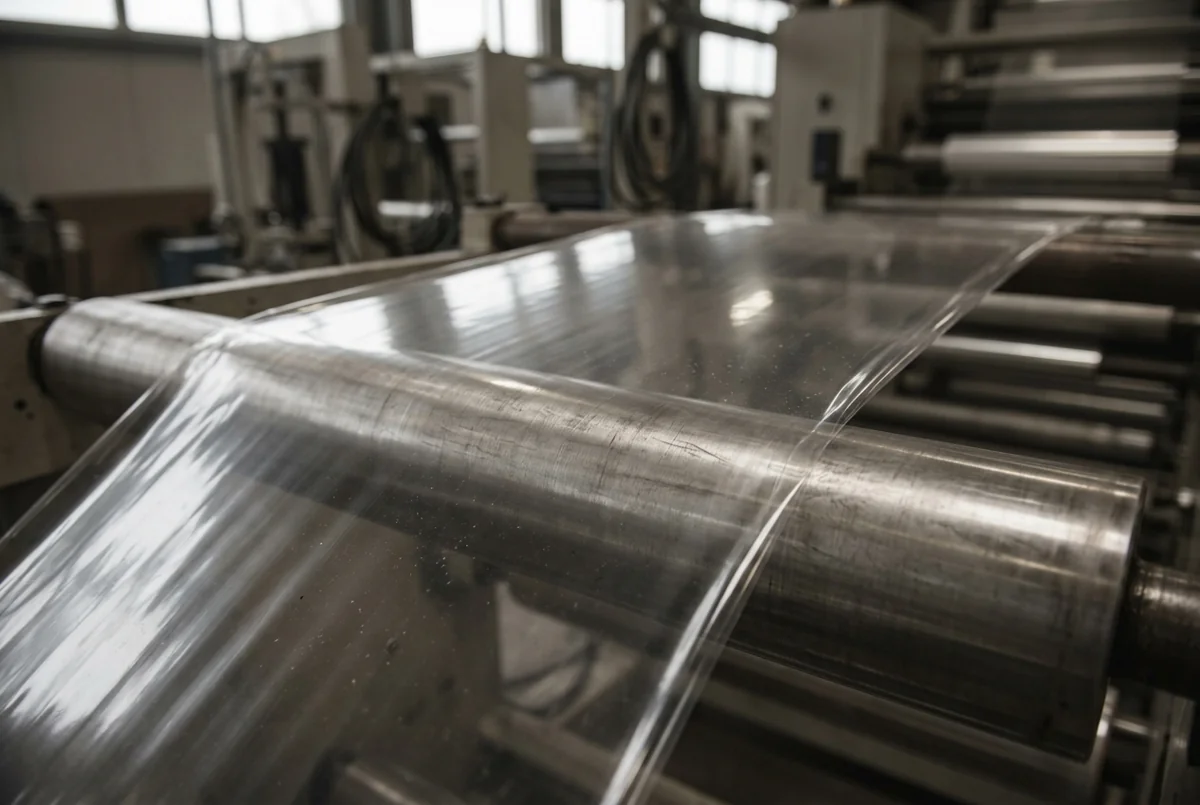
A clear film web spans part of a wider steel roller.
| Source checked on 15 October 2026 | Width wording | Audit question |
|---|---|---|
| Enercon, Watt Density Calculator | Electrode width | Which active electrode span does the equipment documentation specify? |
| Enercon, predicting-dyne-levels article | Web width | Does this station’s calculation actually use the current web width? |
| QC Electronics, calculator page | Treat width in prose; electrode width in forms | What definition applies to this unit’s setting and output? |
The photograph makes the distinction between film edges and roller ends visible; neither edge identifies an active treatment width by itself. Our recommendation is to record physical web width and the documented calculation width separately. If the latter is unclear, enter Unknown / verify on the unit and leave WD blank.
Apply the same discipline to P. Write down whether your source is an actual output reading, a commanded setting or a nameplate rating. Also record whether it belongs to one station, one face or a combined system. Do not assume these are interchangeable. This is a recordkeeping check, not a direction to measure electrical power or open equipment.
For a purchase or operating-cost comparison, use the corona treatment cost worksheet to record quote inclusions and site energy boundaries. A treatment-output figure alone does not supply the equipment’s electricity cost.
Reproduce the published example, then convert both lengths
Enercon publishes an example with 5,000 W output, 5 ft electrode width, 500 ft/min line speed and one treated side. Its result is 2. Repeating the arithmetic with explicit units gives:
5,000 ÷ (5 × 500 × 1) = 2 W·min/ft²
That reproduces a manufacturer’s example; it is not a recommended setting for your material. The original calculator supplies the inputs.
For a metric cross-check, convert both length quantities using 1 ft = 0.3048 m:
| Quantity | Published imperial input | Same input in metric |
|---|---|---|
| Power | 5,000 W | 5,000 W |
| Width | 5 ft | 1.524 m |
| Speed | 500 ft/min | 152.4 m/min |
| Treated sides | 1 | 1 |
| Calculated WD | 2 W·min/ft² | Approximately 21.53 W·min/m² |
5,000 ÷ (1.524 × 152.4 × 1) ≈ 21.53 W·min/m²
The metric arithmetic and rounding are our derivation from the published inputs. The physical example is unchanged; the numerical value changes because the area unit changes. As a check, dividing 2 by 0.3048² gives approximately 21.53.
Use this mismatch checklist before accepting a comparison:
| Possible mismatch | Check to make |
|---|---|
| A kW reading entered into a W field | Multiply kW by 1,000 before entering it |
| Width in inches, speed in ft/min | Convert width to feet first |
| Width in metres, speed in ft/min | Convert one length system so both inputs match |
| Width in mm, speed in m/min | Convert width to metres first |
| An imperial WD number compared with a metric WD number | Convert the area basis and write the complete unit |
| A width, side or power definition changes | Resolve that definition before doing a numerical comparison |
These are mathematical checks. They do not authorize a change to a power or speed setting.
Count treated faces within the same power boundary
The side count belongs to the same calculation boundary as P. A record for one face and a record for two faces need enough context to show what the power figure includes.
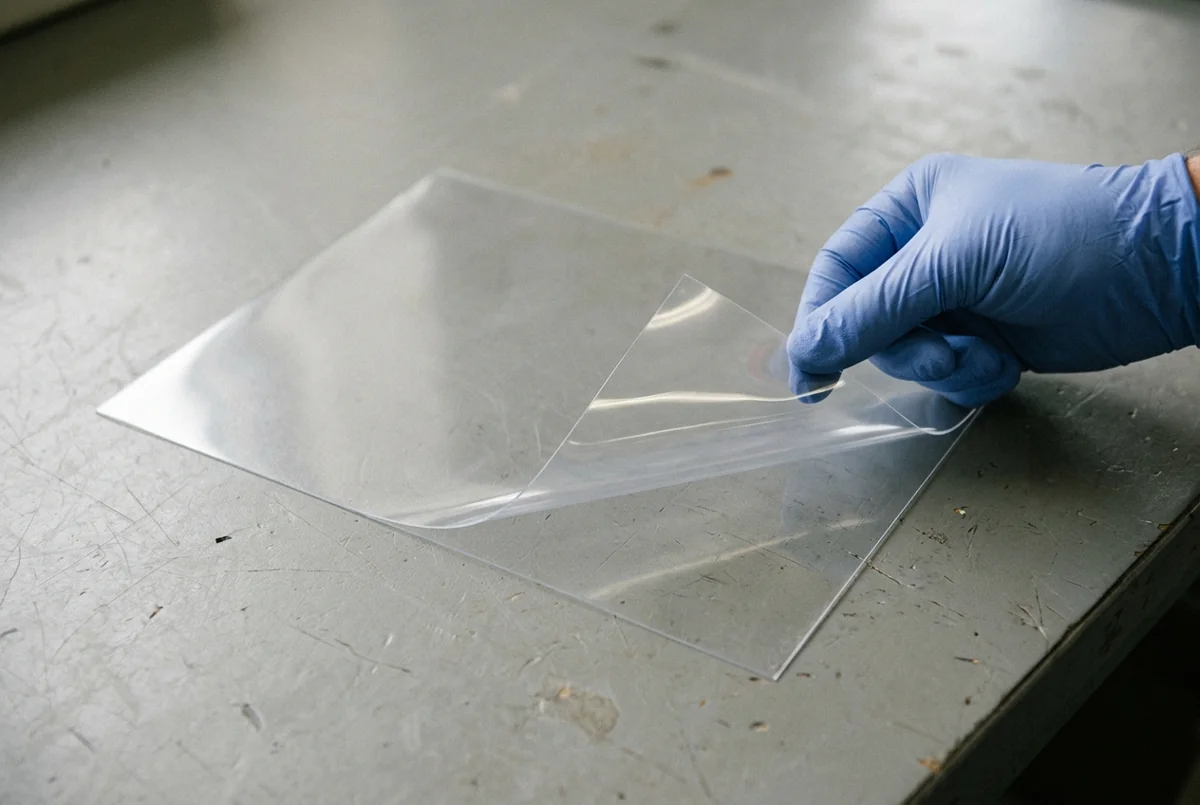
A blue-gloved hand lifts one corner of a clear film sheet.
Our suggested audit record separates what you know from what needs checking:
| Field | Your entry |
|---|---|
| Unit or station identifier | |
| Power reading, unit and source | |
| Power covers which station or face? | |
| Width used in denominator and its definition | |
| Physical web width, if different | |
| Running speed and unit | |
| Faces intentionally treated | |
| Documented side-count convention | |
| Calculation and complete result unit |
Leave an entry blank when it is unknown. If two faces have separate power readings or different treatment arrangements, do not combine them and divide by two without checking the equipment’s convention. An aggregate number would not, by itself, tell you the input on each face.
Unintended treatment of the back is also a different question from intentionally treating two sides. Use the backside corona treatment map to record observations on both faces; a side-count adjustment cannot diagnose that pattern.
Keep the calculated input separate from the surface result
A completed audit makes the calculation reproducible. It still leaves the material response to be checked.
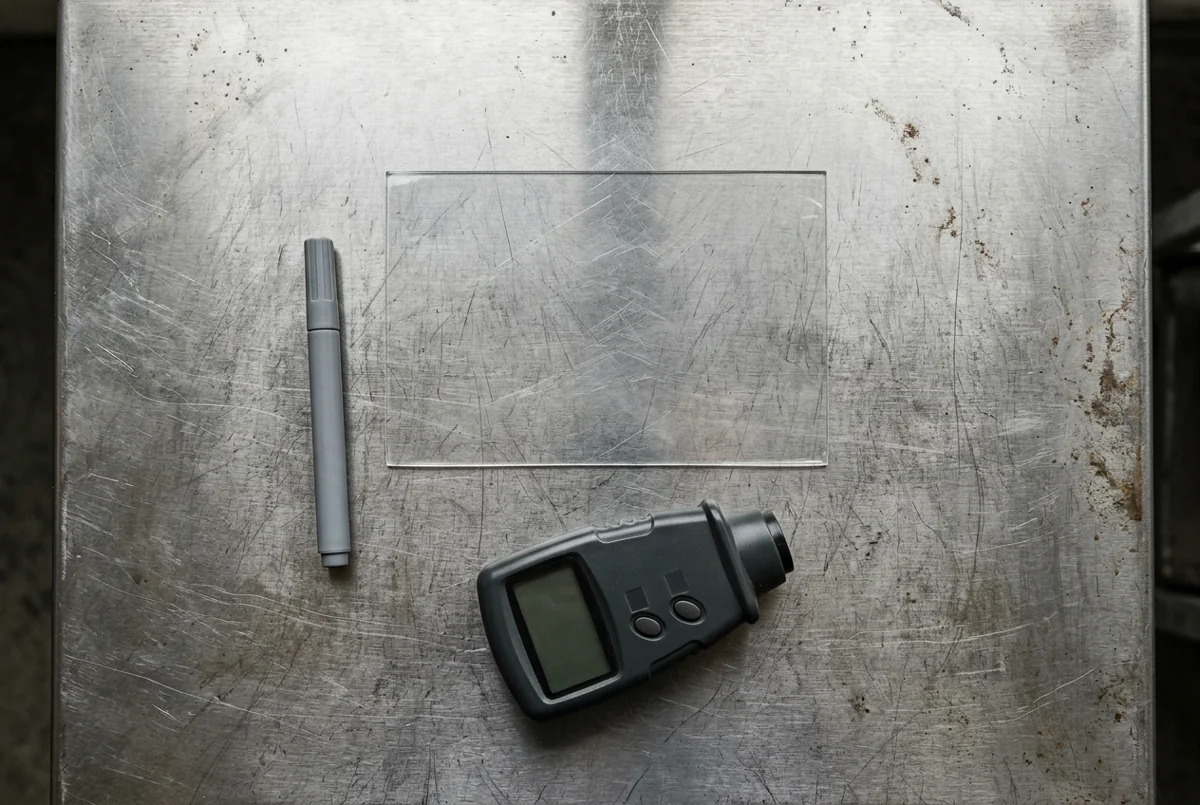
A clear film sample lies beside a capped marker and a handheld meter.
Enercon’s discussion of watt density and dyne levels describes a nonlinear relationship that depends on equipment and material-process parameters. The same calculated input therefore cannot establish a universal surface result. Its calculator also cautions that a dyne level does not guarantee adhesion.
Keep three separate entries in the job record: the audited treatment calculation, the measured wetting result, and the agreed adhesion-test result. Leave the latter two blank until tested. The dyne testing guide explains the wetting measurement and its limits.
If the units reconcile but the surface result differs, preserve both records. Do not invent a conversion from watt density to dynes or choose a new setpoint from this example. The actual material recipe and equipment limits need their own validated basis.
Method and sources
This article compares manufacturer definitions and checks their arithmetic. It reports no production trial, equipment performance or material-specific target. The width and power audit tables are editorial recommendations.
Enercon’s calculator and predicting-dyne-levels article were read from archived originals fetched on 7 and 6 October 2026 respectively, and checked against the current web-reader text on 15 October. Direct fetches returned access blocks. QC Electronics’ calculator and Indeeco’s heater article were fetched live on 15 October 2026. The source list below identifies the originals. Updated October 2026.