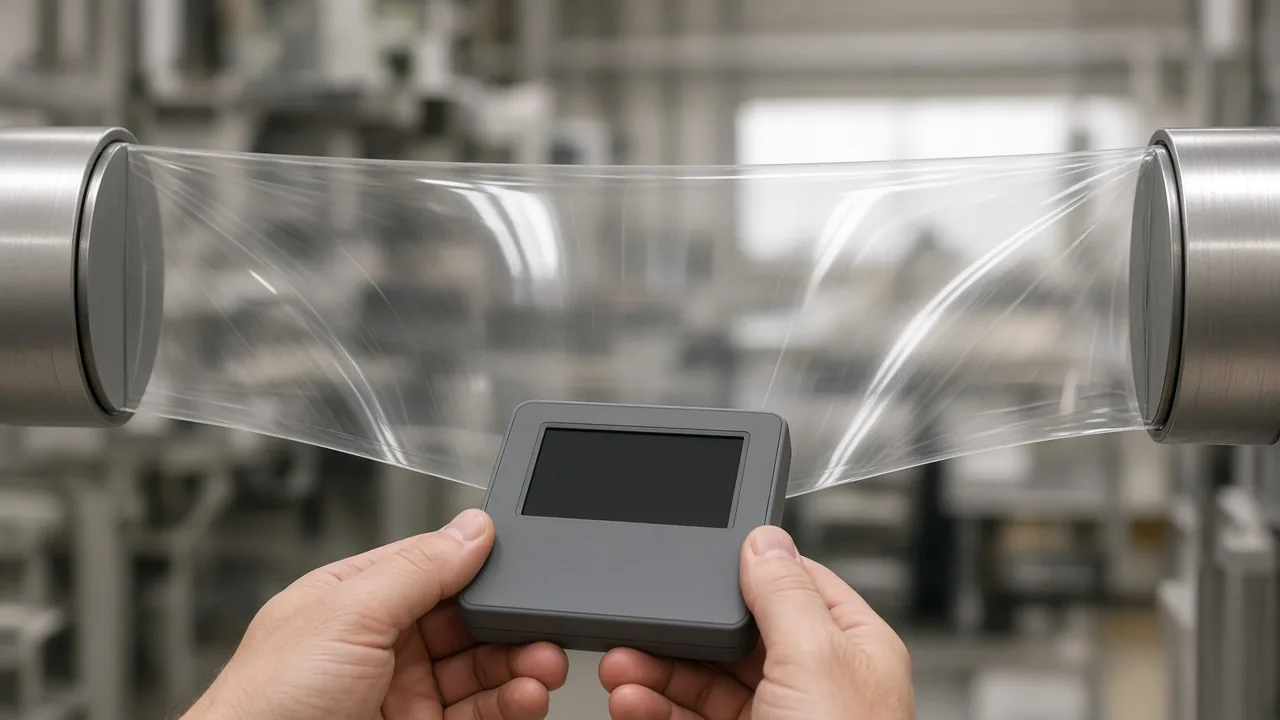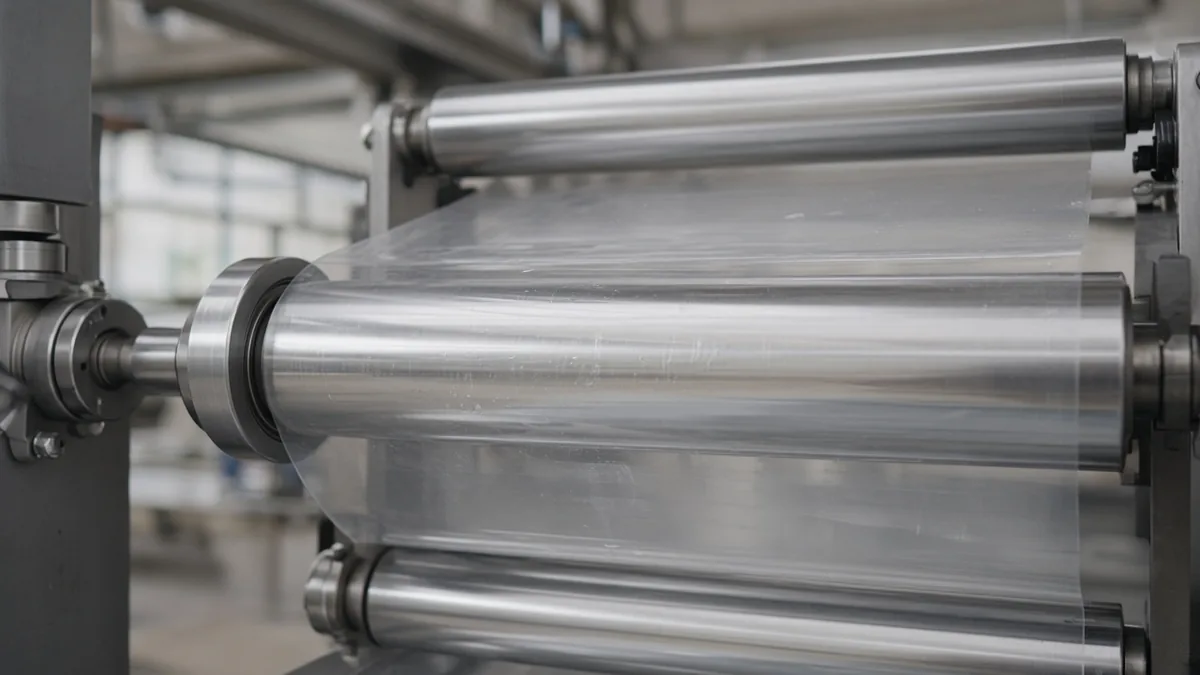
Neutralizing plastic film only at the unwind wastes the bar when dust, cling, or a shock shows up at a later roller. The charge on an insulating web is available again in the open span after the film leaves a roller, and that span, immediately before the defect, is where the neutralizing check belongs.
Static on plastic film is removed where the web is in open air, not while it lies on a roller. Fraser Anti-Static’s elimination guide, last updated 27 November 2020, says the electric field couples into a body the film is touching, so an eliminator at that point cannot neutralize it, and later rollers can generate charge again. Write down the symptom, the open span just before it, and whether the symptom is still there after one change at that span. This page is a location record for film webs in printing, coating, and winding. It is not a meter calibration, a solvent list, or a hazardous-area installation guide.
Ink wetting is a different decision. Use the printing on plastic film guide when the question is whether the surface will hold ink.
| What you record | What to write down | Why it matters |
|---|---|---|
| Symptom | Dust, cling, a wandering web, a shock, or dirt in the seal | Names the station to stand at |
| Last separation before that symptom | Unwind, an idler, a treater roll, a print nip, or the rewind | Charge starts when the film peels off a surface |
| Open span | The web is not touching a roller | The field is available here, and hidden on the roller |
| Control already in place | Grounded frame, an ionizer, an additive film, or none | Separates machine earth from film neutralization |
| Next change | One span, then the same symptom on the next reel | Shows whether that span was the return point |
Why does grounding the press leave the film charged?
A grounded frame gives charge on the machine a path to earth. It does not put ions onto the film, and it does not stop a new charge when the film peels off the next roller.
Impact Plastics, writing on 13 November 2017, describes most plastics as insulators: charges inside them do not flow freely, so a surface charge stays until something discharges it. Fraser’s measurement note, last updated 27 November 2020, describes what that looks like on a web. While the film passes over a roller, the field couples with the roller and seems to disappear. The field returns when the film leaves the roller. A meter aimed at the film on the roller is aimed at a coupled field, not at a cleared web.
TAKK Industries’ packaging note describes the same separation at unwind and rewind: as the web is pulled from the roll, a charge appears and starts pulling in airborne dust. Their page is an equipment maker’s application note, read on 11 October 2026, with a 2026 copyright and no article date.
A dyne pen answers a wetting question, and static on treated film can disturb that reading. The check for the reading itself is in the dyne testing guide. It does not tell you which span regenerated the charge.
Takeaway: If the frame is already grounded and the film still clings or picks up dust, move to the next open span.
Common mistake: Calling the web “clear” because a meter showed nothing while the film was still on a roller. Fraser says an accurate reading is not available there.
How to keep the next reading comparable, including distance, target size, face, speed, and position, is in measuring static on a moving film web.
Where does charge return between unwind and rewind?
Map four places, in web order: the unwind separation, each open span between rollers, the station where the defect shows, and the rewind separation.
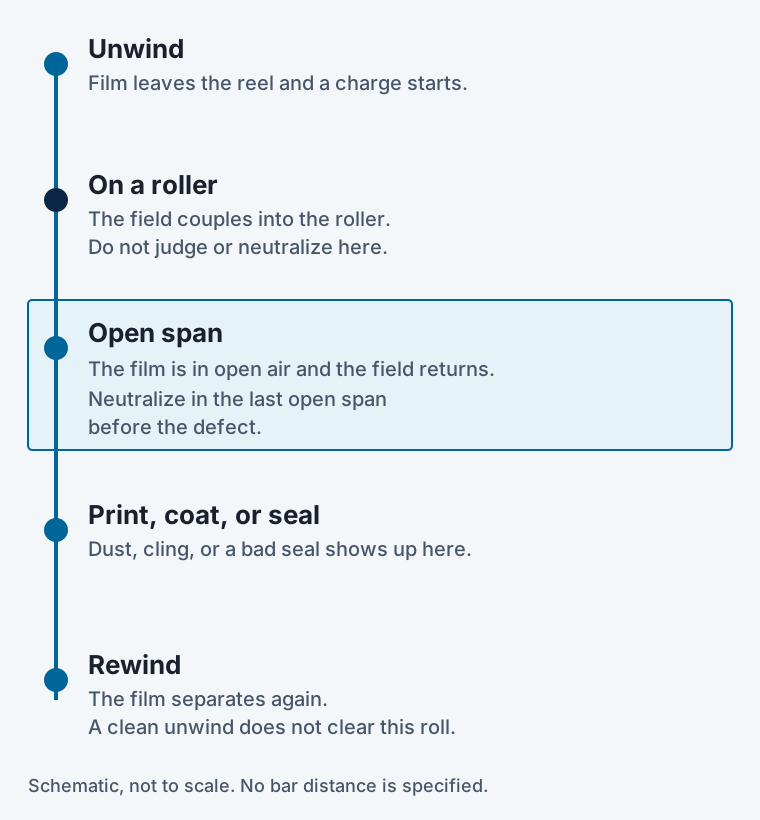
Schematic, not to scale. It shows where the field is hidden on a roller and where it is available in open air. It is not an installation drawing and it sets no distance.
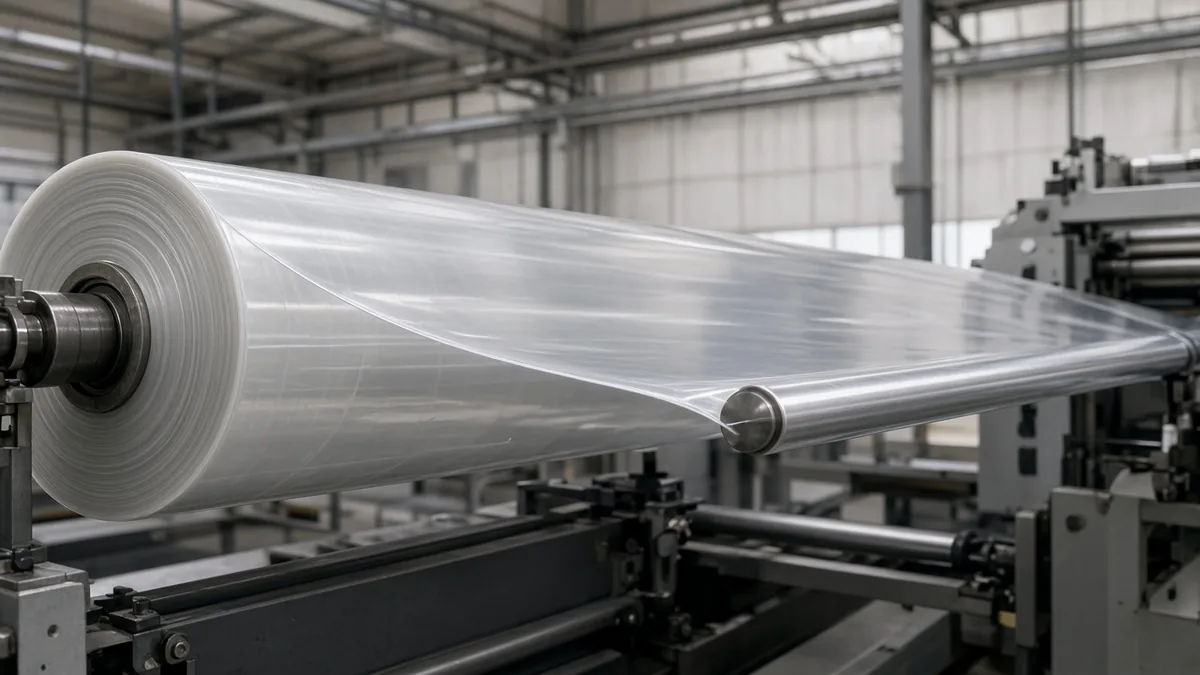
Illustration of separation at unwind: a full-width web leaving a roll. Not a customer line, a test, or a named machine.
Fraser’s rule is to neutralize at the last open position before the problem. An earlier bar is undone when the web passes later rollers or other process points. TAKK’s winding note places a check where the web leaves the reel and again at rewind, on top of the roll, because separation happens a second time. On a form-fill-seal web, TAKK describes dust in the seal area and places eliminators on both sides of the film before the sealing bar. Those sentences are that company’s application descriptions. They are not a spacing to copy onto a different frame.
Corona treatment can also leave charge inside the polymer, not only on the surface. Fraser calls that a volumetric charge and says it is harder to neutralize until the charge has migrated to the surface. The treatment background for that case is in Surface Treatment. This page still starts with the span in front of the defect.
When the dust shows up at an inkjet station added to an existing press, settle the receiving-face questions in the PROSPER Plus 5 substrate checklist separately. The open span in front of that station is still the static check.
Takeaway: Mark the open span immediately upstream of the defect before you add hardware anywhere else.
Which symptom tells you which span to check?
Use one row per symptom. Leave any meter column blank until the meter maker’s instructions say how to read that web. This page sets no voltage limit. Other film and print jobs collected under Films and Printing raise the same location question whenever the web separates.
| Symptom | Look here first | Record | Next step |
|---|---|---|---|
| Dust on the web before print or seal | Open span after the last roller before that station | Which roller the web just left, and which face is dirty | Neutralize in that open span, then look at the same spot |
| Film pulls toward a roller or jams | Open span at unwind, where the web leaves the reel | Whether cling starts at the reel or only after a later idler | TAKK attributes unwind cling and dirt to charge at the reel; confirm that on your web before adding a second bar |
| Dirt in the seal | Both faces just before the seal | Which face carries the dust | TAKK describes bars on both sides before the sealing bar for that job |
| Shock or dirt at the finished roll | Separation at rewind | Whether an upstream check already cleaned the web | A clean unwind does not prove the rewind is clean |
| A sheet that was wiped and then got dirty again | Whether the sheet was on a table during the wipe | Flat on a surface, or held in open air | Fraser says a sheet on a table cannot be fully neutralized, so it can pick dust up again when it is lifted |
Fraser’s guide, in a section on mouldings, says statically attracted dust should be removed soon after it lands. If dusty mouldings are stored for a few days, the attraction can become a bond that neutralizing and blowing the dust off will not remove. The film-web lesson from that paragraph is the same timing: neutralize at the span where the dust is landing, rather than after the roll has sat.
Takeaway: One row, one span, one change. A second change before you recheck hides which span mattered.
Where should the eliminator sit?
In open air, as the last step before the defect, and only as close as the maker of that bar allows.
Fraser says distance is the largest influence on a given bar, and that AC ionization recombines quickly, so closer is better for that class of equipment. The same guide gives spacing for named bars. Those figures stay with those bars. Ask the maker of the bar on your line how far from the web, and how far after the roller contact, that bar is allowed to sit.
For most plastic films, Fraser says neutralizing one side also clears the other, because the film is transparent to the charge. The same paragraph says a thicker film can hold an independent charge on each face, and then both faces need a check. The thickness where Fraser draws that line is in their guide. This page does not turn it into a limit for every web.
Pulsed DC equipment is a partial exception in that guide: DC ionization lasts longer than AC and has more ability to reach charge coupled to another body, and the general rule still stands. Neutralization is best when the product is in open air. Passive eliminators are noted there as having no speed restriction. Which type is already on the machine is a nameplate question.
Faster webs generate higher charge, which is Fraser’s qualitative statement. Whether your line needs a second bar is a question for the maker of the bar you have, read against the charge you actually see. This page has no speed cutoff.
Further notes on this subject are collected under Static Control.
Takeaway: Place the bar in the open span before the defect, then take the spacing from that bar’s own instructions.
Common mistake: Adding a second bar at unwind because the rewind is still dirty. The second separation is a new charge, not proof the first bar failed.
Does an additive replace a check on today’s web?
No. An additive changes the film you order next. It does not show which span on today’s press is generating charge.
Impact Plastics explains internal anti-static additives as materials blended into the polymer. As the sheet cools they migrate, and with moisture in the air they lower surface resistance. The same article says the effect depends on humidity and on the additive, and that a topical coating can be rubbed off. Examples they name are high-impact polystyrene, ABS, and polypropylene sheet. That is a material specification. It is not a map of a printing web.
A water contact angle does not show where charge returns either. That measurement is in the contact angle guide.
Household anti-static sprays show up in consumer discussions of acrylic sheet. They are not a control for a printing or coating web, and this page has no plant trial of them.
Takeaway: If the film is already on the core, map the span. Ask the film supplier about an additive only when you specify the next lot.
When should you stop and follow the equipment manual?
Stop using this page as soon as the decision is about high voltage near solvent, combustible dust, or a classified area. Fraser’s measurement note discusses hazardous-area meters. This page does not. Installation, grounding of the eliminator, and any exclusion zone belong to the equipment maker and to your site procedures.
Also stop when the film supplier already rates the web as conductive or static-dissipative. Fraser’s measurement note says two conductive materials will not hold a charge the way an insulating film does, because they will not keep the charge. Confirm the supplier’s surface-resistance data before you assume a bar is required.
This page also stops short of meter calibration, bar-cleaning solvents, and any ranking of brands.
Takeaway: Use the eliminator maker and the site procedure when the web runs near solvent or combustible dust.
What do you hand to the next shift?
Copy one row from the symptom table into the job log: symptom, span, face, the single change, and whether the same symptom was still there on the next reel. Keep that note with the reel. Other checks on this site are indexed with the technical articles.
Takeaway: The useful handoff is the span and the before-and-after note, not a request for “a static eliminator” with no location.
Method and sources
Compiled from four public pages read on 11 October 2026. Fraser Anti-Static’s elimination guide and measurement note are both marked last updated 27 November 2020. TAKK Industries’ packaging page shows a 2026 copyright and no article date. Impact Plastics’ additive article is dated 13 November 2017. The location table is a new arrangement of those statements for a film web. Bar-to-web distances, named bar models, and speed cutoffs in the Fraser guide are left out, because they belong to named products. No reading here comes from a trial on this site. A search of the local industry library on 11 October 2026 did not return these four guides, so the claims follow the pages named above. Search volume for the query was not available.
Updated October 2026.