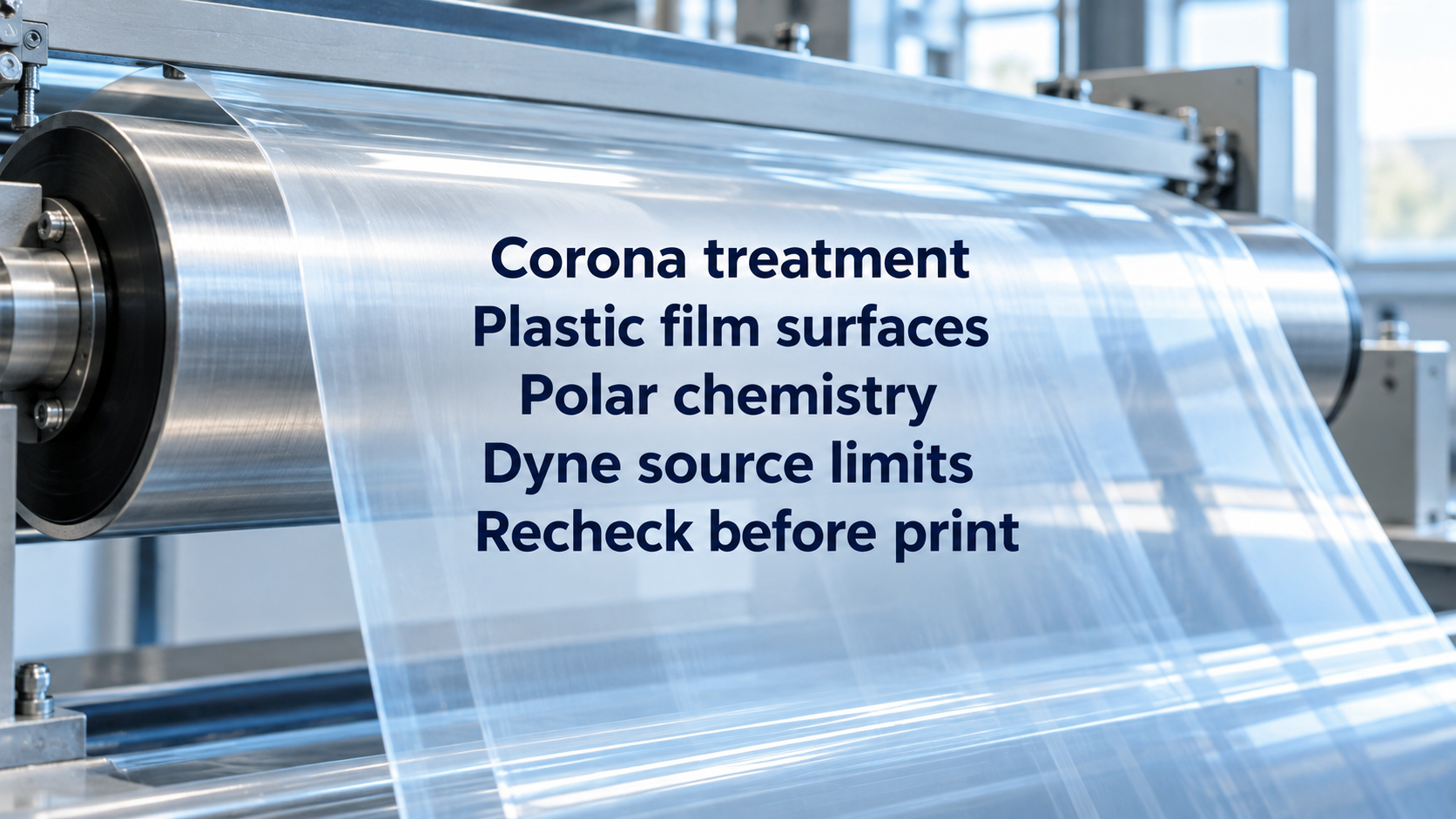
Printing plastic film against an old dyne result can turn usable stock into rejected print. Corona treatment changes the exposed polymer surface through an electrical discharge, creating polar chemical groups that can improve wetting; its effect on surface energy and a measured dyne level depends on the film and the liquid contacting it.
Corona treatment modifies surface chemistry, while a dyne test reports wetting tension under specified test conditions. The distinction matters when setting a target or judging stored film: ASTM D2578 relates wetting tension to acceptable adhesion through experience with the actual application. Its published reference is specific to Type 1 polyethylene tubular film used in commercial flexographic printing. OEM guidance supports checking treatment again after storage, but does not establish a universal decay rate. Use the source’s material and process conditions when comparing a result, then confirm the finished ink, coating or bond separately.
| Input or item | Typical value or source | Why it matters |
|---|---|---|
| Physical change | Discharge-induced surface oxidation and polar groups; Vetaphone FAQ, retrieved 19 October 2026 | Explains improved interaction with suitable liquids |
| Dyne result | Wetting tension; ASTM D2578-23, sections 5.1.1 and 5.2 | A liquid-dependent observation, not bond strength |
| Scoped reference | At least 35 dynes/cm for Type 1 PE tubular film in commercial flexography; D2578-23, Note 3, retrieved 19 October 2026 | Applies to that case; other films and uses may require different levels |
| Storage decision | Recheck before converting; Vetaphone shelf-life discussion, retrieved 19 October 2026 | An extrusion-stage result does not establish the later condition |
| Process input | Power, width, speed and treated-side definitions | Audit these independently from the wetting result |
What changes on a corona-treated film surface?
Corona discharge creates reactive sites at the exposed polymer surface that can react with oxygen and form polar groups. Vetaphone’s corona FAQ describes chain disruption and carbonyl formation; this supplies a chemical explanation for the change in wetting rather than a promise about every resin formulation.
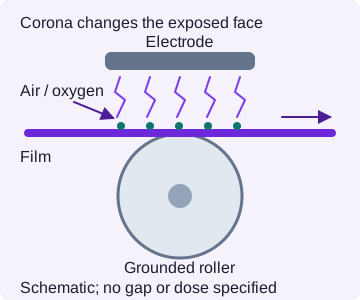
Surface activation occurs where the discharge reaches the film. The sketch represents the relationship, not a specified electrode gap or treatment depth.
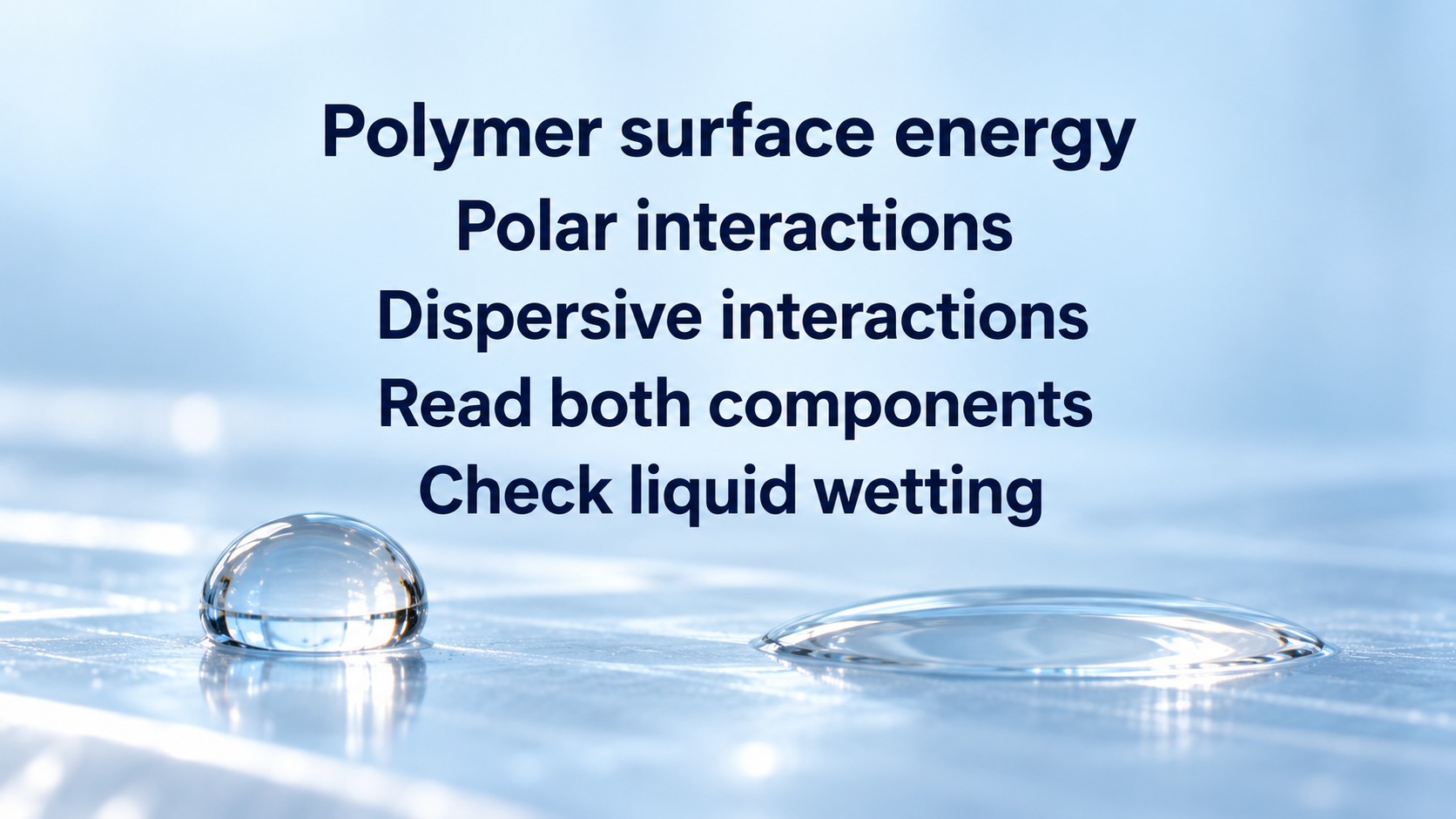
Polar groups can increase attractive interactions with a liquid that also has polar character. The KRUSS OWRK explanation separates these interactions from dispersive interactions. That is why a single total surface-energy number cannot fully describe the film’s relationship with every ink or adhesive.
Keep the process input and the measured outcome separate. To compare treatment settings, use the corona watt-density unit audit; it checks the power, web width, line speed and side definitions that this explanation leaves to that calculation.
Which source actually supports a dyne target?
The public ASTM D2578 page supports a narrowly defined reference case and explicitly limits its transfer to other films. An unqualified printing range drops the conditions needed to use the number correctly.
| Retrieved source | Supported statement | Boundary to keep with it |
|---|---|---|
| ASTM D2578-23, Note 3 | A level of 35 dynes/cm or higher has generally indicated acceptable treatment for Type 1 PE tubular film intended for commercial flexography | Other polyethylene types, manufacturing routes or end uses may need another level; retrieved 19 October 2026 |
| ASTM D2578-23, Note 3 | A generally acceptable wetting-tension level for PP film in commercial flexography is not established there | The PE reference cannot become a PP specification |
| ASTM D2578-23, section 5.2 | Acceptable ink, coating or adhesive retention must be related to the wetting result through application experience | Passing wetting alone does not establish adhesion |
| ASTM D5946-24, sections 1.1 and 5.4.1 | Water contact angle can assess corona-treated film; suitability for acceptance requires a capability study for the particular film and treatment | A water-angle observation is a different measurement |
Threshold rule: For the specific Type 1 PE tubular-film commercial-flexo case in D2578-23 Note 3, a result below 35 dynes/cm is below the published reference. Hold that comparison for investigation against the agreed job specification. The note supplies neither a universal rejection rule nor a universal upper treatment limit. Source: ASTM public page, retrieved 19 October 2026.
For the actual fluid test and its reporting procedure, use the dyne-testing guide. Retain film grade, tested face, liquid system and time since treatment beside the result.
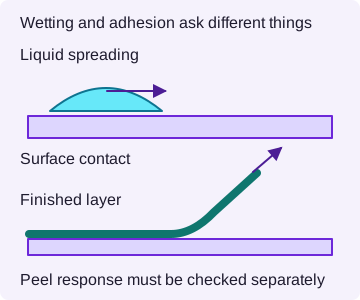
Wetting describes liquid contact. Peeling a finished layer asks a separate mechanical question.
How should the dyne number be read and converted?
A change of units preserves the numerical wetting-tension value; it does not convert wetting tension into a complete surface-energy analysis. ASTM D5946-24 section 5.3 pairs dynes/cm with mN/m for treatment-level reporting.
The explicit unit conversion is:
k = (1 mN/m) / (1 dyne/cm)
T_SI = T_dyne x k
Here T_dyne is the wetting tension in dynes/cm and T_SI is the same wetting tension in mN/m.
Worked example — editorial unit conversion: The D2578-23 Note 3 reference for Type 1 PE tubular film in commercial flexography converts as 35 dynes/cm x (1 mN/m)/(1 dyne/cm) = 35 mN/m. The input comes from that reference and the equivalence from D5946-24 section 5.3, both retrieved 19 October 2026. No treatment response, dose or adhesion strength is calculated.
This unit agreement is useful when a film certificate and an ink document use different notation. It cannot resolve differences in test method or explain why a liquid of apparently compatible total tension still beads.
What does the evidence say about treatment decay?
The retrieved OEM sources support declining treatment levels and the need to recheck the film near use. They do not support assigning every roll the same half-life or expiry interval.
Vetaphone’s shelf-life discussion, retrieved 19 October 2026, identifies elapsed storage, humidity, additives and contamination as influences on a film’s decay profile. Its FAQ also describes treatment level falling after the discharge. These are reasons to record the storage history and compare the same material and test conditions across stages.
Enercon’s metallized-film bulletin, page 2, retrieved 19 October 2026, adds additive migration and transfer from the opposite face of a wound web to its discussion of decay. That bulletin concerns metallized films; its material-specific examples should stay within that scope.
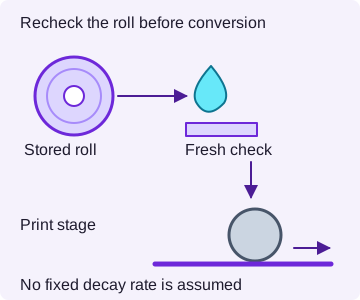
The useful comparison is a new result at the next process stage. The sequence does not prescribe a storage duration or rate of loss.
An editorial record for this comparison should identify the roll and face, treatment event, subsequent handling, storage conditions and result before printing or coating. A lower later result warrants checking both the sample and the measurement conditions before attributing all of the difference to chemical ageing.
When should rework stop at diagnosis?
Stop increasing treatment when the wetting result already meets the validated requirement but the finished layer still fails. ASTM D2578 section 5.2 and D5946 section 5.1 both separate their surface measurements from complete adhesion acceptance.
The following choices are editorial diagnostic recommendations based on those measurement limits and the OEM storage discussion.
| Situation | Useful next evidence | Dominant Failure Mode & Prevention |
|---|---|---|
| Fresh film wets poorly relative to the validated job requirement | Confirm grade, face, fresh sample and treatment-input definitions | Inadequate or uneven wetting; establish the sample result before changing settings |
| Stored film reads below its earlier result | Repeat the same method and review roll history | Conversion against a stale certificate; check the surface at use and validate any bump treatment |
| Wetting passes but print or coating adhesion fails | Evaluate the applied layer with its agreed adhesion test and process conditions | Repeated treatment without finding the weak interface; investigate the finished layer separately |
| Film or functional coating appears damaged | Material disposition and process-specific review | Further rework compounds material loss; hold the roll until its fitness for conversion is resolved |
The rework boundary is the accepted material and finished-layer performance, not the largest dyne reading available. The printing-on-plastic-film guide explains where a print trial and adhesion check fit before release.
Keep an operational loss account alongside that decision: film consumed in trials, repeat unwind and rewind time, treatment energy, lost press availability and rejected inked or laminated stock. These are cost categories to measure on the job, not a reason to assume that more treatment always saves material.
Method and sources
This explanation uses the public Scope and Significance and Use sections of ASTM D2578-23 and D5946-24, OEM guidance from Vetaphone and Enercon, and KRUSS’s OWRK explanation, retrieved on 19 October 2026. The paid ASTM procedural texts were not retrieved. The source roles differ: ASTM supplies the method boundaries, OEM documents explain treatment and storage, and OWRK explains liquid-solid interactions.
Continue with the Films and Printing collection for related process decisions.