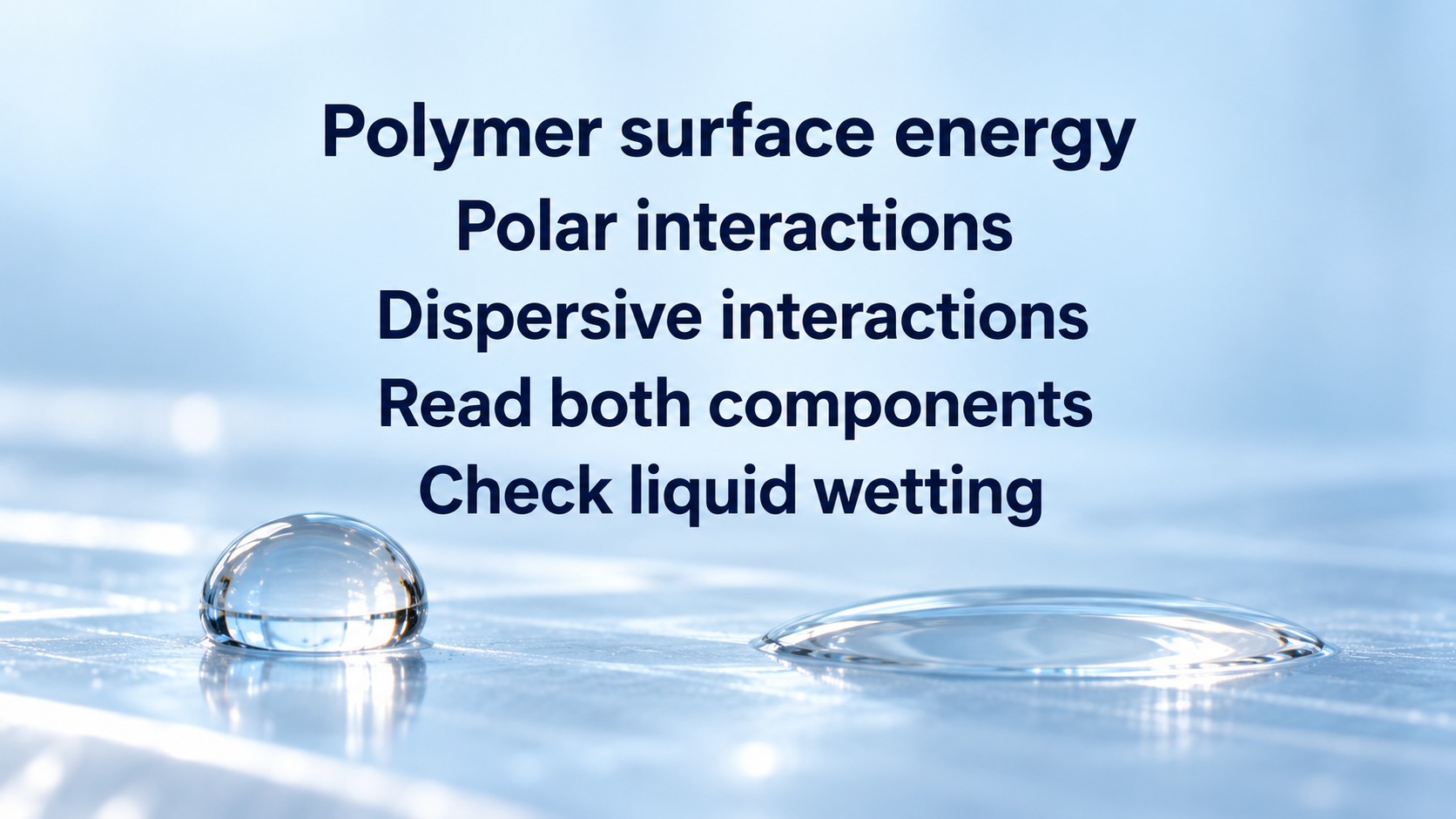
Releasing a polymer against a total surface-energy number alone can leave the applied liquid beading and the finished coating rejected. In the Owens-Wendt-Rabel-Kaelble model, or OWRK, polymer surface energy splits into polar and dispersive components; wetting depends on how those components interact with the liquid’s corresponding components.
Surface energy describes the energetic cost of creating a surface, but the reported polar and dispersive split is a model-based interpretation of liquid-solid interactions. OWRK calculates that split from contact angles with liquids of known component values. A total alone cannot determine whether a particular ink or adhesive spreads, because the liquid-solid interfacial energy also matters. Read the components with the model, probe-liquid data and sample condition attached, then evaluate wetting and finished adhesion separately. The component calculation is a diagnostic aid, not a bond-strength acceptance test.
| Input or item | Typical value or source | Why it matters |
|---|---|---|
| Total surface energy | Sum of polar and dispersive components in OWRK | Equal totals can conceal different interaction balances |
| Units | Surface energy in mJ/m2; dimensionally equivalent to mN/m | Matching units do not make dyne wetting tension and modelled energy the same result |
| Probe-liquid requirement | At least two liquids, at least one with a polar component above 0 mN/m; KRUSS OWRK page, retrieved 19 October 2026 | Repeated water drops alone cannot determine both components |
| Original polymer example | PDMS after 40 s plasma exposure: total 40.3 mN/m; AR272, June 2014, Table 3a | A sourced decomposition with a defined treatment, not a production target |
| Wetting observation | Contact angle of the actual liquid on the actual surface | Gives liquid-specific evidence rather than a total-only prediction |
What do polar and dispersive components represent?
Dispersive interactions describe attractions associated with electron-density fluctuations; polar interactions describe additional attractions associated with molecular polarity. The KRUSS surface-free-energy explanation, retrieved 19 October 2026, describes these contributions and the equivalent mJ/m2 and mN/m units. OWRK pairs each contribution with the same type in the liquid.
The KRUSS OWRK method page, retrieved 19 October 2026, explains the consequence: a surface with little polar contribution offers little polar interaction to water. Increasing the compatible interaction reduces the liquid-solid interfacial tension within the model.
The split is not a count of chemical groups or a thickness measurement. A change in the fitted polar component can help explain a change in wetting, but the inference retains the assumptions and liquid data used to calculate it.
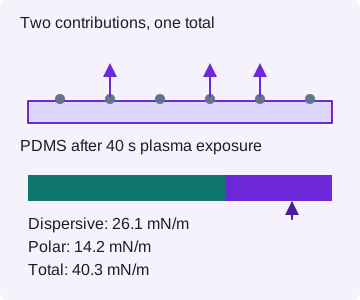
The bar uses the PDMS result from KRUSS AR272, June 2014, Table 3a, after 40 s plasma treatment. The molecular sketch is schematic; bar segments represent energy contributions rather than layers in the material.
How do sourced polymer component values add up?
The total equals the sum of the components within this model. A reported total should therefore be checked against its component values before comparing treatment conditions.
T = D + P
polar percent = (P / T) x 100%
Here T is total surface energy, D its dispersive component and P its polar component, all in the same energy-per-area units. Their ratio is dimensionless and is expressed as a percentage.
KRUSS’s original AR272 report, dated June 2014 and retrieved 19 October 2026, gives the following PDMS result in Table 3a, page 6:
| Reported quantity | Value | Source condition |
|---|---|---|
| Dispersive component | 26.1 mN/m | Cleaned, pure synthesized PDMS after 40 s plasma exposure |
| Polar component | 14.2 mN/m | Same sample and treatment condition |
| Total | 40.3 mN/m | OWRK evaluation of static contact angles |
Worked example: 26.1 mN/m + 14.2 mN/m = 40.3 mN/m. Editorial calculation: (14.2 mN/m / 40.3 mN/m) x 100% = 35.2% polar contribution, rounded to one decimal place. The report prints the component values and total; it does not print this quotient for that row.
The experimental conditions on page 3 matter. The report used water, diiodomethane and ethylene glycol for the contact-angle analysis, and a plasma pen positioned 8 mm above the sample, travelling at 2 mm/s over 40 mm and back for the 40 s exposure. The retrieved report does not state the test temperature or elapsed time between treatment and measurement. This is a plasma-treated PDMS laboratory result, not a corona setting, dyne target or expected result for a production film.
The percentage describes the division of the fitted energy. It does not mean that this proportion of the surface area is polar, that treatment improved adhesion by that amount, or that all polymers should reach the same balance.
Why can equal totals give different wetting?
Equal totals can coexist with different liquid-solid interfacial tensions because the interaction components need to pair across the interface. A strongly polar liquid does not gain the same polar interaction from a surface with little polar contribution.
In OWRK, the modelled work of adhesion can be written as:
a_d = sqrt(S_d x L_d)
a_p = sqrt(S_p x L_p)
W_A = 2 x (a_d + a_p)
Here S means solid, L means liquid, d means dispersive and p means polar; a_d and a_p are the same-type interaction terms. Each component has surface-energy units; W_A is energy per area. The geometric-mean terms follow the KRUSS OWRK model explanation. A dispersive contribution on one phase does not replace a missing polar contribution on the other.
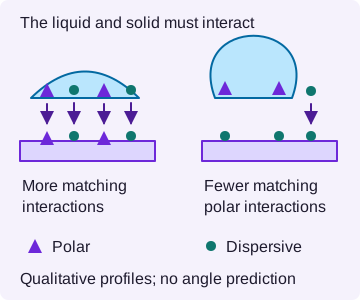
Interaction matching changes the interface. Symbols and drop profiles are qualitative, not calculated contact angles or measured component values.
AR272’s discussion on pages 4-5 explains why complete spreading does not follow simply from equal solid and liquid totals. Its comparison also shows why test-ink wetting values and contact-angle-derived energy values can disagree. The measurements ask related but different questions.
The work of adhesion in the equation is a thermodynamic model quantity. It is not the peel strength of a cured coating or a laminate: those finished systems require their own performance test and acceptance conditions.
What can each measurement establish?
A liquid contact angle establishes how that liquid meets the surface; determining both OWRK components requires independent liquid information. A single water angle can track a change without uniquely solving both components.
The OWRK method requires at least two liquids with known polar and dispersive components, including at least one with a polar component greater than 0 mN/m; retrieved 19 October 2026. Their different interaction balances make the component separation possible. For instrument setup and measurement records, use the contact-angle measurement guide.
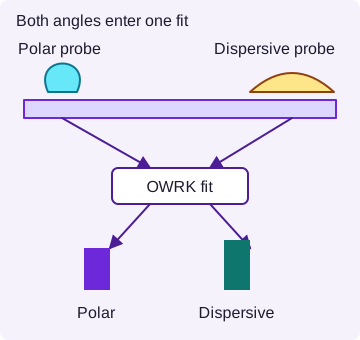
Both contact angles enter one fit. Neither liquid is a direct reading of one component. The bars are symbolic and do not add a new dataset.
The limits below follow the KRUSS sources and the public ASTM D5946 and D7334 pages; the suggested controls are editorial recommendations.
| Evidence | Useful interpretation | Dominant Failure Mode & Prevention |
|---|---|---|
| Water contact angle | Response of the surface to water under the stated method | Treating one angle as both OWRK components; use independent probe liquids for the split |
| Dyne-fluid wetting result | Operational wetting boundary for that test-liquid system | Equating a fluid value with a unique total energy; retain test identity and substrate applicability |
| OWRK total and components | Modelled interaction balance for the measured surface | Comparing incompatible liquid datasets or sample histories; retain model, liquids and conditions |
| Finished-layer adhesion test | Performance of the ink, coating or bond under agreed conditions | Passing surface analysis while the finished layer fails; evaluate the applied system separately |
What threshold and rework boundary are useful?
Use an angle threshold to interpret liquid-specific wetting, and a validated performance criterion to release the finished product. Those are separate decisions.
Threshold rule: For an ideal equilibrium liquid-solid contact, a contact angle below 90 degrees lies on the wetting side of the boundary, while above 90 degrees lies on the non-wetting side. This is the KRUSS contact-angle definition, retrieved 19 October 2026. Below that threshold does not mean complete spreading or acceptable cured adhesion, and the threshold is not a universal polymer treatment specification.
ASTM D5946-24 section 5.4.1 requires capability studies for acceptance of a particular film and treatment. A model result should therefore be compared with the intended liquid and actual film condition before it becomes a process control limit.
The rework boundary is reached when surface wetting passes the validated requirement but the applied layer fails. Hold the affected material and use the printing-on-plastic-film guide to connect surface observations with a print trial and adhesion evidence. Do not prescribe another treatment pass solely to increase the total: first determine whether the problem is the surface, the applied formulation or the subsequent process.
Record losses from repeat sampling, additional treatment, changeover delays and rejected coated material separately. That makes it possible to compare the cost of the diagnostic step with actual scrap and downtime, without assigning a fabricated savings percentage to a higher polar fraction.
Method and sources
This article combines the KRUSS OWRK explanation, its original AR272 laboratory report from June 2014, and the public ASTM D5946-24 and D7334-08(2022) pages, retrieved 19 October 2026. The worked example preserves the report’s material and plasma-treatment conditions. The ASTM pages support method scope and limits; their paid full texts were not retrieved.
Browse Films and Printing for the surrounding film, ink and coating decisions.