A passive brush set past a few millimetres fails the discharge Fraser sizes for 2-3 mm, and an active bar mounted on the roller wastes the ions because the field stays coupled into the roller until the web has left it. Fraser Anti-Static’s product index, read on 20 October 2026, sets 24 V DC short-range bars at 25 mm to 150 mm and up to 1500 m/min, and it sets brushes at a typical 2-3 mm.
Match the eliminator to the open gap after the web leaves the roller. The elimination guide, last updated 27 November 2020, says the field is unavailable while the film touches another body, and it calls that the most common mistake in the industry. The product index then splits the tools: 24 V DC short-range bars at 25 mm to 150 mm and up to 1500 m/min, pulsed-DC long-range bars from 150 mm to 1500+ mm, AC bars up to about 150 mm and beyond 500 mm once air is added, and passive brushes typically 2-3 mm from the material. Two named sheets sit inside that short band with a lower start: the 1250 AC bar and the 3024 Compact 24 V DC bar both list an operating distance of 20-150 mm, with best performance within 50 mm on the 1250 and between 20 and 50 mm on the 3024 Compact. Where on the machine that span belongs is in removing static from plastic film.
| Tool, as Fraser names it | Stated gap to the material | Supply | What else that page states |
|---|---|---|---|
| 101 and 201 brushes | Typically 2-3 mm | No electrical supply. The fibre tips ionise air so charge can flow to earth. | Brochure: they need not touch the web. An 80% neutralisation is typical, depending on the application, and they cannot clear 100% of the charge. |
| 1250 and 1250-S AC bars | 20-150 mm. Best performance within 50 mm. | External Fraser 5.5-6 kV power unit. | Guide: six times better at 25 mm than at 50 mm. EX-ATEX variant is EX-1250. |
| 3024 Compact | 20-150 mm. Best performance between 20 and 50 mm. | 24 V DC (21-28 V). Up to 7.5 kV integrated in the bar. | Lengths 150 mm and 200 mm. CE and UL. |
| DC short-range category | 25-150 mm | 24 V DC, electronics in the bar | Up to 1500 m/min |
| DC long-range category | 150 mm to 1500+ mm | Pulsed DC, electronics in the bar | Guide: for long-range high-performance bars, stay at 250 mm or farther so the ionisation can cover the object. |
| AC category | Up to about 150 mm | External high-voltage power unit | Beyond 500 mm with air. Described as a lower-cost alternative for less demanding issues. |
Why does the same maker publish 20 mm and 25 mm?
The category page and the two product pages are both current Fraser pages read on 20 October 2026. They do not use one start number.
The category calls DC short-range bars ideal from 25 mm to 150 mm. The 1250 page and the 3024 Compact page each open the operating distance at 20 mm and close it at 150 mm. Best performance is a narrower slice of that operating distance: within 50 mm for the 1250, and 20-50 mm for the 3024 Compact. A gap of 22 mm is inside the named operating distance and outside the category sentence that starts at 25 mm. Record which page you are using before you treat 25 mm as a hard start.
The guide adds a performance slope inside that band. AC ionisation recombines quickly, so closer is better. It states that the performance of a 1250 is six times better at 25 mm than at 50 mm. That 6 is Fraser’s statement about those two distances. It is a separate claim from the product page’s “best within 50 mm.”
gap_ratio = 50 / 25
The result is 2. That 2 is only the ratio of the two distances in the guide’s 1250 sentence. It does not produce the sixfold performance figure. Keep 2 as the distance ratio and 6 as the published performance ratio.
Takeaway: Write the model, then the gap. A 22 mm gap and a 40 mm gap are both inside 20-150 mm, and the guide says the closer of 25 mm and 50 mm is the stronger 1250 position.
Where does a brush stop being the tool the brochure describes?
Fraser’s 101 and 201 page says those dischargers are typically positioned 2-3 mm from the material. The fine conductive tips concentrate the electric field and create ionised air so the charge can flow to earth. Carbon fibre on that page is 6/7 micrometres in diameter, 60,000 filaments per centimetre. Conductive nylon is 35 micrometres, printed as 4-5000 filaments per centimetre. Fibre lengths offered are 18 mm standard, then 30, 50, or 80 mm. Those millimetres are the fibre length. The 2-3 mm is the gap from the tips to the web.
The 2025 corporate brochure repeats the gap in the brushes section: passive eliminators do not need to touch the material, and they must be close to it, typically 2-3 mm. The same paragraph says they cannot eliminate 100% of the static charge, and that an 80% neutralisation is typical, depending on the application.
residual_share = 100 - 80
The result is 20. That 20 is the share left when Fraser’s typical 80% applies. The brochure ties the 80% to the application, so 20 is the complement of that stated typical.
catalog_ratio = 150 / 3
The result is 50. The 150 mm is the top of the short-range category. The 3 mm is the far end of the typical brush gap. Fifty is how many times farther that category top sits from a 3 mm brush gap. It compares two published positions.
If the brush gap exceeds 3 mm, the typical position on the 101/201 page and in the brochure no longer describes the installation. The pages do not publish a second brush gap for 10 mm or 25 mm.
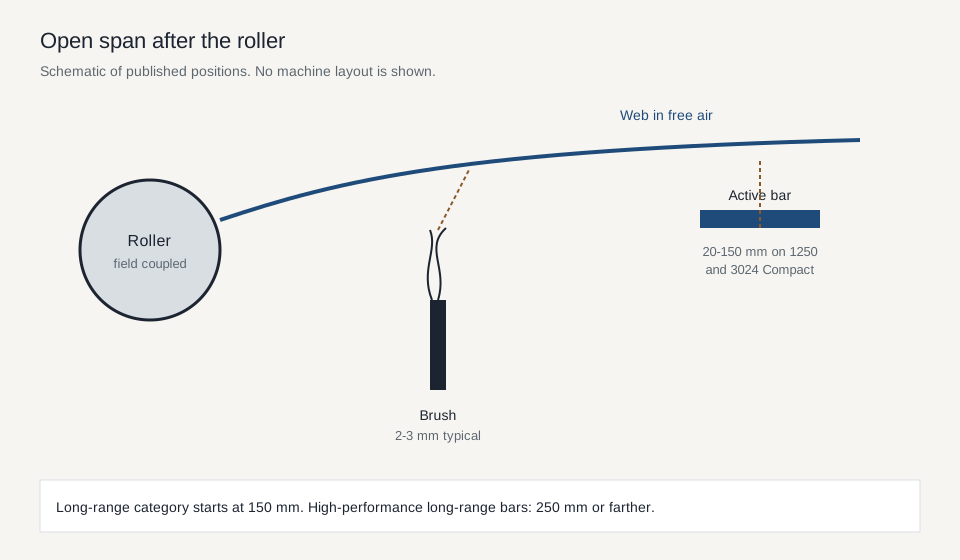
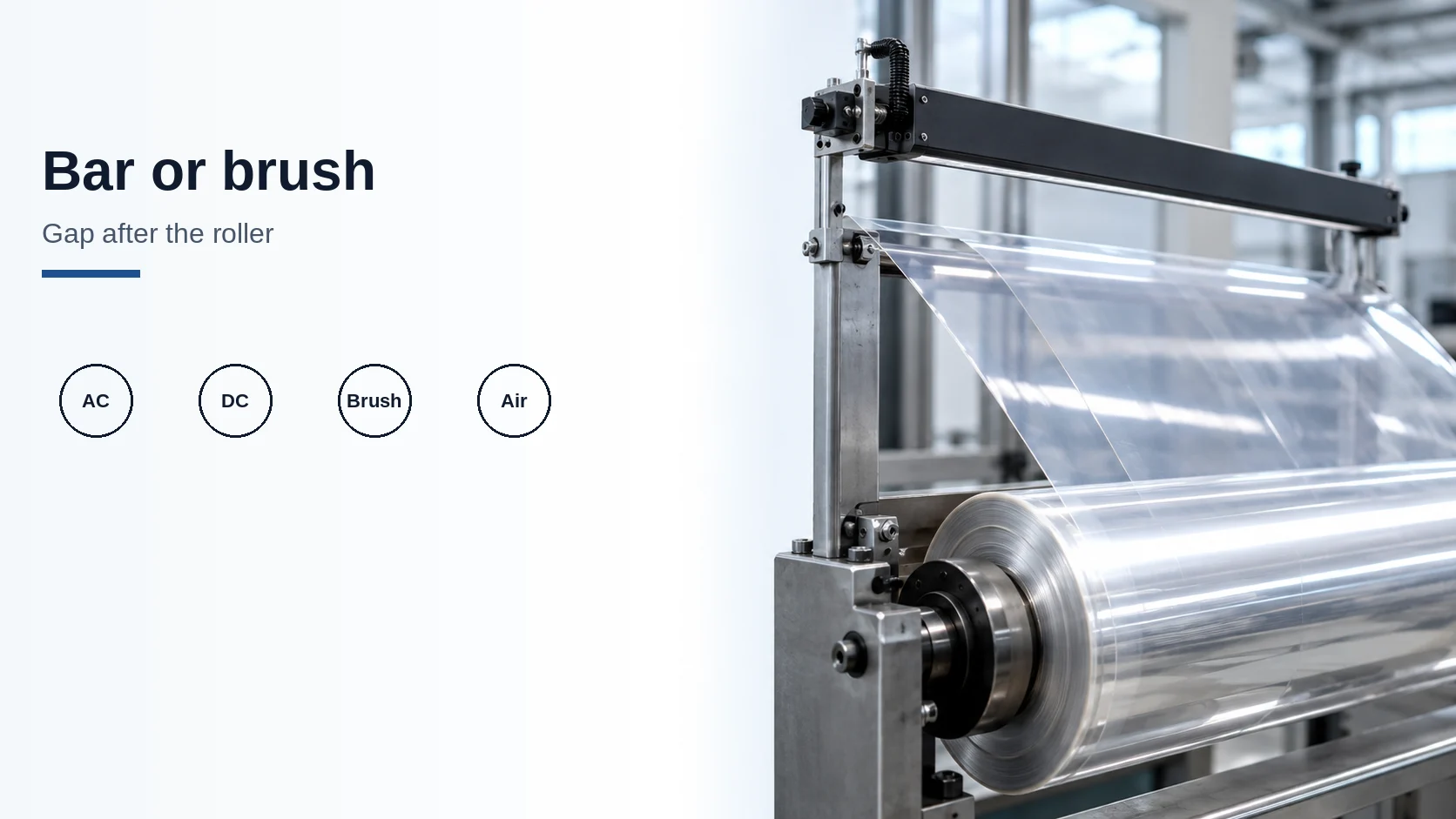
Schematic of published gaps. The roller label marks coupled field. The brush and the bar are drawn in free air.
Takeaway: A brush record needs the tip-to-web gap in millimetres, the fibre, and whether the body is earthed.
What changes when the bar is AC, 24 V DC, or long range?
AC ionisation, in the guide, does not have a long life and recombines quickly. The 1250 page matches that with best performance within 50 mm, even though the operating distance runs to 150 mm. The category page says AC bars reach about 150 mm and can pass 500 mm once air is added. Air-assisted range is a different installation from a plain bar at 40 mm.
DC ionisation, in the guide, lasts longer than AC ionisation, and the bar still has to sit as close to the object as the job allows. Distance is the single factor with the greatest influence for any given bar type. The guide’s 3024L example is a different model from the 3024 Compact: the 3024L is nearly three times as powerful at 200 mm as at 300 mm. The 3024 Compact page stays inside 20-150 mm. Do not copy the 3024L distances onto the Compact.
The long-range category starts at 150 mm and runs to 1500+ mm, with or without air. For long-range, high-performance bars, the guide says to allow the ionisation to cover the whole object and recommends a position of 250 mm or farther. A measured gap of 180 mm is inside the category start and inside the zone where that high-performance note wants more distance. The datasheet for the bar on the machine has to settle that pair of sentences.
cover_gap = 250 - 150
The result is 100. That 100 mm is the width of the band between the long-range category start and the high-performance minimum in the guide. It is arithmetic on those two published numbers.
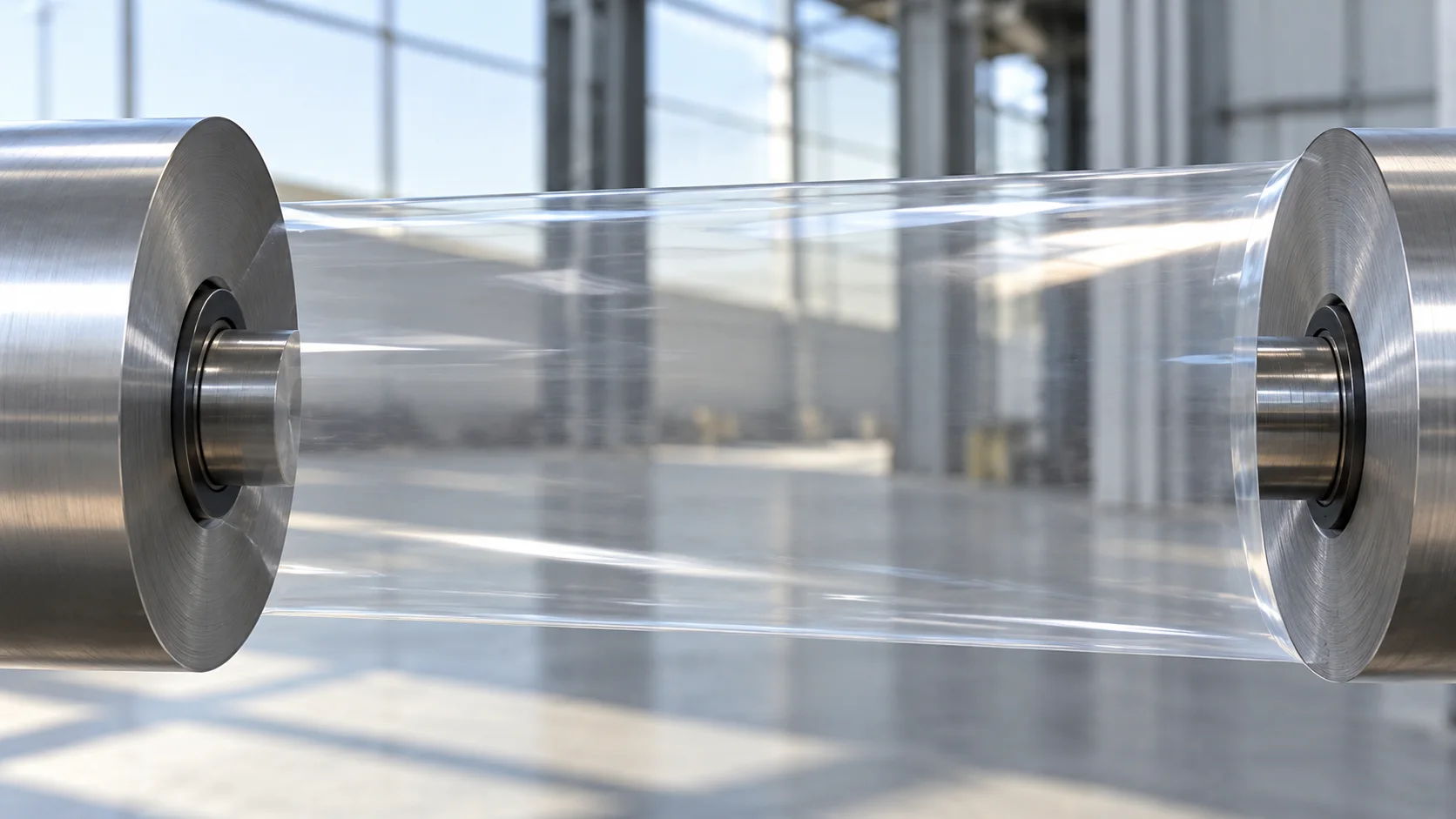
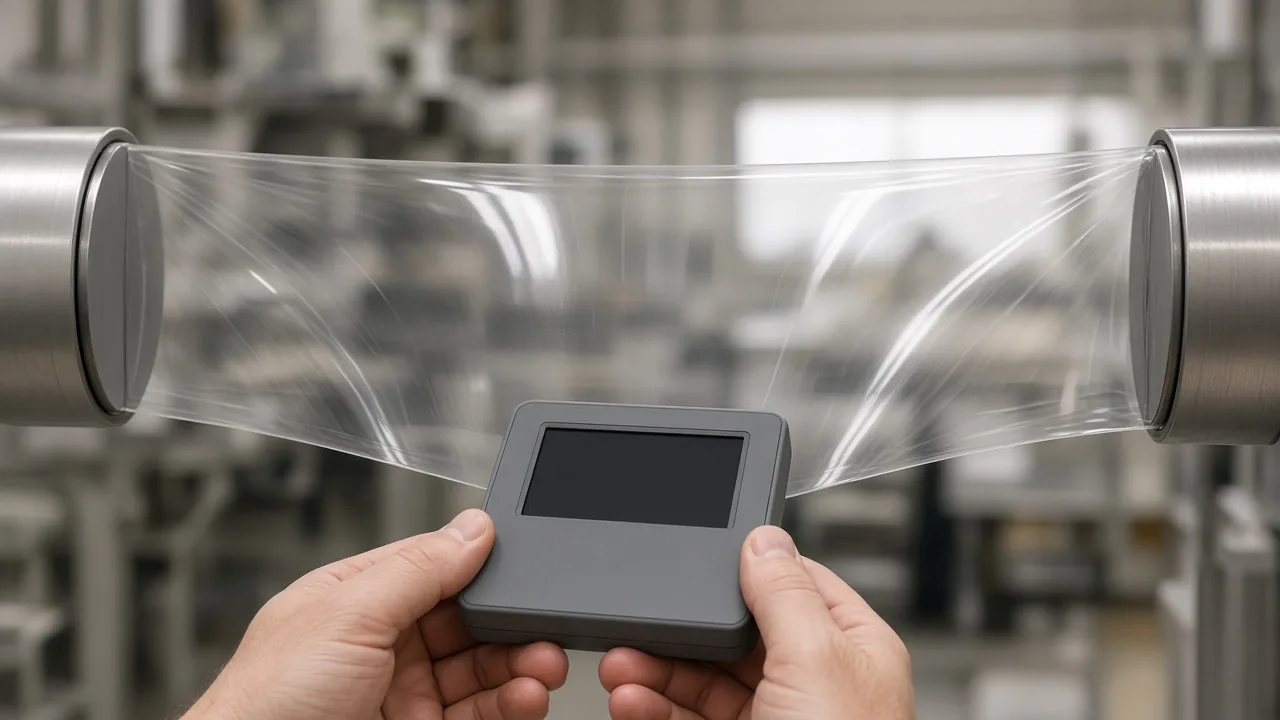
Illustrative photograph of an open span. It does not show a measured gap.
Takeaway: Copy the range from the page that names the model. The category sentence and the 1250 sheet are both Fraser, and they are not the same sentence.
How do speed and thickness change the count of bars?
The guide says static generation is proportional to the speed of the material, so faster webs create a higher charge. It also says speed decides whether more than one bar is required. Some years ago the rule was that material over 300 m/min needed two or more AC bars. The same paragraph says modern pulsed-DC eliminators are more powerful and can cope with higher speeds, and that more than one bar can still be required when the charge is high. Passive static eliminators, in that guide, do not have a speed restriction.
The product index puts the DC short-range category at speeds up to 1500 m/min. That ceiling and the old 300 m/min AC rule sit on two Fraser pages. They are not one test.
speed_ratio = 1500 / 300
The result is 5. The 1500 is the category ceiling. The 300 is the old AC cutoff in the guide. Five is the ceiling divided by that cutoff. A line at 400 m/min is above the old AC cutoff and far below the short-range category ceiling. Whether that line needs a second bar stays with the charge on the web and the manual for the bar installed.
The 1250 page gives a length relation, separate from web speed. Active ionisation length equals overall bar length minus 50 mm. Overall length runs from 60 mm to 6000 mm.
active_length = 60 - 50
The result is 10. A 60 mm overall 1250, the short end of the published lengths, has 10 mm of active ionisation under that relation. The 3024 Compact states the opposite coverage rule: active length equals overall length, on its 150 mm and 200 mm bars. Use the relation that names the bar.
Thickness is the other count. The guide says most plastic films are transparent to the charge, so one side clears the other. For materials over 5 mm it says to assume double-sided neutralisation. Record the thickness before you leave the second face bare.
How a later reading stays comparable is in measuring static on a moving film web.
Takeaway: One speed number from the category page does not retire the guide’s warning that a high charge can still need a second bar.
Which failure mode shows up in the log?
| Failure mode | What Fraser states | What to write on the job |
|---|---|---|
| Bar or brush aimed at film that is still on the roller | The field couples into the roller and is unavailable. The guide calls this the most common mistake. | The web had left the roller, or it had not. |
| Brush gap past the typical band | 101/201 and the brochure: typically 2-3 mm. | Tip-to-web gap in millimetres. |
| 1250 or 3024 Compact outside 20-150 mm | That is the operating distance on each product page. | Bar-face to web, and which model. |
| Long-range high-performance bar inside 250 mm | The guide wants 250 mm or farther so ionisation can cover the object. | Gap, and whether the bar is in that high-performance class. |
| Standard bar or brush in a classified area | 1250 EX-ATEX is the EX-1250 variant. 101/201 ATEX work is the EX-HPSD. The brochure says the EXHP power unit for EX1250 bars must sit outside the ATEX area. | The variant name, and where the power unit stands. |
| One face on material over 5 mm | The guide says to assume both faces. | Thickness and which faces have an eliminator. |
If the bar gap is below 20 mm, the operating distance published for the 1250 and the 3024 Compact, which starts at 20 mm, no longer describes that mount. If the bar gap exceeds 150 mm, those operating distances and the short-range category stop. The long-range category begins at that same 150 mm.
A classified area is a different column from distance. The brochure’s short-range introduction says hazardous-area requirements are addressed with ATEX and IECEx certified products. A standard 1250 listing CE, with UL as an option, is the standard listing. EX-1250 is the named EX-ATEX variant. The EXHP power unit is a 6 kV unit for those bars, and the brochure places that power unit outside the ATEX area.
Emitter cleaning, when the bar is the one already mounted, stays with that bar’s manual. A blank before-and-after record for a dirty bar is in cleaning ionizing bars.
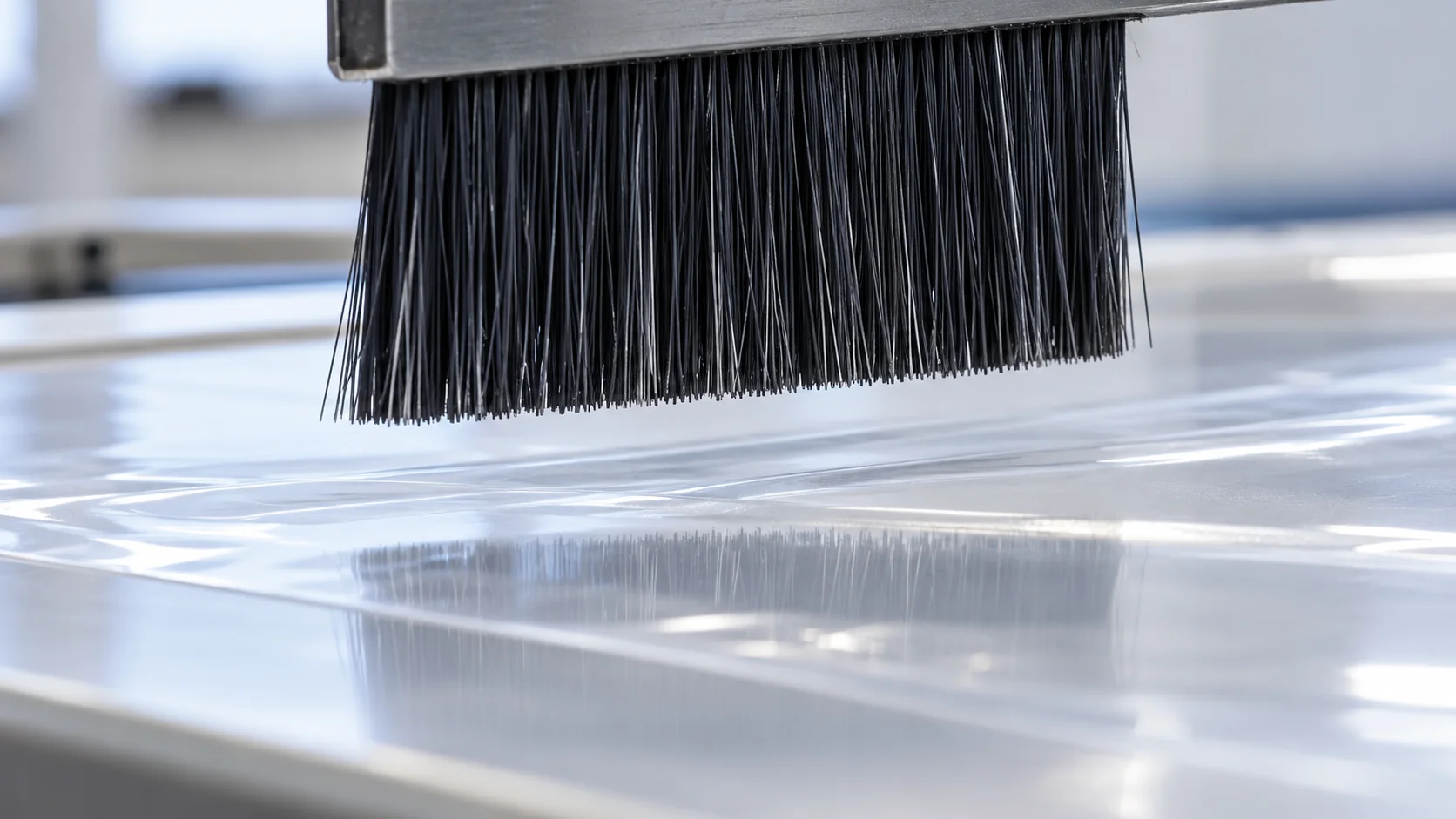
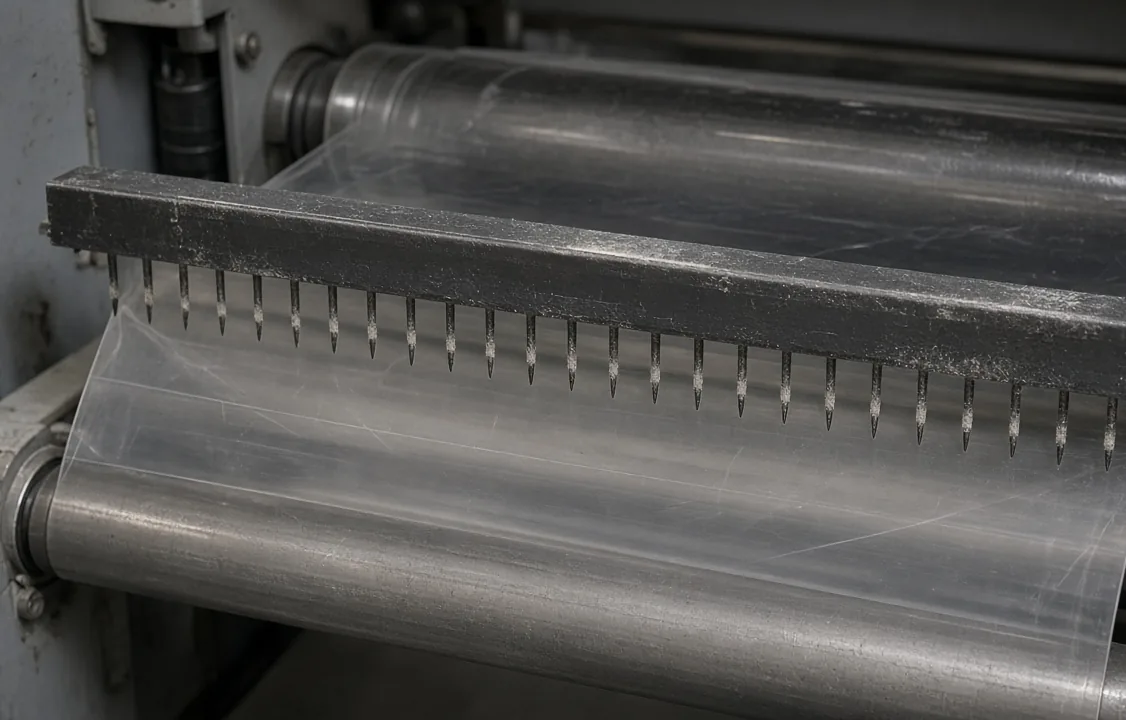
Illustrative photograph. The 2-3 mm figure comes from Fraser’s pages, not from a scale in this picture.
Takeaway: The row that fails is the one whose published gap, variant, or face count does not match the mount.
What do you copy onto the work order?
Copy six cells: model, the Fraser page that states its gap, the measured gap after the web has left the roller, web speed, thickness, and whether the area is a standard location or an EX-1250 / EX-HPSD location. Then note one change and whether the same dust, cling, or shock is still at that station on the next reel.
Other checks on this site are indexed with the technical articles.
Takeaway: The work order carries the model and the gap. A request for “a static eliminator” with neither cell still has no distance.
Method and sources
Compiled from six Fraser Anti-Static documents read on 20 October 2026. The elimination guide is marked last updated 27 November 2020. The product index, the 1250 page, the 3024 Compact page, and the 101/201 page show a 2026 copyright and no article date. The corporate brochure is the PDF at the 2025 file path linked above. The 2, the 50, the 5, the 10, the 20, and the 100 in the formulas are arithmetic on numbers those pages print. The sixfold 1250 claim and the 80% typical neutralisation are Fraser’s statements. The guide requires the material to be in free air, and it gives no millimetre for how long that open span must be after the roller.
Updated October 2026.