Contamination on the emitter points reduces neutralizing efficiency, in Simco-Ion’s IQ Power HL manual, and a conductive film left by a cleaner is a separate failure in the EXAIR and IONTIS notes. Open the maintenance section for the bar on the machine and copy its brush, cleaner, and drying step. A step from one of the notes below does not transfer to a bar that note does not name.
Cleaning an ionizing bar means following the maintenance section for that bar. The four notes opened for this page do not share one interval or one cleaner. Simco-Ion’s IQ Power HL instructions, document 5201051 Rev. F, section 5, say to service that bar when the Clean Bar indicator lights or every three weeks, whichever comes first. IONTIS, writing about its AC and 24 VDC models, says to look at the emitter tips at least every two months and to clean them before they stop performing and go into alarm. EXAIR’s note of 5 March 2015 says a dirty industrial application may require daily cleaning and a clean room may require only monthly cleaning. TAKK’s emitter-point page names isopropyl alcohol and a paintbrush, and it names no interval. The voltage cells on this page stay blank until that bar’s manual names the meter and the reading.
| What you hold still | Where it is written | Why a borrowed step fails |
|---|---|---|
| The document and revision | The manual for the bar on the machine | A three-week line and a two-month look are different notes |
| The brush | That same section | IONTIS says a metal brush damages the potting around the emitters |
| The cleaner | That same section | Isopropyl alcohol is named in some notes and unnamed in EXAIR’s |
| Drying and residue | That same section | IONTIS warns that a conductive film left by Barclean can discharge the high voltage |
| The reading | The meter setup that manual names | EXAIR’s zero-volt line is for its Model 7905, not a target for every bar |
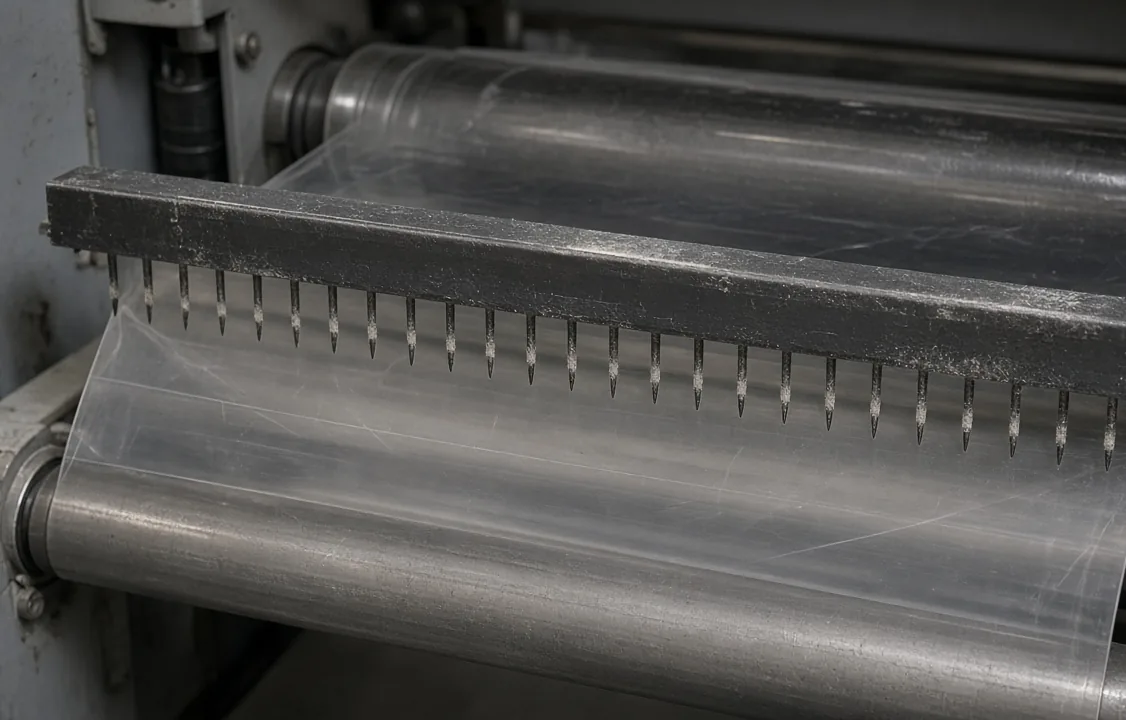
A metal bar with dusty pins hangs above clear film between two steel rollers.
Which manual do you copy?
Copy the maintenance section for the bar on the machine. Keep each public note on its own row.
The last row is blank because this page has not seen the manual for the bar in front of you. Fill it from that manual. Leave a cell empty when the manual does not say.
| Document and the equipment it names | Interval | Brush | Cleaner | Drying and residue | Leave this out |
|---|---|---|---|---|---|
| Simco-Ion, IQ Power HL Static Bar, installation instructions 5201051 Rev. F, section 5. That bar. | When the Clean Bar indicator lights, or every three weeks, whichever comes first. Dirty environments may need cleaning more often. | A nylon-bristle brush. A dry, stiff nylon brush for loose dirt. The same stiff nylon brush, with cleaner on it, for the emitter channels. | Isopropyl alcohol or mineral spirits on a clean cloth, then on the brush, for coatings that the dry brush does not lift. Clean, dry compressed air to blow the bar off. | Blow the bar dry with clean, dry compressed air. It has to be completely dry before power returns. Do not soak the bar or its parts in alcohol or mineral spirits. | A hard or sharp object on the points. Lacquer thinner, naphtha, or acetone. |
| IONTIS, Cleaning of Ionising Bars, for all AC and 24 VDC models. Discharge and charge ionizers, and the tips in their blowers and spot ionisers. | Look at the tips at least every 2 months, and clean as a precaution. On a unit with a contamination warning, clean before it stops performing and goes into alarm. The period still depends on how long and how hard the unit runs, and on dust. | A plastic brush. Their natural-bristle brush, Art. Z200183, for Barclean. | A cloth moistened with alcohol, isopropyl alcohol, or white spirit. A plastic brush and soapy water. They recommend water-based Barclean for discharge and charge ionizers. | Spread Barclean with the brush, let it sit briefly, brush the electrode once, then polish with a damp cloth and a dry cloth as required. Do the body first, then the tips. Barclean’s anionic surfactants are conductive. Wipe every residue off with a damp soft cloth. | Acetone or toluene. A brush that is too hard, or a metal brush. IONTIS says that brush damages the potting, and the grooves then hold dirt. |
| EXAIR, Static Eliminator Cleaning And Maintenance, 5 March 2015. An ionizing bar with many points on the Super Ion Air Knife and the Standard Ion Air Knife. One point inside the outlet of the Ion Air Gun, Ion Air Jet, and Ion Air Cannon. | Dirty industrial applications may require daily cleaning. Clean-room applications may require only monthly cleaning. Judge each installation. | A soft-bristle brush. A toothbrush is the example. Nothing that bends or dulls the points. | Do not use soaps or liquid cleaners that leave a conductive residue. EXAIR says they can destroy the effectiveness of the bar. No drying line is in the cleaning paragraphs. | Anything that bends or dulls the points. Soaps or liquid cleaners that leave a conductive residue. | |
| TAKK, How to Clean Static Eliminator Bar Emitter Points. Emitter points on a static eliminator bar. No model is named. | A paintbrush, for dirt that air does not lift. | Compressor air for light dirt. Isopropyl alcohol with the paintbrush for heavy dirt. | Dry completely before power returns. | ||
| This bar. Copy from its own manual. |
Takeaway: Copy one row, or the manual for the bar you have. Do not pair a cleaner from one row with a “leave this out” line from another.
Common mistake: Treating isopropyl alcohol as the cleaner for every bar because Simco-Ion, IONTIS, and TAKK each name it somewhere. EXAIR’s note does not.
Why do the residue rules conflict?
A cleaner one maker sells can be the film another maker tells you not to leave behind.
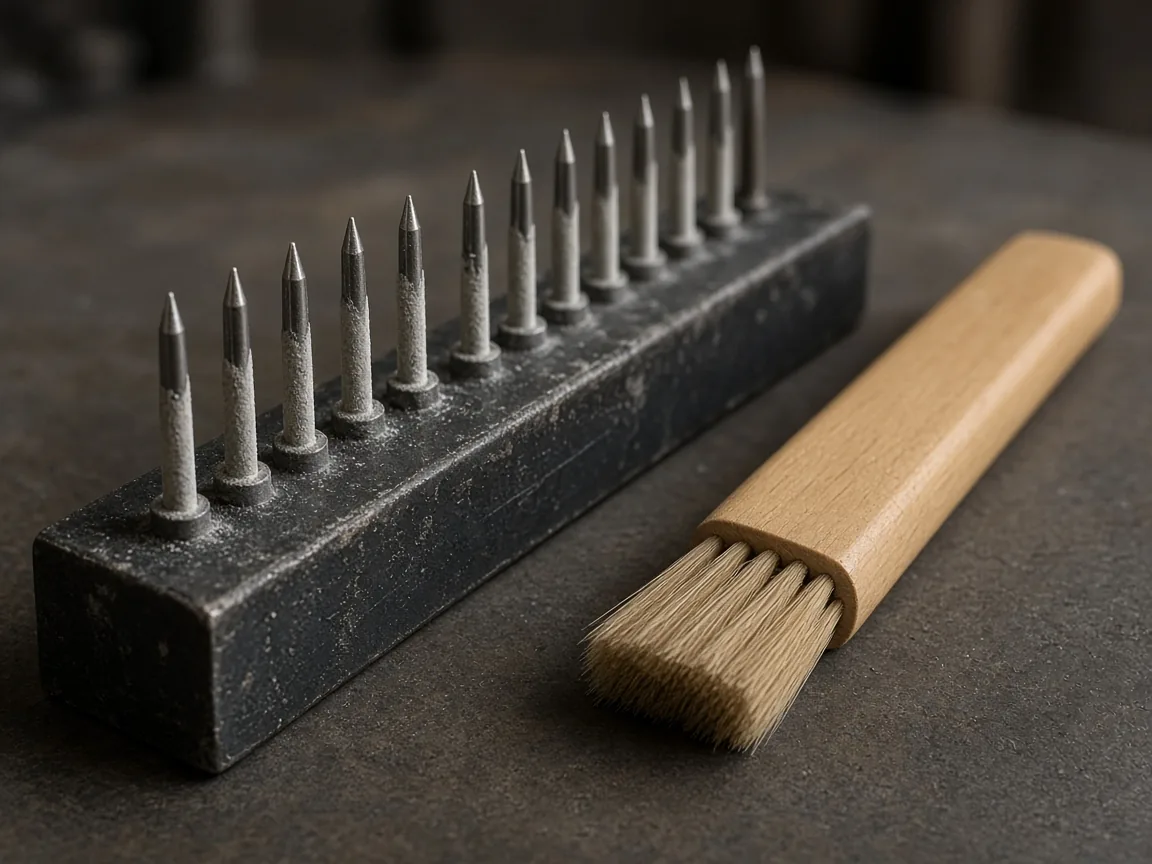
Dust sits on some of the metal pins. A plain nylon brush lies beside the bar.
IONTIS recommends Barclean, a water-based fluid, and says the fluid contains anionic surfactants that are conductive. The same note says to wipe all of that residue off with a damp soft cloth, or the performance can fall because a conductive layer discharges the high voltage. The soapy-water line on that page is also IONTIS’s, and it points you back to the operating instructions for the ionizer.
EXAIR’s 5 March 2015 note says not to use soaps or liquid cleaners that leave a conductive residue, and that those residues can destroy the effectiveness of the ionizing bar. It does not name a solvent to use instead.
Simco-Ion’s section 5 allows isopropyl alcohol or mineral spirits for resistant coatings, then requires a complete dry-off, and forbids soaking the bar in those liquids. It does not discuss a water-based surfactant cleaner.
Those three sentences are three manuals. If the manual in your hand forbids a conductive film, the Barclean and soapy-water steps stay on the IONTIS row.
Takeaway: Wipe off whatever the manual for that bar says will conduct. Do not decide that from a neighboring row.
When is the power off, and when does it come back?
Follow the shock warning in the manual for that bar. This page does not add a live test.
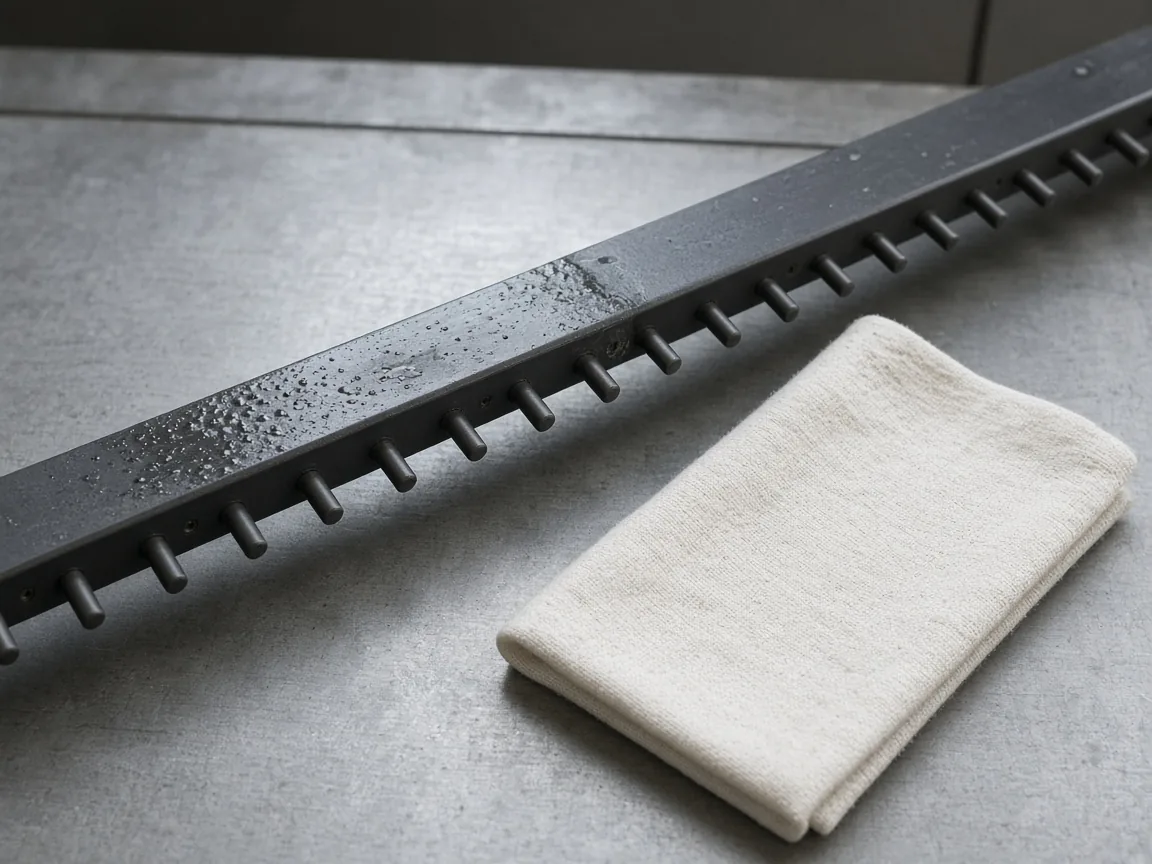
Water beads cover part of a metal bar with short pins. A folded cloth with no print sits next to it.
| Document | Before the brush | Before power returns |
|---|---|---|
| Simco-Ion, IQ Power HL, 5201051 Rev. F | Qualified service personnel only. Turn off the power supply. The manual calls this an electrical shock hazard. The safety section also says to disconnect input power to the power supply before maintenance. | The bar is completely dry. |
| IONTIS | Switch the power off and unplug the cables. Keep the whole line out of operation for the whole task. The tips are sharp. | A dryness-before-power line is not in the note. The Barclean residue still has to be wiped off with a damp soft cloth. |
| EXAIR, 5 March 2015 | The meter check starts with the power supply and the compressed air off. The cleaning paragraphs do not repeat a power-off line. | |
| TAKK | Power to the static eliminator is off during cleaning. | The bar is completely dry. |
| This bar |
Simco-Ion also says the emitter points must stay sharp, and not to scrape them. EXAIR says not to bend or dull them. IONTIS warns that the tips can cut you, and that a hard or metal brush damages the potting around them. None of those lines is a voltage.
Takeaway: Power returns only on the condition that bar’s manual gives. Where the cell above is empty, the manual you have has to fill it.
What do you write down before and after?
Write the reading only after you copy the meter and the distance from the manual. The voltage cells on this page stay blank until that bar’s manual names the meter and the reading.
EXAIR’s note of 5 March 2015 describes one check for its own static eliminators. With the power supply and the compressed air off, read the surface. Ionize the surface and read it again. EXAIR says a large drop means the unit is working, and a charge that stays at or near the first reading is a reason to clean or to take further steps. Later in the same note, EXAIR says a zero-volt reading on its Model 7905 means the ionizing bar is working, and a charge that is still there may mean the bar needs cleaning. The same opening paragraph says that meter reads up to +/− 20 kV at 1 inch. Those figures are the meter’s, in that note. They are not a pass limit for every web, and they are not filled in below.
How to keep the distance, the face, and the free span the same from one reading to the next is in measuring static on a moving film web. A number taken on a grounded roller is a different measurement from a number taken in open air.
| Check | Copied from this bar’s manual | Before cleaning | After cleaning |
|---|---|---|---|
| Meter, and the distance it states | |||
| Web face and position | |||
| Power and air state for the first reading | |||
| Reading | |||
| Brush and cleaner actually used | |||
| Dry, or residue wiped, before power returned |
Takeaway: A filled “manual” cell and an empty reading cell is the right state of this table before anyone measures.
When this checklist does not apply
Use it to compare the four notes above and to hold a blank record. It is not a cleaning procedure for a bar those notes do not name.
A consumer ionic air purifier is outside these notes. So is any job done with the bar still powered: Simco-Ion and IONTIS both start from power off, and this page does not add a powered test. The IQ Power HL introduction lists hazardous locations for that bar. Cleaning in those locations stays in that manual and in the plant procedure.
Method and sources
The IQ Power HL interval, the nylon brush, isopropyl alcohol, mineral spirits, compressed air, the dry-before-power line, and the forbidden solvents are from Simco-Ion, IQ Power HL Static Bar Installation and Operating Instructions, 5201051 Rev. F, section 5, read 11 October 2026. The two-month look, the cloth solvents, soapy water, Barclean, the conductive-surfactant warning, the brush Art. Z200183, and the shock steps are from IONTIS, Cleaning of Ionising Bars, read the same day. The before-and-after reading, the Model 7905 range, the environment intervals, the soft brush, and the conductive-residue warning are from EXAIR, 5 March 2015, read the same day. The compressor-air step, isopropyl alcohol, the paintbrush, and the dry-before-power line are from TAKK’s emitter-point page, read the same day. A Simco-Ion blog page on emitter cleaning was retrieved that day and returned only the title, so none of its claims are used. No cleaning was done for this page, and no reading was taken. Updated October 2026.