A low equipment price can leave installation work and running costs outside the comparison. Compare corona treatment cost by matching the supplied equipment and installation scope, then recording energy, maintenance and production losses over the same period.
This worksheet is for industrial film-line proposals. It provides blank fields for your quotes and site records; it supplies no machine price range, assumed electricity bill or predicted payback. An unknown cost stays blank until its source is available.
Choose the cost question first
Keep these decisions separate so that a figure answering one question does not become the answer to another.
| Decision | Starting evidence | What to compare |
|---|---|---|
| Which proposal covers the installation? | Dated quotes and site work scopes | Equipment, exclusions and buyer work |
| What does the existing station cost to run? | Meter records, service invoices and event logs | The same equipment boundary and period |
| Could a material change justify investment? | Qualified material trials and actual purchasing records | Accepted production with each material route |
Vetaphone’s total-cost discussion, checked on 16 October 2026, already identifies installation, maintenance, downtime, spare parts and energy as ownership considerations. The worksheets below turn those questions into a record you can complete. They do not reproduce its comparative performance or life-expectancy claims.
Match the job before comparing quotes
Write one shared job description above both proposals: substrate and coating or metallization, web-width range, intended treated faces, running-speed range, downstream ink or adhesive system, and acceptance method. Identify whether the purchase is a new installation, a replacement station or an upgrade using existing equipment.
QC Electronics’ web-treater explanation distinguishes the supply and transformer, electrode assembly, and dielectric/air-gap arrangement. Its bare-roll and covered-roll discussion also makes clear why a system description matters. Record the proposed configuration rather than comparing two generator ratings alone.
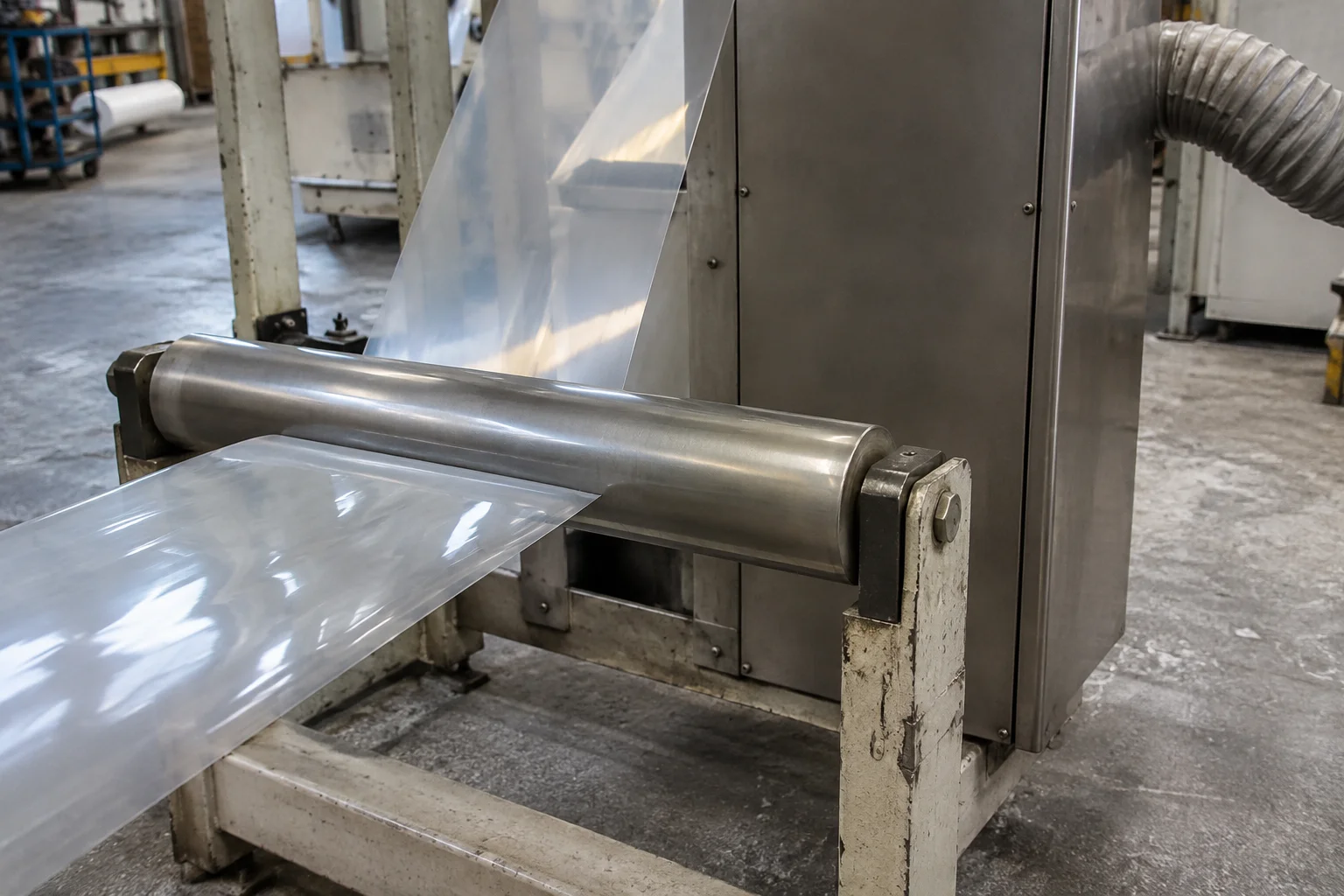
A clear film web passes over a steel roller beside a closed metal housing.
Download the blank quote-scope worksheet (CSV). In each proposal column, enter included, excluded, or unknown, followed by the quote reference and any separately stated amount. Empty cells below are intentional. Confirm an exclusion’s owner before adding its cost to a comparison.
| Scope to resolve | Proposal A | Proposal B |
|---|---|---|
| Quote date, revision, currency and validity | ||
| Job description and acceptance basis | ||
| Generator, transformer and controls | ||
| Station, electrodes, roll and dielectric arrangement | ||
| Number of stations and treated faces | ||
| Extraction fan and ductwork; other specified exhaust equipment | ||
| Mounting, line alterations and access space | ||
| Electrical supply work and control integration | ||
| Delivery, unloading and installation labor | ||
| Commissioning, trial material and training | ||
| Initial spares, service scope and warranty exclusions | ||
| Buyer work, taxes and other exclusions | ||
| Quoted amount and separately priced additions |
The Corona Supplies user manual, printed pages 7–8, separates generator connections, station mounting and ozone extraction. That supports checking these work packages individually; it does not establish what another supplier includes. Have the responsible site and equipment specialists define the installation requirements for the actual unit.
If one proposal includes the fan but excludes the duct run, mark those separately. If a replacement reuses a roll or controller, identify its condition and who is responsible for compatibility. Leave the comparison unresolved where a necessary inclusion remains unknown.
Collect site inputs without using output watts as an electricity bill
Use energy records that identify the equipment they cover. The Corona Supplies manual lists input current separately from rated output power on printed page 5, and explicitly includes the extraction fan in that unit’s input-current entry. This is a useful warning about measurement boundaries; neither entry supplies your site’s energy use or tariff.
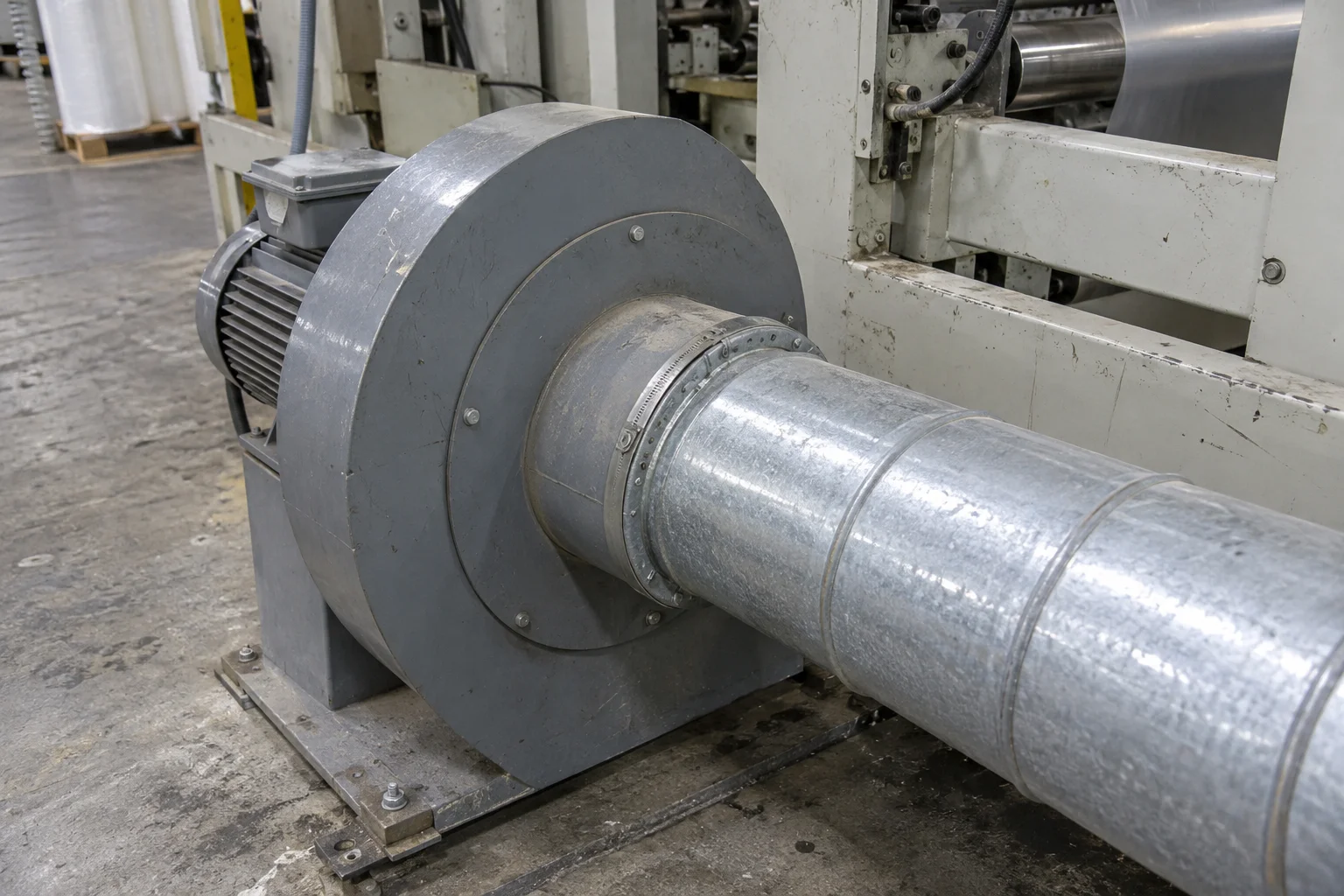
A grey blower housing connects to a round metal duct beside a machine frame.
The visible blower and duct illustrate why “treater” needs a defined scope in a cost record. State whether the energy record includes the generator, extraction and other auxiliaries, or list separate records for each. Do not add a fan estimate to a meter total that already includes it.
Download the blank site-input worksheet (CSV). It includes separate columns for your value, unit or period, and evidence reference. Use Unknown / verify on the unit when a boundary is unclear, and leave the cost value blank.
| Input to collect | Your value | Source or boundary to record |
|---|---|---|
| Review start and end | Same period for all entries | |
| Station and auxiliary equipment covered | Equipment list or metering scope | |
| Production and standby hours | Operating log, kept separate | |
| Metered electrical energy | kWh record and included loads | |
| Applicable energy charges | Site tariff and billing period | |
| Other utility use, if applicable | Record, allocation method and unit | |
| Accepted production output | Length or area, width and face convention | |
| Maintenance labor and parts | Work orders and invoices | |
| Planned service stops and fault stops | Event durations and reasons | |
| Rejects and rework attributed to treatment | Quantity and investigation reference | |
| Cost allocations or estimates | Assumptions, owner and evidence |
Label each input as quoted, observed, or estimated in the source column. A quote is not an operating measurement. Keep a preliminary budget estimate distinguishable from a later measured record.
The corona watt-density unit audit serves a different purpose: it checks the power, width, speed and face definitions used for treatment input. Copying its output-power value into an electricity-cost field does not resolve the site energy question.
Record maintenance and lost production as events
Use the actual unit’s service schedule and your event history. The Corona Supplies manual’s maintenance section, printed pages 20–25, covers fans and filters, interlocks, electrodes, and rollers and bearings. These are prompts for finding the relevant work orders, not a maintenance schedule for every treater.
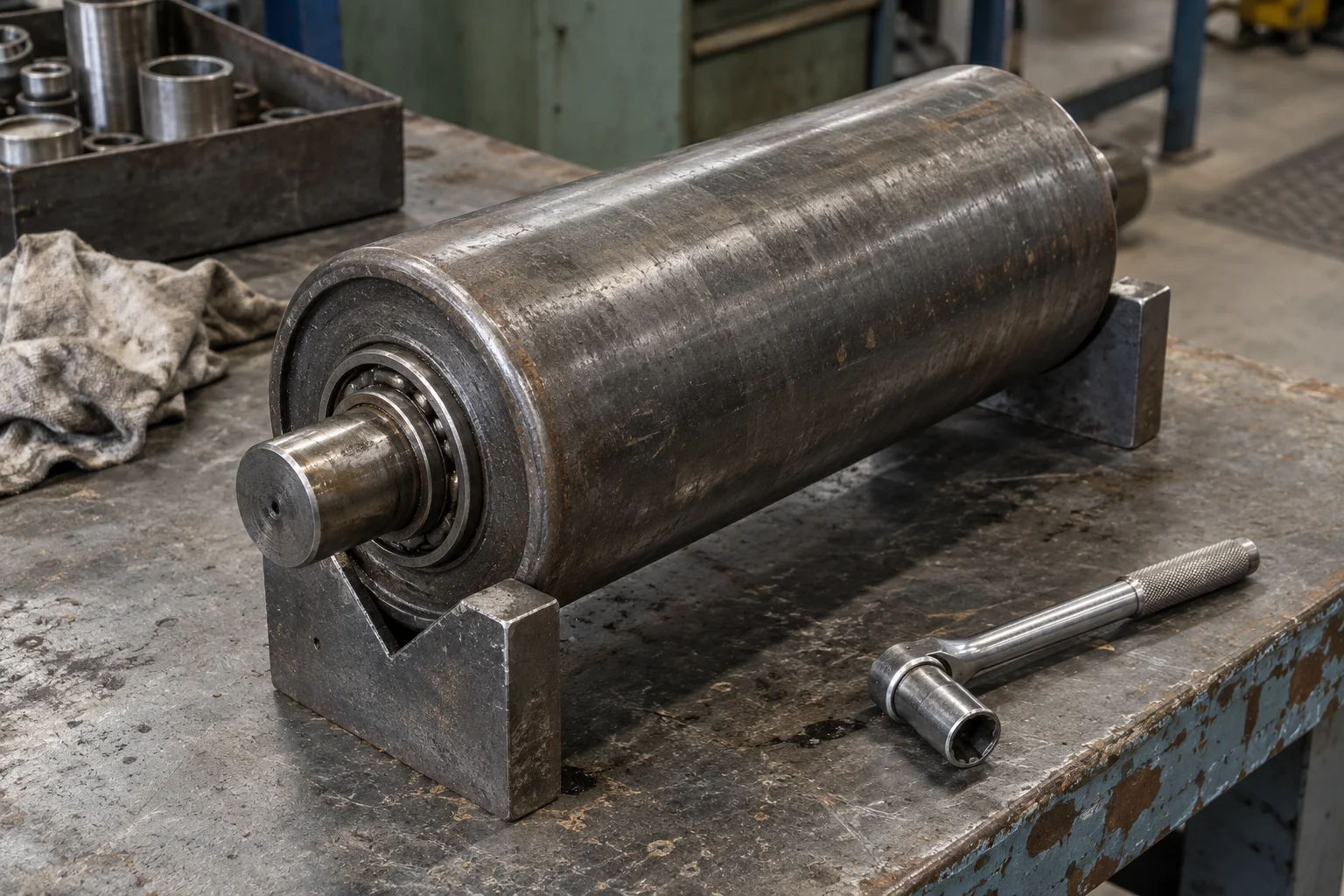
A worn steel roller rests on metal supports beside a socket wrench.
For each event, record the date, symptom or planned task, equipment involved, elapsed stop time, labor, parts and production disposition. Separate hands-on service time from time waiting for access, diagnosis or parts. A component’s price alone will not explain the event record.
Our suggested accounting check is to give each expense or production loss one reference and one treatment in the comparison. Keep a scrapped-material cost separate from a downtime allowance, and ask the cost owner whether either allowance already contains the other. Do not automatically add lost sales revenue to material, labor and overhead charges for the same event.
Record a treatment-related reject only with its investigation reference. A failed print or bond does not, by itself, establish the cause. Define the agreed acceptance test and preserve its result; the dyne testing guide explains why a wetting measurement cannot stand in for adhesion acceptance.
These records support budgeting. Work on electrical equipment, extraction and guarding belongs with qualified personnel following the equipment documentation and site procedures.
Close the comparison with a list of unresolved costs
Before preferring the lower total, check that both proposals answer the same job description and that every added cost has an owner and a reference. Keep one-time installed costs separate from recurring costs over the selected period. If you later report cost per accepted length or area, state the denominator and use the same width, treated-face and output convention for both records.
| Check | Hold the comparison when… |
|---|---|
| Equipment scope | An essential station, auxiliary or reused component is undefined |
| Installed cost | Buyer work or commissioning responsibility is unresolved |
| Operating evidence | The energy boundary or recording period differs |
| Production basis | Output includes different amounts of rejects or different jobs |
| Loss accounting | A charge may appear in more than one category |
| Evidence quality | A claimed saving substitutes for a quote, trial or site record |
A material-substitution calculation needs its own evidence. Enercon’s top-coating savings calculator asks for web width, running speed, top-coat cost and operating schedule. Those inputs address a particular substitution scenario. They do not show that your ink, adhesive and substrate combination can dispense with a coating, or establish the installed cost of your proposal.
Use the completed worksheets to identify missing scope and records. A blank cell is a follow-up item, not a zero-cost assumption. For the related process and measurement guides, return to the technical article index.
Method and sources
This is an editorial comparison worksheet based on manufacturer documents, checked on 16 October 2026. The CSVs and scope questions are our recordkeeping recommendations. No plant trial, supplier quote, electricity measurement, payback calculation or equipment ranking is reported.
Vetaphone’s ownership article, QC Electronics’ basics page and the Corona Supplies manual were fetched live. Enercon’s calculator was read from the archived original fetched on 11 October 2026; the direct live request was blocked. Its input fields are discussed only to distinguish its purpose. The source list below identifies the originals.